
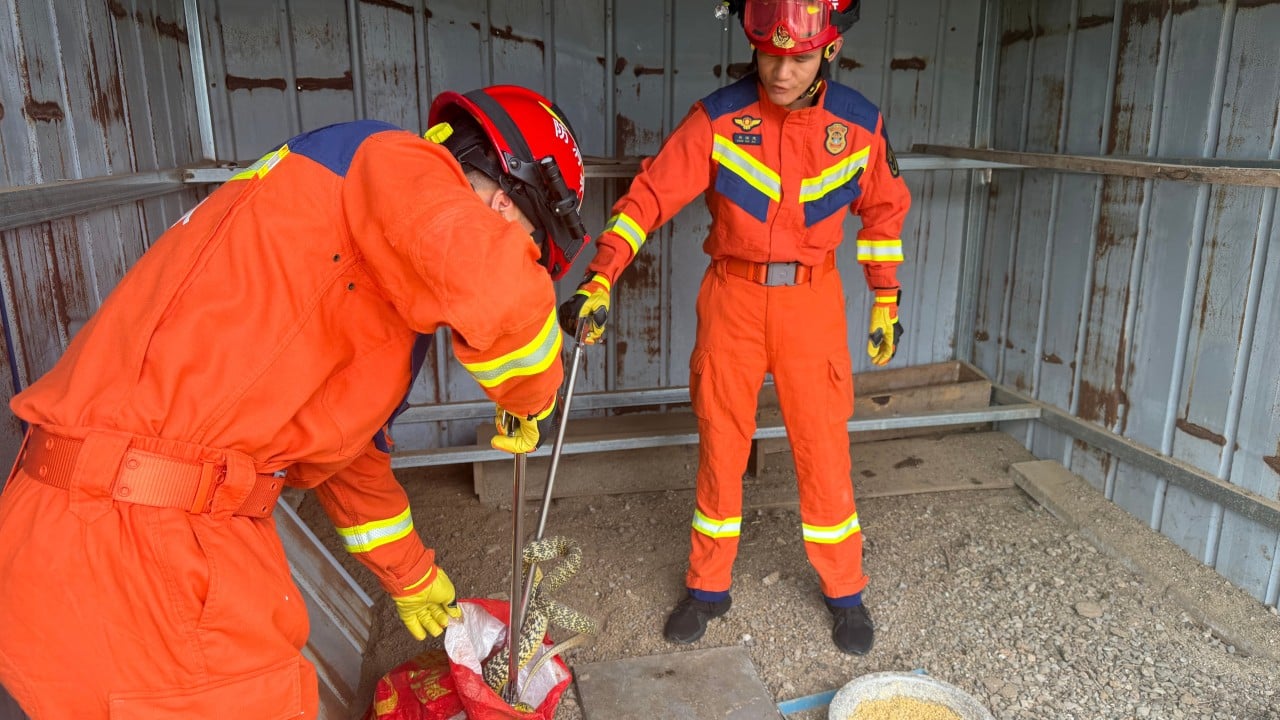
Residents in some parts of Beijing are on edge as rises in humidity and temperature lure snakes into the Chinese capital, where encounters with the reptiles are usually rare.
Concerned residents have been sharing their sightings on social media.
“Why are there snakes in Beijing’s parks?” one user posted. “It scared me to death.”
In the comments section, many others shared similar experiences, with one woman recounting her shock at finding a snake hiding behind the fridge of her 25th-floor flat.
Official media reports said the active season for snakes in Beijing had arrived early this year, leading to a surge in calls from residents seeking help both at home and outdoors.
While the peak season typically begins in July, local media outlet The Beijing News reported on May 28 that snakes were already being repeatedly spotted across residential compounds, suburban parks and mountain trails.
A fire and rescue station in the capital’s mountainous western district of Mentougou received more than 10 requests for snake-catching help in the previous week alone, with six or seven incidents over a single three-day period.
A firefighter at the station surnamed Li said properties near mountains, suburban parks and older, low-rise residential estates were frequent hotspots. The areas often accumulate rubbish and attract clusters of rats, offering snakes food and shelter.
The firefighter added that the snakes captured so far were mostly non-venomous and quite small, averaging about one metre (3.3 feet) in length and none exceeding two metres. He assessed the overall risk of snakebites or injuries to the public as low.
In his interview with The Beijing News, Li Li, the founder and director of the Black Leopard Wildlife Conservation Station in suburban Beijing, attributed the spike in sightings to a combination of climatic and ecological factors.
Over the past two years, Beijing has had a lot of rainfall during its rainy season, resulting in high humidity.
Optimal temperatures above 25 degrees Celsius (77 degrees Fahrenheit), coupled with continuous rainfall, have created ideal conditions for snakes to breed and remain active, according to Li.
At the same time, Beijing’s ecological restoration projects have established environmental corridors linking the surrounding mountains to the urban centre. This has allowed snakes to migrate and breed more freely, leading to a steady rise in their population.
Beijing was home to about 17 snake species, only four of which were venomous, Li said.
He described these venomous species as typically “thick, short and fat” with distinctive triangular heads. When frightened, they tend to coil up and remain perfectly still, but their bites carry a relatively high risk of causing disability or death.
The surge in snake sightings is not unique to the Chinese capital.
Recently, other parts of China have reported entering periods of heightened snake activity as well, including central Anhui province, southern Guangdong province and southwestern Sichuan province.
As a precaution, Li advised hikers to steer clear of stagnant water, marshes and riverbanks in hilly areas because they were feeding grounds for snakes. He also recommended wearing long trousers and high-top boots to minimise skin exposure.
“When heading out, you can place camphor balls around your socks or inside your backpack to help repel snakes,” he added. “But the most important thing is to stay alert at all times and watch where you step.”
Li also warned the public against trying to corner, catch or attack snakes with sticks or stones, saying such actions could easily provoke a retaliatory strike.
The correct response when encountering a snake is to step back immediately, maintain a safe distance of at least five metres and wait for the reptile to move away on its own.
Li, a wildlife conservationist, urged residents not to panic, stressing that snakes were a vital component of the natural ecosystem, played a crucial role in maintaining ecological balance and did not attack humans under normal circumstances.