
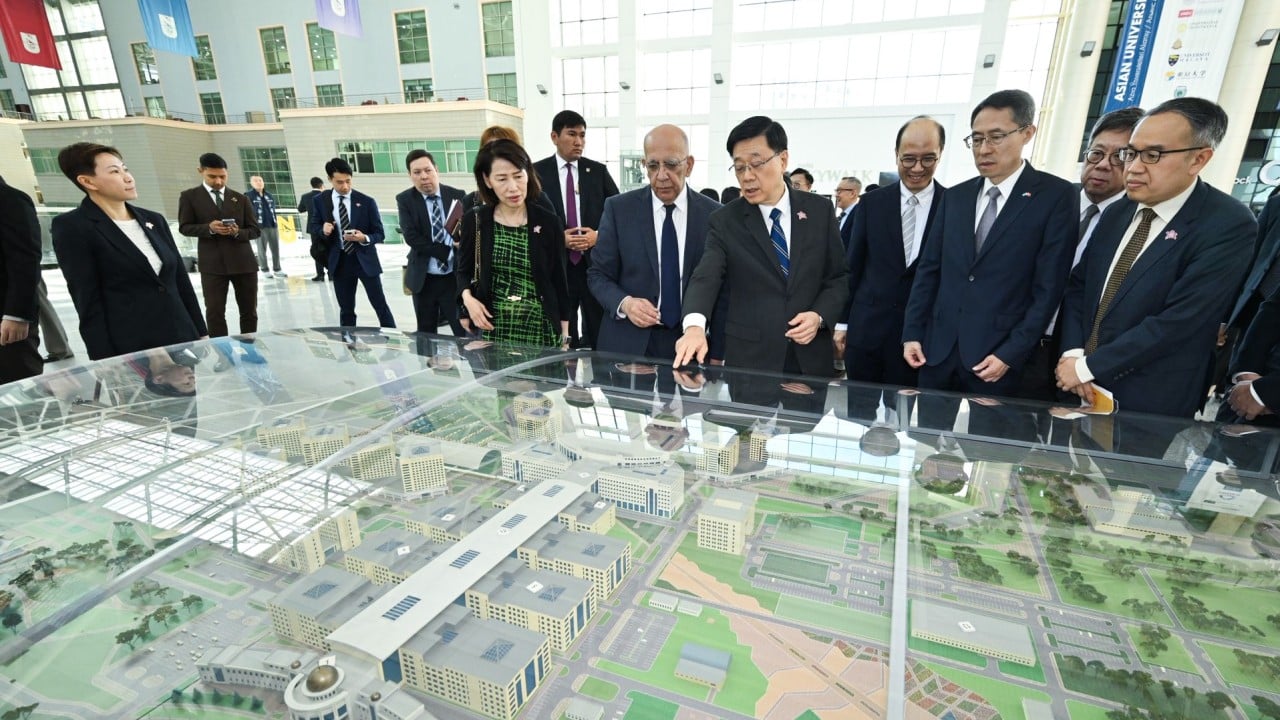
Hong Kong leader John Lee Ka-chiu has wrapped up his visit to Central Asia after meeting high-level leaders and sealing nearly 100 partnership agreements aimed at opening the “big door” for local and mainland Chinese businesses.
While reviving direct flights to the region was considered a big win from the trip, observers noted that the real challenges lay ahead as authorities and different parties must take necessary follow-up actions to realise the gains.
Local authorities and businesses signed 96 agreements and memorandums of understanding (MOUs) with their Central Asian counterparts, sealing 61 in Kazakhstan and 35 in Uzbekistan. The deals spanned sectors including finance, innovation, trade and media.
Investment bank China International Capital Corporation emerged as a key player, signing at least six agreements.
That included one with Kazakhstan’s sovereign wealth fund Samruk-Kazyna, which aims to leverage Hong Kong’s financial expertise to facilitate the privatisation of the country’s state-owned enterprises and key national industries.
Amid the trend, state-owned national railway company Kazakhstan Temir Zholy (KTZ) had already decided to get listed in Hong Kong, according to Trade Development Council Frederick Ma Si-hang. KTZ is understood to be among those Kazakh companies that will join a roadshow in Hong Kong to draw investors later this month.
As of January, Hong Kong was the 10th largest net investor in Kazakhstan globally, with a net inward foreign direct investment stock of US$2 billion.
Economist Gary Ng Cheuk-yan, of the Natixis Corporate and Investment Bank, said the listing of KTZ in Hong Kong would be symbolic and stressed the importance of ensuring a smooth process to demonstrate that the city was an ideal place for Central Asian companies to raise funds.
“After the trip, the government should identify the areas with the most potential. It should also ensure the first batch of such listings would be smooth, which could serve as a role model to encourage more other companies to follow suit,” he said.
Since last year, the listing of Kazakh companies in Hong Kong has become easier after the National Bank of Kazakhstan aligned with the regulatory standards of the International Organization of Securities Commissions.
Rocky Tung Yat-ngok, executive director of the Financial Services Development Council, said Hong Kong as a multicurrency international financial centre could provide a lot of currency options for Kazakhstan to seek trading finance in the city such as offshore yuan asset management.
“Hong Kong can allow Kazakhstan investors to carry out currency hedging to reduce currency risk,” he said.
In an exclusive interview with the SCMP, Bauyrzhan Dosmanbetov, Kazakhstan’s consul general in Hong Kong, said he viewed the city – located within a six-hour flight of his country – as an ideal fundraising hub to access renminbi capital through bond issuances.
Kazakhstan and Hong Kong have collaborated on two major dim sum bonds, with an aggregate total of 3.25 billion yuan (US$479.7 million). This included one issued by the Development Bank of Kazakhstan, marking the first-ever yuan-denominated bond from a government-owned Central Asian entity.
Currently, no Kazakhstan companies are listed in Hong Kong. Last year, Tungsten miner Jiaxin International Resources became the first Kazakh-backed company to complete a dual listing on the Hong Kong and Kazakhstan stock exchanges.
Freedom Holdings, the top Kazakh retail brokerage and investment bank, is exploring a secondary listing in Hong Kong. It recently signed MOUs with China International Capital Corporation, Hong Kong-based Templewater and A-Grade Energy.
Edwin Lai, professor emeritus and adjunct professor at the Hong Kong University of Science and Technology’s department of economics, said Lee’s trip was more than just economics – it carried a political dimension aimed at consolidating Hong Kong’s role as a belt and road hub.
With the launch of the new Almaty-Hong Kong route next year, he said Hong Kong would need to put more effort into boosting tourism and cargo to make full use of the service.
“Hong Kong does not need so many of these resources from Central Asia,” he said. “But it has a good airport, it is very centrally located so that it is perhaps worthwhile and cost effective to transport the goods via the city to other destinations, be it other mainland cities or Asean countries.”
Wingco Lo Kam-wing, president of the Chinese Manufacturers’ Association, who was in the delegation, said the business environment of Kazakhstan and Uzbekistan had greatly improved compared with a decade ago when his group last visited.
He also said his association would build on the visit and organise another field trip to Central Asia with its members later this year, focusing on matching potential partners for Hong Kong businesses.
From the Central Asian countries’ perspective, some local conglomerates were also looking forward to partnering with Hong Kong businesses after their meetings during the trip.
Uzbekistan tycoon Babur Parpiev, chairman of the Orient Finans Bank, said his team was very interested in collaborating with Hong Kong hotel groups.
The bank is under the Orient Group, one of the biggest private conglomerates in Uzbekistan with a diversified portfolio ranging from real estate and agriculture to textiles, among others.
Hong Kong hotel groups could bring their brand names to Uzbekistan, or jointly build more resorts in the country, Parpiyev said, citing the Uzbek authorities’ initiative in offering subsidies to developers who build such projects.
“We need some investors. We have many historical cities where we can build new hotels,” he said.