
Mainland China has equipped frontline troops facing Taiwan with a new missile, state media reported.
The missile is believed to be an HQ-16F, which has comparable qualities to the US Patriot PAC2 and 3 systems.
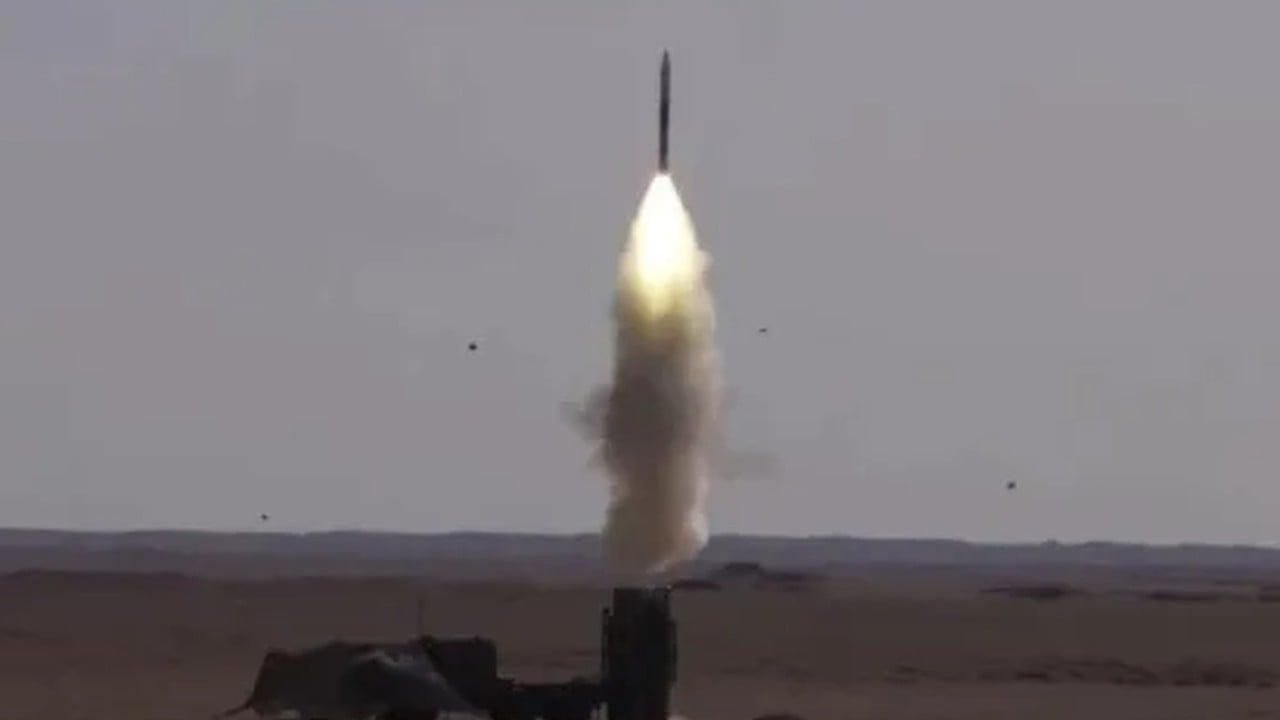
On Friday, state broadcaster CCTV aired footage of the 73rd Group Army’s first operational and live-fire assessment of the missile in the Gobi Desert.
The unit, which forms part of the People’s Liberation Army Eastern Theatre Command, had travelled thousands of kilometres from its base in Fujian province to the northwestern desert to receive the new system before the test, the report said.
The test included a missile launch from a mobile launcher and CCTV said it had successfully hit an incoming target that was 50km (30 miles) away.
The video showed that the missile had a distinctive aerodynamic design with no wings and relied on four tail fins for flight control.
This design makes the missile lighter and reduces drag to improve efficiency and extend its range.
The report did not explicitly name the new missile, referring to it only as “a new air defence system”, but one shot showed a nameplate that read “HQ-16F”.
The system’s appearance also matches that of the HQ-16FE, the latest export-oriented variant in the Hong Qi (red flag)-16 series, which went on display at the Zhuhai Air Show in 2022.
The HQ-16 is a medium-range surface-to-air missile with both land and ship-launched variants. Footage showing that the new version was launched from fully vertical cells suggested it would be fully compatible with a naval vertical launch system.
Although official specs for the HQ-16F have not been released, Chinese domestic-use weapons are usually superior to their export versions.
The road-mobile HQ-16FE can intercept a diverse range of targets, including planes, tactical ballistic missiles and even supersonic cruise missiles from significant distances, according to publicly available information.
It has a maximum range of 160km against conventional combat aircraft, four times that of the basic HQ-16, and a minimum range of 3.5km. It can also strike targets flying as low as 15 metres (50 feet) from the ground and has a ceiling of 27km.
This range is comparable to that of the Patriot PAC-2, while its advanced electronics and missile-defence capabilities are on par with those of the PAC-3.
However, the PAC-3 relies on “hit-to-kill” technology, which uses the missile’s kinetic impact to destroy targets rather than explosives.
In contrast, the HQ-16FE’s “directed warhead” uses a directional fragmentation explosion, which sends the blast in a particular direction.
Because it has no wings, the missile uses an advanced integrated motor and thrust vectoring to manoeuvre and engage highly evasive targets.
The HQ-16FE integrates a combined guidance system with command updates and can home in on its targets using its onboard transmitter or via a ground station.
The system’s Active Electronically Scanned Array radar has a detection range of over 250km, capable of simultaneously tracking 12 batches of targets and engaging eight.
The new missiles complement the PLA’s existing arsenal, which already covers an entire spectrum of ranges and altitudes, from close to ground level up to near space.
The PLA’s 73rd Group Army, headquartered in Xiamen, is directly opposite Taiwan and is regarded as the spearhead in any cross-strait conflict.