
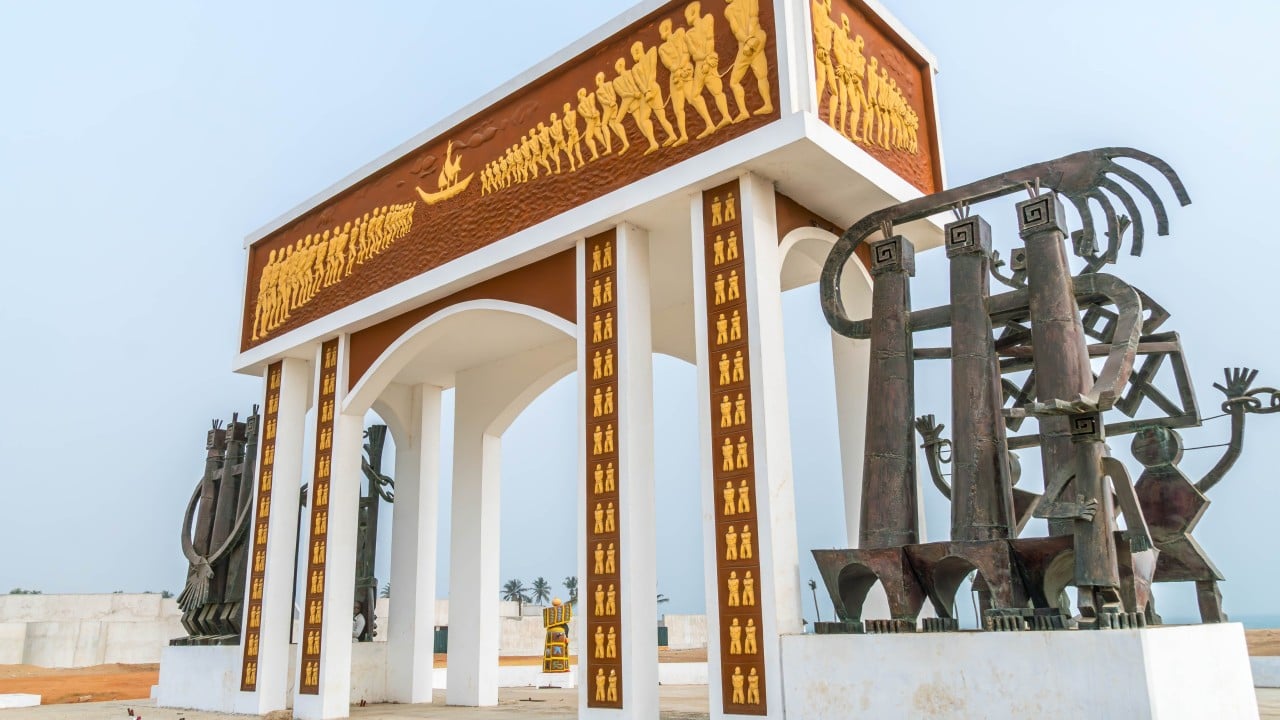
In Benin’s southern Atlantic coastal town of Ouidah, located about 40km (25 miles) west of the economic capital of Cotonou, China is turning a former slave trade hub into a busy tourist destination.
The historic port once saw nearly 2 million enslaved Africans marched along the 2km “Slave Route” from the auction plaza to the beach during the transatlantic slave trade.
On the shore, captives were passed through the “Gate of No Return”, with a monumental memorial arch now standing at the exact point where they boarded the ships.
The Beninese government has contracted Chinese state-owned firms to build an expansive La Marina waterfront complex located at what once was the main slave port. This is being done under an infrastructure agenda inherited by Benin’s newly sworn-in president, Romuald Wadagni.
The project aims to boost tourism by linking the modern seaside complex directly to the historic slave route and memorial sites in Ouidah.
Benin’s National Agency for Heritage Promotion and Tourism Development manages the project. Construction started under the government of former president Patrice Talon. President Wadagni, who took the oath of office on May 24, was the finance minister at the time.
Ghislain Hologan, the technical adviser for International Financing at Benin’s Ministry of Economy and Finance, said the country had a lot of infrastructure to build, including in tourism, which had been picking up lately. He said the plan was to grow visitor numbers by 3 million in the medium term.
“Benin has built a lot of tourism infrastructure. We have Ouidah, which is a historical slavery and cultural area, a city about 30 minutes from Cotonou. It has been completely transformed with a lot of tourism infrastructure,” Hologan said in an interview.
Over the past two years, they have held an event called Vodun Days to celebrate the local Vodun culture, which is an ancestral religion in Benin that originated in West Africa and is practised in Benin and among descendants of enslaved Africans in the diaspora.
The three-day event in January drew hundreds of thousands of domestic and international visitors, according to Hologan.
“That gives us comfort that our infrastructure investment and focus on tourism are paying off,” Hologan said.
The site in Ouidah includes a 3,500-seat open-air arena, a life-size slave ship replica, and luxury hotels such as the Dhawa Ouidah resort. Partially funded by China and built by state-owned Yunnan Construction and Investment Holding Group, the project has completed structural work and major landscaping for beachfront facilities.
Construction continues on 4km of underwater barriers in the Avlekete district to calm the sea for visitors.
The Dhawa Ouidah hotel building itself is nearing completion, with workers finalising the wiring, plumbing and interior styling ahead of the official opening later this year.
The seaside initiative runs alongside the broader reconstruction of Ouidah, a separate state-backed urban preservation scheme.
This inland project focuses on the physical restoration of historic forts, local squares and memorial pathways to complement the multimillion-dollar upgrades along the main corridor. This is part of Benin’s bid to market itself as a key destination for overseas Afro-descendant tourists.
Benin’s tourism, culture and arts ministry said recently that the Dhawa Ouidah hotel was part of the state-led Ouidah Marina project aimed at “expanding heritage, cultural and seaside tourism”.
Located on a 23-hectare (57-acre) coastal site to the left of the Gate of No Return and facing the Atlantic Ocean, the four-star, 132-room hotel will feature restaurants, bars, a spa and event spaces.
Dhawa Ouidah underlined Benin’s ambition to become a leading cultural and memorial destination in West Africa, the ministry said.
Simon Pierre Adovelande, Benin’s ambassador to China for eight years until 2025, said most new infrastructure in the tourist hub of Ouidah had been built by Chinese companies with joint funding, bringing the multimillion-dollar “heritage project to life”.
Data from research lab AidData shows that Chinese state capital is backing the Ouidah Marina project. The funding includes a €90 million (US$104.8 million) syndicated buyer’s credit loan from the Bank of China and the Industrial and Commercial Bank of China, alongside a separate €167.37 million Bank of China loan covered by Sinosure insurance, according to AidData.
These credit lines help finance Benin’s commercial contract with the main contractor, Yunnan Construction and Investment Holding Group.
Across Africa, China has also built several high-profile cultural centres and theatre buildings as diplomatic gifts. Such gifts include Senegal’s US$34 million National Grand Theatre, Algeria’s US$40 million Algiers Opera House and a US$30 million grant to modernise the National Theatre of Ghana.