
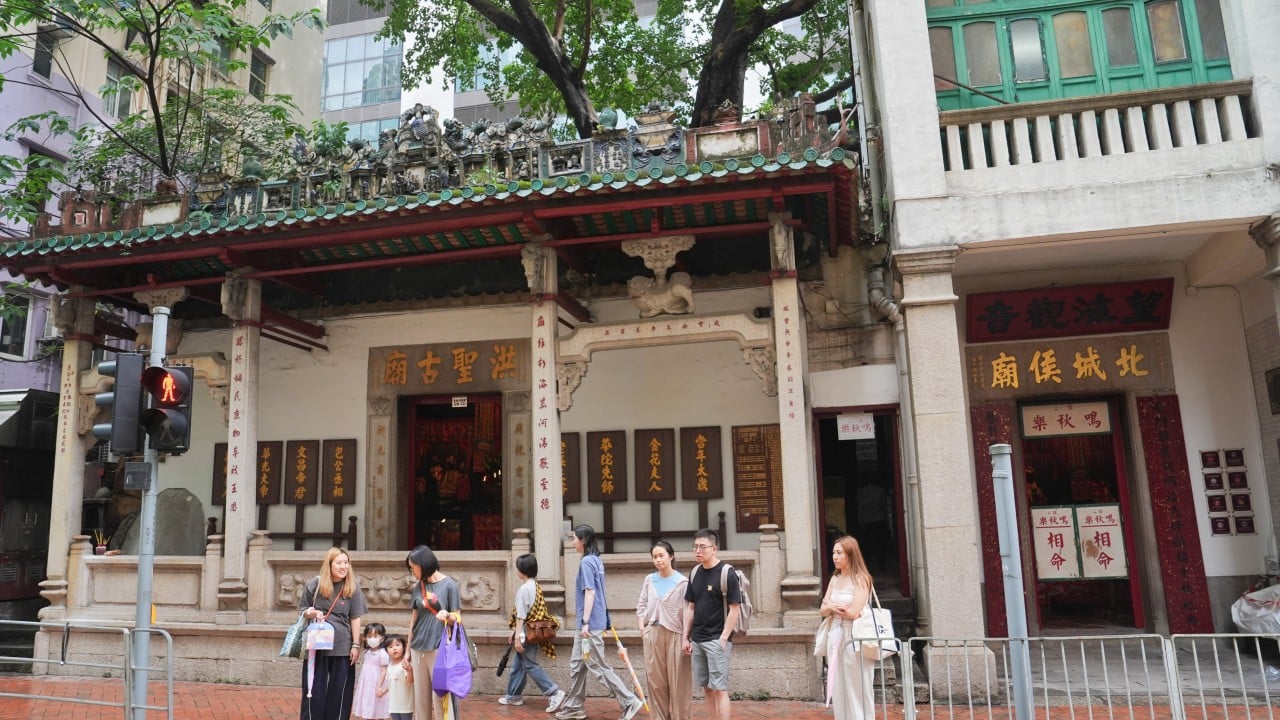
A nearly 180-year-old temple nestled in the heart of Wan Chai and Hong Kong’s only mosque inside a prison are poised to receive the city’s highest level of heritage protection under a government proposal.
In a paper submitted ahead of a board meeting on Thursday, the Antiquities and Monuments Office recommended that Hung Shing Temple in Wan Chai and the Stanley Mosque at Stanley Prison be declared statutory monuments. Both buildings currently hold Grade 1 historic building status.
“The two historic buildings … have significant heritage value,” the office said, adding that both met the “high threshold” required for statutory monument protection under the Antiquities and Monuments Ordinance.
“Consent for the intended declaration has been obtained from the respective owners and management bodies.”
If endorsed by the board and approved by the chief executive, the two buildings would be declared monuments through publication in the Government Gazette, granting them permanent statutory protection.
Hung Shing Temple, located on Queen’s Road East, is believed to have been built between 1847 and 1852, making it one of the oldest in Wan Chai.
Originally situated along the shoreline, it was established to serve fishermen and merchant seamen who worshipped Hung Shing, the God of the South Sea.
The paper said contributions from local tradespeople, including stone quarry workers, as well as support from the wider Chinese community during major renovations in 1860 and 1867, reflected strong social cohesion and the growing popularity of Hung Shing worship in 19th-century Hong Kong.
The temple has long served as a centre for worship and community activities, hosting religious ceremonies and housing soul tablets, wooden or stone placards inscribed with the names and titles of ancestors.
The temple’s influence is also reflected in the names of nearby Tai Wong Street East and Tai Wong Street West, according to the paper.
Tai Wong, or Great King, is an honorific used for great deities such as Hung Shing.
Officials said that the building remained a reminder of Wan Chai’s early religious landscape and retained a high degree of its original design.
Architectural features include a traditional Lingnan-style single-hall, three-bay layout, granite columns, “prawn beams”, stone carvings and Shiwan ceramic ridge decorations dating from 1909.
The Stanley Mosque, meanwhile, was constructed between 1936 and 1937 and is the city’s only mosque inside a prison, according to the paper.
It is one of just two surviving Islamic buildings constructed before the second world war.
It was built with the efforts and donations of Indian and Pakistani Muslim staff working for the Prisons Department, alongside members of Hong Kong’s wider Indian community.
“It stands as a testament to the growth of the Muslim community in Hong Kong and demonstrates the government’s respect for religious practices and its commitment to inclusivity among its staff,” the paper said.
Architecturally, the building was modelled on the Badshahi Mosque in Lahore, Pakistan, and is considered a rare example of its type in Hong Kong.
It features an arcaded facade with ornamental arches and minaret-like columns, although it lacks the traditional minarets found in many mosques.
Officials said the building had undergone only limited and reversible alterations since its construction.