
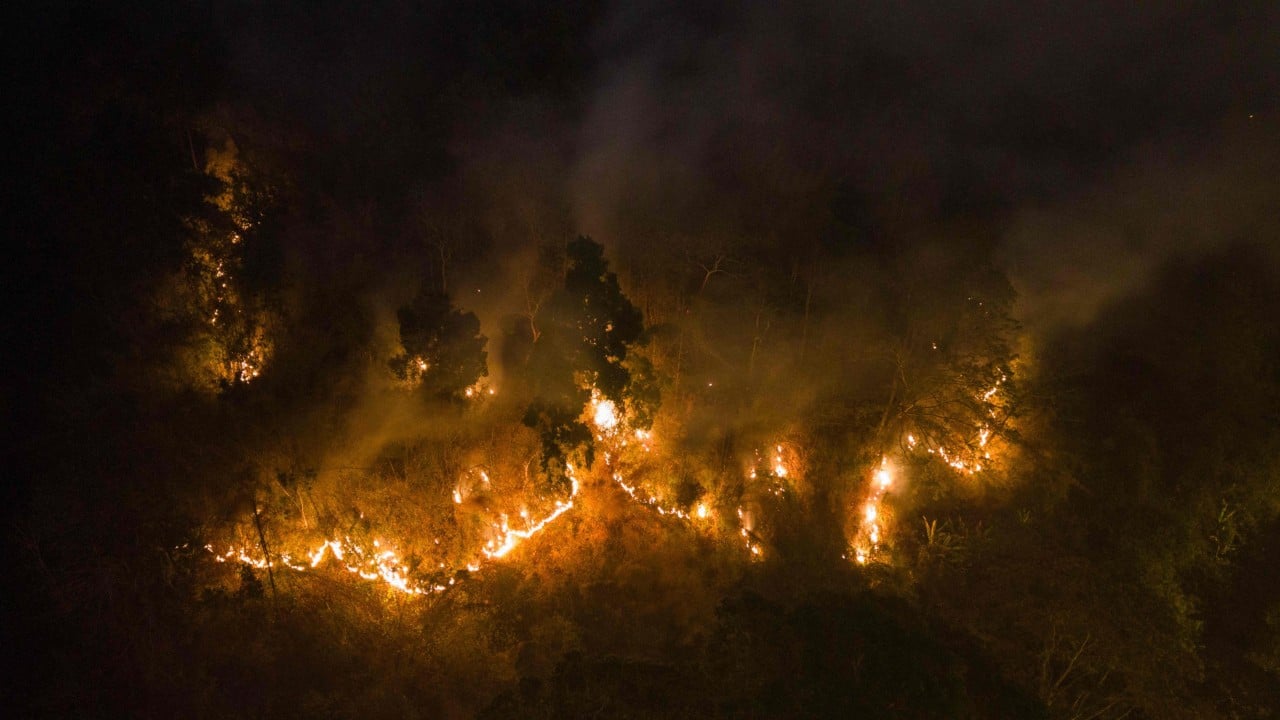
Forest fires raging through Laos, Myanmar and Thailand have smothered large areas in dangerous smoke, leaving overstretched firefighters battling blazes and smog-choked communities looking to the skies for rain and their governments to fix a scourge that worsens each year.
Dry season fires have brought a public health crisis to northern Thailand, including Chiang Mai, as well as much of Laos and eastern Myanmar, as parched bush provides tinderbox conditions for wildfires.
Some fires are also due to farmers slashing and burning to clear land in the quickest, least labour-intensive way possible ahead of a planting season, especially in Laos and Myanmar, where enforcement of bans against the practice remains patchy.
Thailand’s northernmost provinces of Chiang Rai, Chiang Mai and Mae Hong Son have been blanketed by thick clouds of pollution drifting across the Myanmar and Laotian borders.
On Sunday, Thailand recorded over 600 fire hotspots, most in the north, with some snaking down the western border with Myanmar. Hospitals across the country have reported a surge in patients seeking help for respiratory sickness linked to high levels of PM2.5, the ultrafine, toxic particles carried in polluted air.
“The air we breathe is a fundamental right that every person deserves,” Maneerat Khemawong, a senator from Chiang Rai province, told reporters on Monday. “The air quality situation in the northern region has been at a critical red-to-dark purple level for over two months … a trend of worsening conditions every year,” she said, flanked by fellow northern senators pressing the government to do more over the worsening pollution.
“Accumulated hotspots in neighbouring countries number over 10 thousand, and this smoke drifts into Thailand,” she said, referencing satellite data.
“Solving the PM2.5 problem must begin by addressing the root causes. This is a structural issue that cannot be resolved through short-term measures alone. It requires comprehensive, dedicated legislation to systematically manage air pollution.”
On Monday, Prime Minister Anutin Charnvirakul visited Chiang Mai, a tourist-reliant city where dangerous levels of toxic smog have been recorded for several weeks.
Doctors have warned of rising cases of severe respiratory sickness and even lung cancers detected among young non-smokers, as toxic air regularly topped 200 on the air quality index – a level that is deemed unhealthy.
The political task of tackling air pollution is complicated by Bangkok’s inability to force Myanmar and Laos to control burning on their land – much of it believed to be for animal feedstock. At the same time, some northern Thai forest communities also burn remote hillsides to clear dead crops for a new harvest.
Thailand’s Clean Air Act is awaiting promulgation into law, which will force polluting companies from factories to power plants to decarbonise and reduce the PM 2.5 particulate they emit. Bangkok saw fewer than 50 clean air days last year.
Weak enforcement of transnational agreements has complicated the haze issue and efforts to stamp out fires. This means, for example, northeastern Thai communities who face fines and jail for burning the stubble from their fields breathe polluted air from a few kilometres away over the Mekong River in Laos, where farmers continue to torch their land at the end of each dry season.
“The smog is overwhelming,” said Saiduan Jinda, from Thailand’s Beung Kan opposite Laos. “Nobody in our town is slash and burning any more, we can’t. So it is coming from over the border. There’s a rumour they are about to set another hill on Laos side on fire to clear it. A lot of people are sick, they have coughs, breathing issues. It’s the worst I’ve seen.”
In Laos, poorly equipped teams of volunteer firefighters have plugged the gaps in state forces to tackle blazes that have ripped through swathes of the country’s fields and forests.
Over 1,400 hectares (3,459 acres) of forest in Phou Phanang, a nature reserve near Vientiane, had been torched, the government said, according to the Vientiane Times.
A volunteer firefighter said the flames had stopped, but “we never know if they are going to reignite again”. The fire-fighting team only had “basic equipment” but was doing its best, he added, requesting anonymity.