
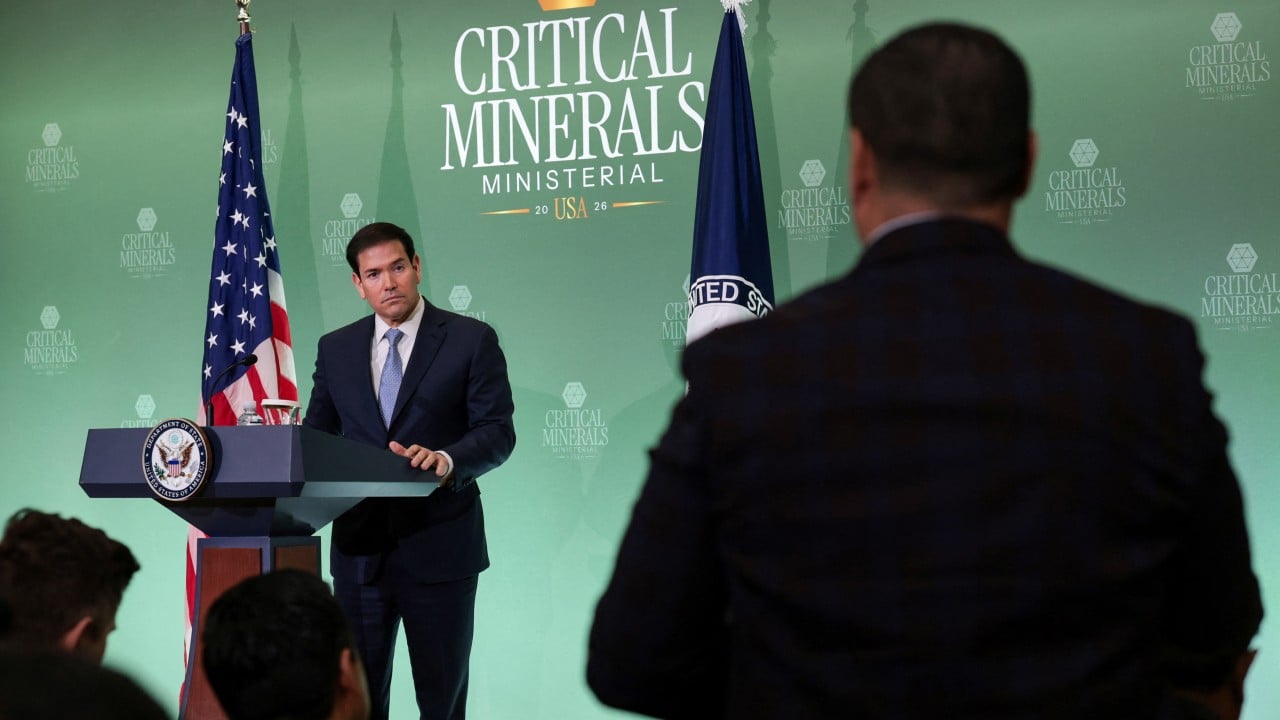
The Quad’s newly announced US$20 billion critical minerals framework aims to loosen China’s near-monopoly on the materials that power modern defence, technology and clean energy industries.
But analysts say its success will depend on the ability of Australia, the United States, India and Japan – the Quadrilateral Security Dialogue’s four members – to move beyond policy declarations and deliver measurable outcomes.
The initiative, announced after a meeting of Quad foreign ministers on May 27, has widely been interpreted as a response to China’s dominance in global critical mineral supply chains.
According to the International Energy Agency, China is the world’s leading refiner for 19 of 20 strategically important energy minerals, controlling an average of 70 to 90 per cent of global processing capacity for lithium, cobalt, graphite and manganese, among others.
These materials are essential for electric vehicle batteries, wind turbines, solar panels, semiconductors and aerospace technologies. Beijing has already shown its willingness to restrict supplies, banning select shipments of so-called dual-use goods to Japan earlier this year following a diplomatic dispute.
“China’s dominant position was built over decades through scale, processing capacity and industrial policy,” said William Heidlage, senior director of technology at strategic advisory firm BowerGroupAsia.
On paper at least, Heidlage said the Quad framework assembled a coherent set of national strengths: Japan’s capital and industrial capacity, Australia’s resource base, India’s market scale and processing ambitions and America’s economic heft.
But he said there was much work still to be done.
“The Quad framework is useful if it helps convert strategic intent into investible projects,” he said. However, it “matters most as part of a wider latticework of arrangements, rather than as a standalone answer”.
Other critical minerals blocs have been forming alongside the Quad initiative.
In March, Japan, France and Canada agreed to coordinate on critical minerals, joining a field that already includes the US-Japan-South Korea Trilateral Partnership and the 54-member Forum on Resource Geostrategic Engagement, or Forge, which held its inaugural ministerial meeting in February.
Australia launched its own A$1.2 billion (US$858 million) Critical Minerals Strategic Reserve last year and sits inside several other overlapping frameworks including Pax Silica – the US-led initiative to coordinate global supply chains for AI and semiconductors – and a bilateral US-Australia critical minerals arrangement.
“Each [bloc] helps mobilise a different combination of capital, policy support, market access and strategic trust,” Heidlage said, noting that the overlapping groups could “provide flexibility” with managing complex critical minerals supply chains.
“Overlap can also help countries move faster when the interests of a smaller set of partners align,” he said, while acknowledging that too many partially overlapping initiatives might risk duplication and lead to competition for the same projects.
Kevin Chen, an associate research fellow in the US programme at Singapore’s S. Rajaratnam School of International Studies, said the new Quad framework’s success would ultimately be determined by “funding and political will” – two areas where the grouping has a troubled track record.
Past initiatives on Covid vaccine distribution and infrastructure investment “fell woefully short of their promises” on both counts, he said.
The US$20 billion investment target is another concern, according to Chen, as it is partly contingent on private-sector investors who are typically wary of critical minerals projects with long development timelines, given “policy uncertainty and weak revenue visibility”.
“The drawback of having this many overlapping groups is the importance it places on coordination,” he said. “Without constant coordination between groups, efforts can be unnecessarily duplicated or even lead to disputes.”
On the plus side, involving more countries in the decision-making process created the right conditions for ideas to be tested, Chen said – and reduced the risk of any single change of government upending plans.
Still, he said it was “unclear whether the Quad framework can act as the driving force for a larger latticework of agreements”.
Integrating India
Geopolitical analyst Vlado Vivoda, an honorary fellow at the University of Queensland’s Sustainable Minerals Institute, said India’s involvement within the new framework could prove to be the most pivotal.
Of the four Quad members, India was the least integrated into existing allied critical minerals supply chains, he said.
“Australia, Japan and the US are already closely connected,” Vivoda said. “India brings something different: a large domestic market, manufacturing ambition, a growing e-waste and recycling base, Indian Ocean geography and relationships across the Global South that do not map neatly onto US-allied structures”.
For the Quad framework to fulfil its potential, Vivoda argued that New Delhi must occupy a central role, from capability building and technology transfer to processing, recycling and rule setting.
“If the Quad is serious, India should not simply be treated as a downstream customer or low-cost manufacturing platform,” he said.
On the recent proliferation of different critical minerals agreements, Vivoda said these need not be an issue if handled well.
“Different minerals require different coalitions,” he said. “The overlap allows countries to assemble coalitions around specific bottlenecks rather than pretending one institution can solve everything.”
“The drawback is institutional clutter,” Vivoda added. “The private sector invests when projects become commercially viable. The key question is therefore not how many partnerships exist, but whether they solve the bankability problem.”
The key question is not how many partnerships exist, but whether they solve the bankability problem
Vlado Vivoda, University of Queensland
Demand for critical minerals is only set to increase, driven by “the global transition towards clean energy, electric mobility, battery storage, semiconductors, artificial intelligence and advanced defence systems”, according to independent mining consultant and environmental engineer Hitanshu Kaushal, founder of consultancy H. K. & Associates.
He said the Quad framework’s long-term success would require a pipeline of tangible outcomes, spanning new mining projects, refining and processing infrastructure, binding investment commitments, technological collaboration and strategic stockpiles.
“Future competition in critical minerals will be determined not only by access to resources but also by control over processing technologies, refining capacities, manufacturing ecosystems and supply chain integration,” he said.
“The Quad framework has the potential to contribute meaningfully to this objective if it remains focused on implementation, investment and long-term strategic cooperation.”
Kaushal said the “real value of the Quad” came from creating trusted supply-chain partnerships, encouraging investment and facilitating technology transfer.
“Therefore, the framework should be viewed as a critical pillar within a broader global effort to diversify supply chains rather than as a standalone solution,” he said.
“Overlapping partnerships should be seen not as competing structures but as complementary building blocks of a broader global critical minerals architecture.”
In the global geopolitical scramble for critical minerals, analysts say the real power belongs to those who build the refineries, not those who sign the treaties. The Quad has successfully mapped out its strategic intent. Now, it has to deliver.