
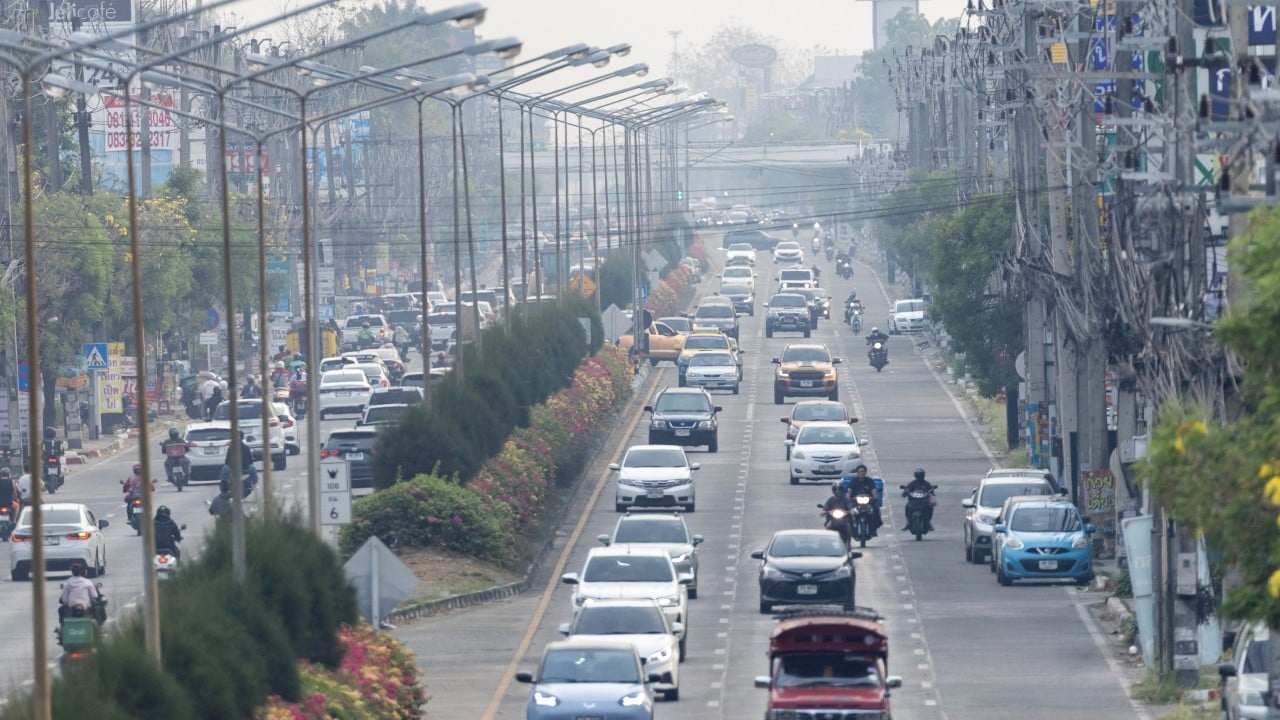
Governments across Southeast Asia have been banking on work-from-home arrangements for civil servants to ease the sting of soaring energy costs triggered by the Iran war, but analysts say the maths is messier than it may first appear.
Indonesia estimates its Friday work-from-home policy, introduced on April 1, will save around 6.2 trillion rupiah (US$361.5 million) in state fuel subsidies and nearly 10 times that amount in total consumption.
The Philippines has similarly introduced a four-day work week for civil servants, while Thailand ordered all non-essential government employees home last month after crude oil prices crossed US$100 a barrel and Malaysia became the latest to follow suit last Wednesday.
But will the gains at the pump simply shift to pain at the power socket?
While fewer commuters on the roads would doubtless cut petrol consumption in the short term, analysts told This Week in Asia that any savings could be eaten up by higher household power use as air conditioners were left running all day in homes across the region.
Singapore has, so far, stopped short of rolling out such a mandate – instead directing government offices to adopt energy-saving measures such as setting air conditioners to 25 degrees Celsius (77 degrees Fahrenheit) or higher and switching off non-essential equipment when not in use.
Unlike in the city state, where the government estimates nearly two-thirds of peak hour trips are by public transport, many workers in neighbouring nations rely on private vehicles to commute.
Lawrence Jin, an assistant professor of economics at the Lee Kuan Yew School of Public Policy in Singapore, said that this meant remote-working arrangements were likely to deliver short-term benefits for the likes of Malaysia and Thailand.
But diesel consumption is another matter, according to Victor Nian, founding co-chairman of the Centre for Strategic Energy and Resources. Transport and logistics operations that depend on the heavier, oilier fuel were unlikely to be much affected by remote or hybrid working arrangements, he said – though such measures could potentially save commuters millions of litres of petrol monthly.
Work-from-home arrangements would also have little impact on electricity usage, Nian added, as air conditioners in private homes are typically far less efficient than the centralised systems often found in commercial and public buildings.
While Singapore could eventually issue a mandate similar to its neighbours, Jin said the wide use of public transport would make any benefits less pronounced for the city state.
Shifting the time people spend from offices to homes may not generate large net energy savings
Lawrence Jin, behavioural economist
“In addition, residential electricity use is relatively high in Singapore, so shifting the time people spend from offices to homes may not generate large net energy savings.”
According to an Ipsos study published earlier this month, 77 per cent of Malaysians rely on private vehicles as their main form of transport, with 10 per cent primarily using public transport.
In Singapore, meanwhile, a YouGov poll released last year found that three in five respondents used public transport as their primary mode of travel.
Anne Shaqur, a 35-year-old programme manager from Singapore who occasionally takes private-hire cars or taxis to work, said she hoped the city state would mandate work-from-home arrangements for both the private and public sectors. Her daily commute can cost up to S$40 (US$31.50).
“Commuting to the office feels noticeably more expensive now, and coupled with the increase in household utility bills, it adds to my financial pressure,” she said.
No Southeast Asian nation has yet attempted to order private companies to alter their working arrangements, though Indonesia and Malaysia have encouraged their private sectors to make the shift, while Singapore has urged businesses to do their part to conserve energy.
Analysts say such a step warrants caution – though it could work for countries that are heavy importers of petroleum products such as Indonesia, Vietnam and Cambodia.
“In the short term, this seems a viable strategy to ride out the storm,” Nian said. “It could also help drive the development of telecommuting and more efficient remote co-working to further future-proof Asean countries.”
Private companies across the Association of Southeast Asian Nations would nonetheless have to weigh other factors, including productivity and employee engagement, said Lewis Garrad, a career practice leader at the consultancy Mercer Asia.
Knowledge-based industries had greater capacity to adopt hybrid arrangements than manufacturing or frontline sectors, he said, adding that uncertainty surrounding the duration of the war meant it was difficult to predict if companies would shift to remote working at scale.
Whether remote work is a net positive or negative remains a subject of debate, with different studies offering conflicting conclusions.
But Garrad advised companies to adopt a hybrid approach, citing Mercer’s most recent Global Talent Trends survey that found more than half of respondents in the Asia-Pacific reported increases in productivity under such a model.
Jin said enforcing remote work in the private sector would be difficult and costly, and would only be viable in extremely dire circumstances.
“If the crisis prolongs, I think governments are more likely to provide guidance, advisories, or incentives rather than mandates,” he said.