
Anna, a domestic helper from the Philippines, had managed her finances well until she took out two loans over the past few months for a friend she described as being “like a mother to me”.
The 37-year-old, who asked to be identified only by her first name, now has to pay creditors about HK$9,000 (US$1,149) a month – almost twice her salary – leaving her extremely stressed about her debt.
“My friend said she needed the money and asked if I could borrow from banks under my name, saying she would pay back the loans, but I was wrong to believe her,” she said.
“I am really hurt about this … I told her, you really put me in trouble, you put my job at risk. But she just says ‘I’m so sorry, I didn’t mean it’.”
Anna said the debt had taken a toll on her mental health, but she was prioritising her children’s needs over repayments, even as banks continued to chase her.
“The school told me my son has borderline depression because they kept asking him for payments, which I failed to give. That really breaks me,” she said.
“My situation really gives me depression. I just take it in a positive way and submit everything to God.”
Anna is among the hundreds of thousands of domestic helpers in the city who have taken on debt that totals billions of Hong Kong dollars.
Enrich, a charity that promotes the economic empowerment of Hong Kong’s domestic helpers, said that more than 80 per cent of them were in debt, with four in five paying off loans of between HK$1,000 and HK$4,000 every month.
As of 2024, Hong Kong had 368,000 foreign domestic workers, accounting for 10 per cent of the local workforce.
A survey on unsecured personal loans by the Companies Registry, released in January, shows that domestic helpers accounted for 364,851 – nearly 37 per cent – of the 993,655 transactions in 2024, collectively borrowing a total of HK$6.31 billion of the HK$49.7 billion that was disbursed.
New measures start in August
Measures introduced by the Financial Services and the Treasury Bureau, starting in August, are aimed at tackling this long-standing problem and have been welcomed by employers and non-governmental organisations.
The bureau said the rules targeted the “excessive borrowing” that had become “particularly acute among low-income earners” and domestic helpers in Hong Kong, often leaving employers harassed by debt collectors trying to recover unpaid loans.
But some fear the measures could push domestic helpers towards unlicensed virtual lenders and are calling for stricter regulations, more open conversations about money between employers and employees and greater support to improve financial literacy among the workers.
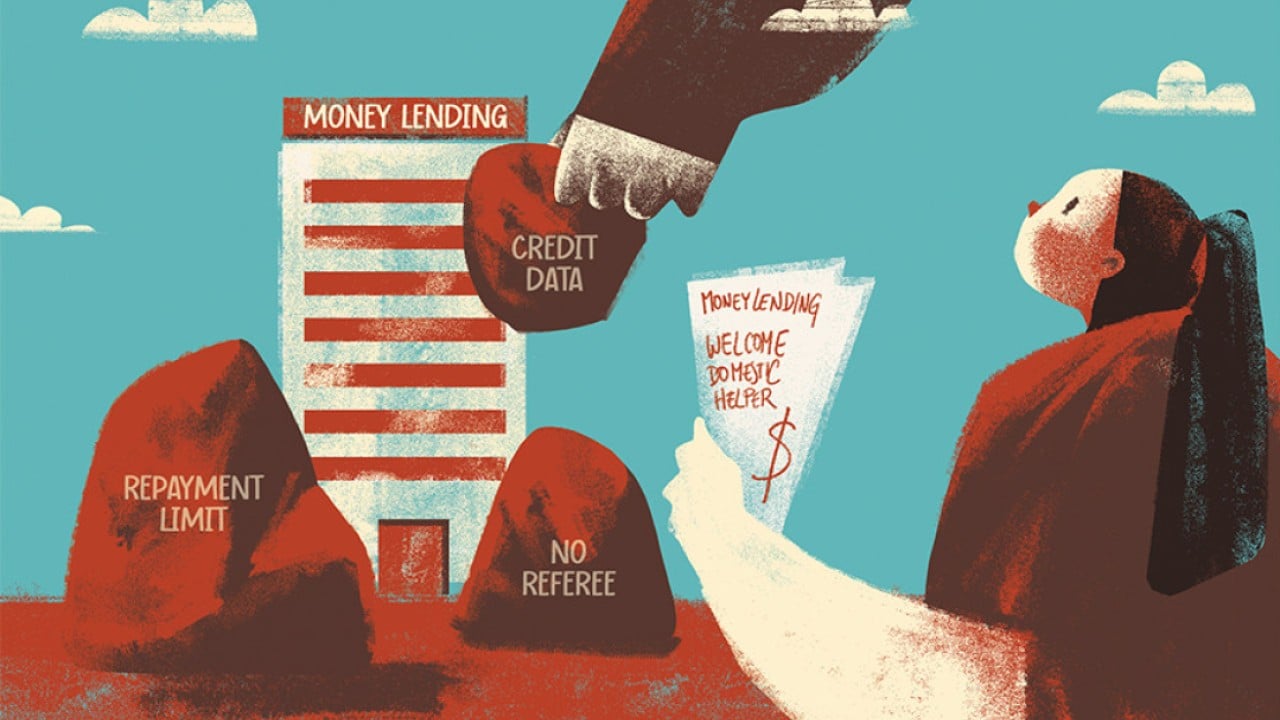
In the first phase of the roll-out in August, monthly repayments for borrowers earning HK$6,000 or less will be capped at 35 per cent of their income, while those earning between HK$6,001 and HK$12,000 will face a 40 per cent limit.
A helper earning the minimum wage of HK$5,100 a month will have her maximum repayment capped at HK$1,785.
Money lenders would also be prohibited from requiring all applicants to provide referees, and they must not contact those people if the borrower defaults.
The bureau said that under the current system, borrowers could easily obtain unsecured personal loans because many lenders offered “simple and efficient approval processes” while applicants often failed to carefully assess their own repayment ability.
It added that this convenient process often tempted people into taking on heavy debts they could not repay.
From the second phase, starting in June next year, all lenders offering personal loans will be required to report borrower data to the Credit Data Smart platform every 30 days.
Those serving clients earning less than HK$12,000 a month must join the platform to access credit reports and see an individual’s total debt across banks and other financial institutions, effectively preventing borrowers from “stacking” loans from multiple lenders.
The Companies Registry received a growing number of complaints relating to money lenders in the past three years, with 57 cases alone in the first quarter of this year.
In 2025, the registry received 264 complaints, up from 214 in 2024 and 109 in 2023.
Employers face stress test
Many employers are also affected by the spiralling debts of their helpers.
Shadow Chow recently ended her domestic helper’s contract after discovering she had accumulated HK$90,000 in debt across three licensed money lenders.
“She previously asked to borrow money from me five days after her payday, saying her husband had a stroke and they needed money to buy milk powder and diapers,” said the 40-year-old surveyor, who is a first-time employer.
Her Indonesian helper, who had been employed for one year, regularly requested salary advances. When Chow began refusing these requests, the helper turned to credit companies instead.
“I am worried she would use our employment contract to borrow more money; lenders will not know that she was fired,” she said.
Chow said she was constantly stressed about being contacted by creditors and feared for her mother’s safety.
“She knows too much about our family’s daily life, and my mother is sometimes at home alone during the day,” she said. “I am worried money lenders might start turning up at our door.”
Cycle of debt
Hong Kong charity Help for Domestic Workers said the recruitment process pushed these helpers into a cycle of debt from the start, with an average of HK$30,000 owed before they even arrived in the city.
“That means travelling from a province in Indonesia or the Philippines to the capital city, approaching an agency, paying for medical fees, training fees,” said Rachel Li, head of case management and research.
“On top of that, they carry a lot of family obligations. A lot of the helpers who work in Hong Kong are breadwinners and are expected to send money home.”
Li said most of the helpers she encountered on the frontline needed funds for family emergencies, natural disasters or their children’s tuition fees.
“There’s a very strong family-focused culture in their home countries, so even if a distant relative needs financial help, most will step in because they are working overseas,” she said.
Enrich executive director Suzanne Gendron said there might be a deeper emotional reason why domestic helpers take out loans to support their families.
“There’s quite a bit of guilt that would occur when a mother has to leave her child back home to be raised by others, and you compensate for that in many different ways since you can’t be there in person,” she said.
“Without meaning to, one of the other ways that they get into debt is that they want to give their children things because they’re overseas and they can’t be there physically.”
Head of programmes Katrina Eeyan Villamarin said the most extreme case she had come across was a domestic worker who accumulated more than HK$500,000 in debt, with most helpers averaging HK$80,000 to HK$100,000 in loans.
“They would go through 10 or 15 money lenders, even their friends, including their employers,” the trainer said.
Chow said her helper borrowed HK$44,000 from a single credit company and questioned why she was allowed to borrow so much, given her income.
She said some creditors preyed on helpers who were vulnerable to the lure of quick cash, with some even setting up shop next to domestic worker agencies.
The new rules have also brought cautious hope for helpers like Anna, who said the restrictions would greatly help to prevent helpers from borrowing beyond their means.
“If we know about this limit, it might help avoid putting domestic helpers in the kind of trouble that happened to me,” she said.
“It is because [the lenders] are so free [with the money], they just give out our full month’s salary, three or four thousand from one bank.”
Gendron said the new measures, especially the one eliminating the need for referees, would reduce the harassment suffered by employers or friends.
“Even though the referee is not obliged to pay and will not pay most of the time, there is harassment by the lenders,” she said.
Illegal lenders, easy targets
The Coalition of Global Home Service Sustainable Development, an NGO focusing on family and helper issues, said many illegal online lenders preyed on domestic workers, who might not have the resources to check if these companies were licensed.
“Some illegal lenders use names very similar to legitimate companies, and are opaque about terms and conditions to attract domestic helpers on Facebook,” president Chrystie Lam Hau-yiu said.
“I hope the government could ban websites to nip these online operators in the bud.”
All three NGOs emphasised that the regulations should not be so strict that they deny domestic helpers access to small personal loans, since they may have legitimate needs such as family emergencies.
Chow said she initially believed her helper’s claim that her family was facing an emergency, but began to doubt it after seeing her “spend frivolously” on beauty treatments and a new mobile phone.
She also said domestic helpers generally mistrusted their employers and tended to heed the financial advice of friends, even when it was uninformed.
“From the start, I advised her not to borrow money from credit companies and she promised me, but she was still influenced by her friends and went ahead,” she said.
Once bitten, twice shy, Chow said she would now screen domestic helpers more carefully during interviews and ask about their financial habits.
“I would ask if they have any habit of saving, how much they would send home every month and what they do with their remaining income, and whether she has enough savings in case of an emergency,” she said. “My experience with my previous helper has left me traumatised.”
Education is key
Chow said the issue boiled down to a lack of financial literacy, a problem Enrich hopes to solve through its workshops on money management, entrepreneurship and investments for domestic helpers.
Since its establishment in 2007, the charity’s programmes have helped 70,000 domestic helpers gain more knowledge on money matters, and have made it easier for them to talk to their employers about finances.
“We give them financial skills on how to manage their money, how to talk to their families, and how to speak up for themselves so that they can discuss money matters with their employers in a healthy way,” Gendron said.
Domestic helpers have also become targets of money laundering syndicates looking for “mules”, with police arresting 21 people last January, including 12 women from the Philippines and Indonesia for allegedly laundering a total of HK$74 million.
Gendron said most syndicates approached domestic helpers in person and asked for their personal details such as identity cards to set up stooge bank accounts.
An Enrich workshop on fraud, scams and money laundering educated domestic helpers not to be lured by promises of quick rewards such as HK$1,000 for lending their bank cards, she said.
With adequate financial literacy, domestic helpers would be better equipped to resist the lure of quick cash, even if they were targeted by loan companies, she added.
Joselyn Bisquera, a beneficiary of Enrich’s courses, said she realised the importance of financial literacy after she suddenly lost her job during the Covid pandemic.
While she previously only saved whatever money she had left at the end of the month, Bisquera, 43, now knows she has to set up an emergency fund of three to six months and save before she spends.
She also learned, through the workshop, how to have “the money talk” with her family back home.
“I told them they need to have an extra income, budget their expenses and not only depend on my salary,” she said.
The domestic helper has become a community ambassador for Enrich and encourages her friends to join the programmes, saying she has seen clear improvements in how they handle their money.
“Even if they have debt, they can manage it, they can do the calculations so it’s not too much,” she said.
Having been in Hong Kong for eight years, she is now saving diligently and has set her sights on returning to the Philippines to run her business in agricultural supplies.
“Maybe in five years, after I reach my financial goals, I can go home for good,” she said.