
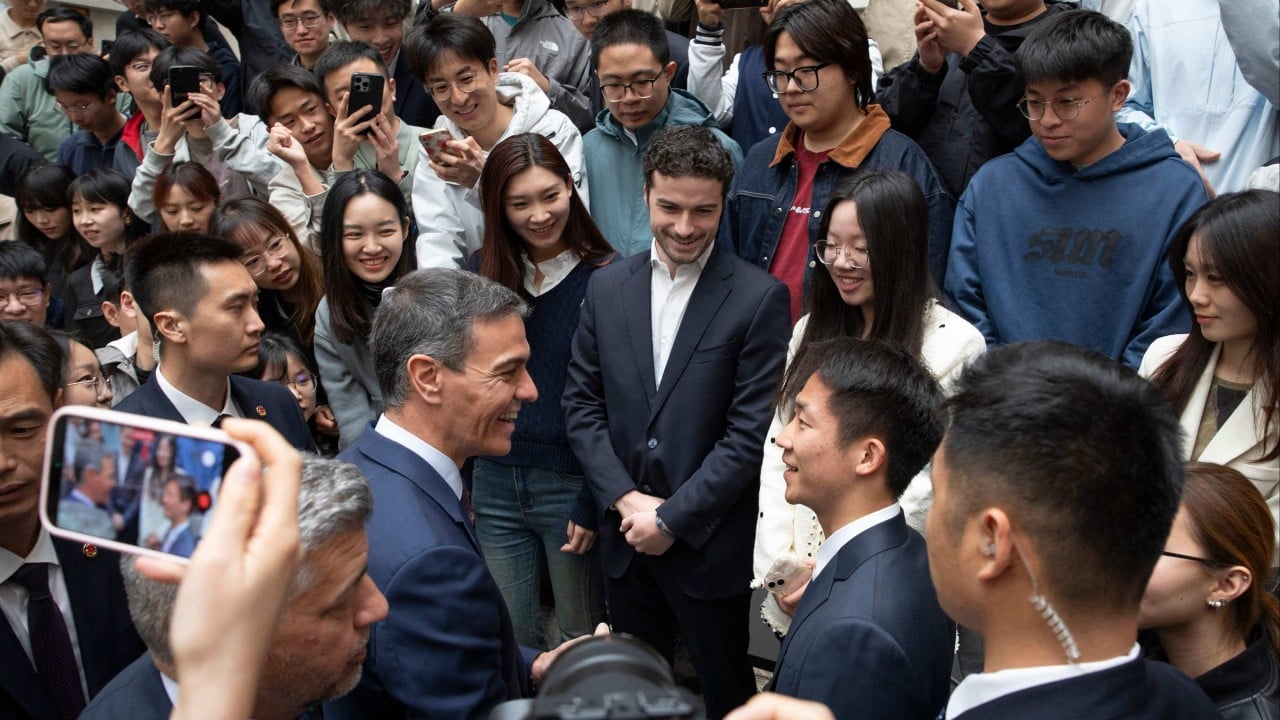
Spanish Prime Minister Pedro Sanchez’s fourth visit to Beijing in four years has once again drawn attention across Europe and the Atlantic, but perhaps less scepticism than before. In an era marked by intensifying US-China rivalry, geopolitical fragmentation and the European Union’s emphasis on “de-risking”, Spain’s sustained engagement with China is often seen as a strategic divergence from Brussels.
That reading, however, underestimates both Spain’s intentions and the broader shift under way in Europe’s approach to China. Europe’s de-risking strategy is necessary to curb excessive dependencies, but if reduced to limiting exposure alone, it could create another vulnerability: too little engagement in areas where the cost of doing without China is higher than the cost of cooperating.
Sanchez’s latest visit to Beijing points to a more pragmatic path, with Spain positioning itself at the forefront of an approach that mitigates risks while preserving and deepening ties in domains where China plays a critical role.
Spain’s engagement rests on a simple premise: China is not a marginal actor that Europe can sideline. It is central to global industrial production, green technologies and major global challenges. The question is not whether to engage, but how to do so in ways that strengthen resilience, reduce asymmetries and expand Europe’s room to manoeuvre.
The recent visit produced three notable advances.
First, Spain and China agreed to establish an annual strategic dialogue, signalling Beijing’s recognition of Madrid as a key European interlocutor. This is not symbolic. It creates a permanent channel to address both opportunities and frictions, from market access to geopolitical coordination, strengthening Spain’s ability to shape outcomes rather than merely react.
Second, the visit deepened the economic dimension of the relationship, with a clearer emphasis on quality and reciprocity. Ten agreements were signed, including some aimed at opening the Chinese market to Spanish agri-food products. These developments come as Spain’s exports to China grew by 6.25 per cent between 2023 and 2025, while EU exports declined by 10.7 per cent. Spain is also set to benefit from the Chinese Ministry of Commerce’s “Export to China” initiative, having been designated a priority country for import diversification.
However, the key issue is achieving more balanced economic engagement. Sanchez warned that current asymmetries are unsustainable. In 2025, Spain’s trade deficit with China reached €42 billion ($49.3 billion), around 74 per cent of its total deficit. This underscores that engagement must be conditioned on reciprocity and a more level playing field.
The same logic applies to investment. While Chinese investment in Spain rebounded to €643 million in 2025, China remains only the ninth-largest investor. The challenge is not dependence but quality: investment that integrates into local value chains – especially in electric vehicles, batteries and renewables – rather than assembly operations reliant on imported components. The meeting with 36 major Chinese companies signals intent, but delivery will be the real test. The same can be said about the agreement related to increasing mutual “training and technology transfer” to enhance “local added value”.
Third, the visit broadened relations beyond economics. Eight agreements in science, innovation, culture and biodiversity reflect recognition of China’s advanced scientific ecosystem. A resilient relationship cannot be narrowly transactional but must be embedded in broader cooperation that enhances understanding and reduces mistrust.
Beyond bilateral ties, the visit highlighted a broader geopolitical dimension. Sanchez framed the relationship as contributing to a more stable multipolar order and called on China to play a more active role in providing global public goods, from climate action to poverty reduction.
This must be understood against an international environment where alliances are being reassessed. In Spain, as elsewhere, perceptions of the United States are evolving. Washington is increasingly seen not only as an ally, but also as a source of disruption. An aggressive Trump administration is creating openings for China to enhance its international standing, as global actors unsettled by US policies turn to Beijing as a stabilising force.
A recent poll in El País identified US President Donald Trump as the greatest threat to world peace, ahead of Russian President Vladimir Putin. This perception is not unique: other US allies, including Canada, are also hedging by re-engaging China. During his visit, Sanchez intelligently called for a more active Chinese role in defending international law so that the “conflicts in Lebanon, Iran, Gaza, the West Bank, and also Ukraine come to an end”, framing Beijing as a necessary interlocutor for stability.
Spain remains committed to the EU framework that defines China as partner, competitor and systemic rival, signalling no departure from the transatlantic relationship. However, it also signals a pragmatic recognition that deepening ties with China is more feasible than expanding cooperation with the current US administration.
In a multipolar world, resilience requires diversification, and strategic autonomy depends as much on engagement as on protection and investment. Ultimately, autonomy is not the absence of interdependence. It is the capacity to shape it.
Spain’s approach can be described as structured and conditioned engagement, a model that could resonate across Europe. It combines openness with clear expectations: improved market access, fair competition, stable supply chains and greater Chinese responsibility in global governance.
The success of this strategy will ultimately depend on whether China is willing to respond in kind and address long-standing European concerns over market access and reciprocity. Engagement is only sustainable if it produces tangible, mutual benefits. But in a world of growing fragmentation and uncertainty, Spain’s bet is that retreat is not a viable option. The challenge is not to disengage from China, but to engage more effectively.