
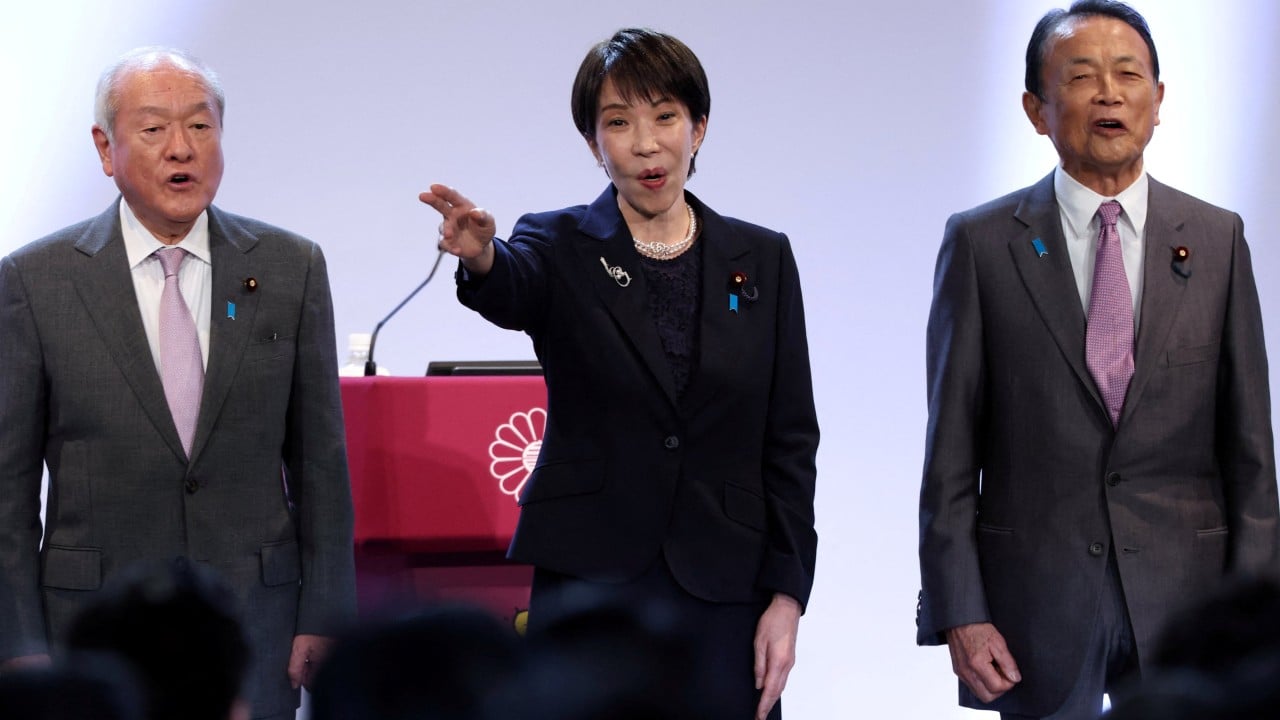
Reports of friction inside Japan’s ruling Liberal Democratic Party (LDP) suggest Prime Minister Sanae Takaichi’s biggest political challenge may now lie not with the opposition, but within her own party.
Despite her strong public standing after February’s general election, reports have grown louder that Takaichi is clashing with the LDP’s influential old guard, notably former prime minister Taro Aso.
Japanese tabloids, which are often more willing than the mainstream press to air insider grumbling, have reported complaints from within the party that Takaichi is acting “like a queen” and that senior figures who assumed they would be able to control her after she took power have been proved wrong.
The veteran male politicians who have long set the party’s agenda are also said to be unhappy with Takaichi’s plan to suspend the 8 per cent consumption tax for the next two years to combat inflation, as well as with what critics inside the party see as overly fawning performances in meetings with US President Donald Trump in Tokyo and Washington.
“There has been a cleavage within the party based on factional lines,” said Go Ito, a professor of international relations at Tokyo’s Meiji University.
Even though the party nominally banned formal factions after its 2023 scandal involving unreported slush funds, the alliances still remain, and Takaichi’s Seiwa Kai faction – the LDP’s once-dominant conservative bloc – has increased in influence since she became party leader and prime minister, Ito said.
“There are a lot of old-school politicians within the party who dislike her personally,” Ito said. “These are the older politicians who do not want change and did not like to see her fawning over Trump.
“There is also a degree of jealousy among some of them,” he said. “She has risen to the highest political position in the land and they wanted that job.”
While Aso briefly served as prime minister, Foreign Minister Toshimitsu Motegi is also seen as harbouring ambitions for the top job, and Takaichi defeated Shinjiro Koizumi – the younger son of former prime minister Junichiro Koizumi – last year to become party leader.
After her overwhelming victory in the February general election, however, no one is ready to challenge her leadership and her rivals are biding their time, Ito suggested.
A public-opinion poll published by Jiji Press on April 16 showed that support for Takaichi’s cabinet stood at 59.1 per cent, down a marginal 0.2 percentage point and the lowest in two months.
It is still, however, a clear indicator of broad public backing, with respondents citing trust in the prime minister and saying she has demonstrated leadership since taking office.
Yet the rumours of internal machinations refuse to go away.
The Monday online edition of the Shueisha news magazine quoted party insiders as saying Takaichi has ruffled feathers by “repeatedly making important decisions without providing sufficient explanations to party executives, leading to growing distrust among those close to Aso”.
Aso, now 85, reportedly believed Takaichi was trying to sideline him by offering to make him speaker of the House of Representatives, while the two are also said to be firmly at odds on a number of key issues.
Aso, a former finance minister, favours fiscal discipline, for example, while Takaichi advocates more proactive fiscal policies and is pushing for tax cuts to encourage growth.
Takaichi has also dismissed the head of the LDP’s panel on tax reform, another Aso ally who was opposed to tax cuts, and the long-serving head of the Diet council on electoral systems, which is under pressure to examine reducing the number of seats in the house – another policy that Takaichi is resisting.
Aso was also reportedly unhappy that he did not learn of Takaichi’s decision in January to dissolve the House of Representatives for the election until the “last minute,” while she has elevated loyalists in other party positions.
Insiders have commented on an “invisible wall” that now exists between the prime minister’s office and senior party leaders, with one former LDP cabinet member telling Shueisha that “the prime minister’s attitude of acting like a ‘queen’ who wants to do whatever she wants just because she won the general election is wrong”.
“There is mistrust on both sides,” said Ito. “But she won the election not long ago and her popularity with the public is still high, so those who are against her are still hesitating to say so.
“I think that Aso believed that he would be able to control Takaichi after he helped her to become prime minister, but it has quickly become clear that she is far more difficult to control than he thought.”
Hiromi Murakami, a professor of political science at the Tokyo branch of Temple University, said it should not come as a surprise that Takaichi is clashing with the party’s veterans.
“It has been clear for a long time that she has her own way of doing things and even though the old guard will indicate that they ‘allowed’ her to become prime minister, she does not see it that way,” she said.
“She has reacted differently and she is showing them that the old rules no longer apply,” she added. “And she feels secure in her position because she knows she has strong public support and, very likely, the Japanese people are tired of the old way of doing politics.”
With more than two years until she needs to call another election, Takaichi is in a strong position, Murakami said, although that could change suddenly. A national security crisis, an economic emergency beyond her control or some sort of scandal within the party could weaken her grip, she said.
In the meantime, the plotting continues, Shueisha reported, and there are already signs of shifting alliances “with an eye on the ‘post-Takaichi’ era”.