
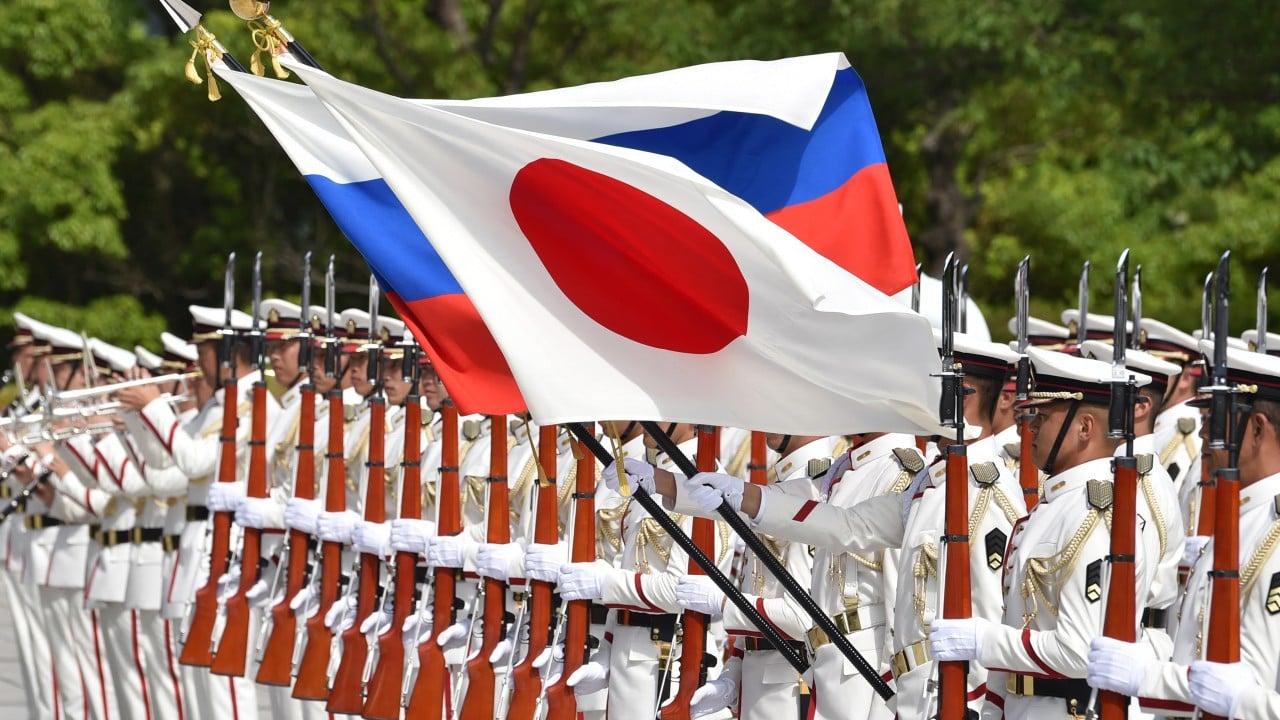
A pro-Kremlin Japanese politician has said Russia is trying to arrange a meeting of the two nations’ foreign ministers in July, although analysts suggest that Muneo Suzuki’s efforts to act as a go-between are unlikely to bear fruit.
Suzuki, who represents a constituency in Hokkaido and returned to the ruling Liberal Democratic Party in 2025 after 23 years as an independent member of the Diet, met senior Russian government officials in Moscow on Monday.
Andrey Rudenko, deputy foreign minister in charge of Asian affairs, told Suzuki that Moscow would be willing to arrange talks between Russian Foreign Minister Sergey Lavrov and his Japanese counterpart, Toshimitsu Motegi, on the sidelines of a meeting of ministers attending the Asean summit in the Philippines in July.
Russia’s TASS news agency quoted Suzuki as telling his hosts that Japanese Prime Minister Sanae Takaichi was in favour of closer bilateral ties and that he was strongly opposed when Tokyo aligned with the US administration’s Moscow policy under then- president Joe Biden.
“I very much want to restore Japan-Russia relations to the state they were in under [former prime minister Shinzo] Abe and [Russian] President [Vladimir] Putin,” Suzuki said in a meeting with Grigory Karasin, head of the Russian Federation Council Committee on International Affairs.
“Takaichi said that she is very well aware of the importance of Japan-Russia ties,” he added. “I have consistently taken a negative view of the fact that Japan, at the request of Biden, has adopted cold ties with Russia.”
Suzuki assured his Russian counterparts that he would take steps to improve relations and help Takaichi to achieve that end, according to the TASS report.
James Brown, a professor of international relations specialising in Russian affairs at the Tokyo campus of Temple University, described Suzuki as a “notorious self-promoter” and suggested that the challenges of arranging a meeting of foreign ministers from both sides were too difficult to overcome.
“Suzuki is effectively declaring himself to be an envoy of the prime minister, but he is not,” Brown said.
“He does appear to have met Takaichi and Motegi in Tokyo before he went, and there were clearly no objections to him meeting Russian government officials. I’m sure Takaichi is keen to hear what they are saying, but he is not speaking on behalf of the Japanese administration.”
While Suzuki claimed that Moscow had attached no preconditions to any meeting, Brown said Russian-language reports cited a requirement by Moscow for Tokyo to end its “deeply hostile policies” before talks between both sides could take place at the Association of Southeast Asian Nations event in July.
Given that negotiations with Japan would indicate tacit support for the Russian government and its actions, not least in Ukraine, Brown said he saw no likelihood of Tokyo conceding to Moscow’s condition for such a meeting.
The biggest leverage that Russia can exert over Japan involves energy, with a Russian vessel carrying crude oil arriving off the Ehime prefecture on Monday, the first such delivery on Japanese soil since the US launched its attacks against Iran in late February. With the conflict showing no signs of ending, Japan is seeking new energy sources, with Russia possibly a key provider due to its proximity, according to analysts.
Japan has managed to convince its allies to grant an exemption from sanctions against Moscow for energy projects on the Russian Far East island of Sakhalin, developed in part with Japanese financial support.
Toshimitsu Shigemura, a professor of international relations at Tokyo’s Waseda University, said Russia sensed it could manipulate Suzuki and offer energy supplies in a move to peel Japan away from the international coalition arrayed against it since its invasion of Ukraine in February 2022.
“Suzuki has built up a very good working relationship with Moscow and Putin, but I am not sure how much influence he has on Takaichi,” he added, pointing out that Suzuki had long been an outspoken supporter of the Russian invasion of Ukraine.
“It may be a geopolitical long shot, but Moscow may be hoping that a first meeting between foreign ministers might be the first step towards something else.”
Shigemura conceded that finding common ground with Moscow would be deeply unpopular with the Japanese public and international partners.
However, Brown said the arrival of the first Russian crude tanker in more than a month was “symbolically important”, with more frequent deliveries expected.
“Japan is in a difficult position, and it needs to find alternative sources,” he added.
Shigemura said: “As the war in Iran goes on, Japan is getting a little bit more desperate about its energy supplies and is also competing with other countries for limited resources.”