
Risks of conflict in the Gulf of Oman are rising after the US Navy fired on an Iranian-flagged cargo ship, though analysts say both Washington and Tehran have shown a reluctance to prolong the war.
US President Donald Trump on Sunday confirmed that the guided-missile destroyer USS Spruance opened fire on the Touska after its crew reportedly ignored repeated orders to halt.
The incident took place about 550km (342 miles) east of the Strait of Hormuz in the strategic waters connecting the Persian Gulf to the open sea and marked the first known use of force against a vessel since the American naval blockade of Iran began last Friday.
It prompted Tehran to accuse Washington of violating a fragile two-week ceasefire that is set to expire this Wednesday.
On Monday, Chinese foreign ministry spokesman Guo Jiakun expressed “concern” over the US interception of the vessel in the “sensitive and complex” Strait of Hormuz.
Urging all parties to honour ceasefire agreements and exercise restraint, Guo cautioned against escalating tensions and called for conditions that would restore normality to the vital waterway.
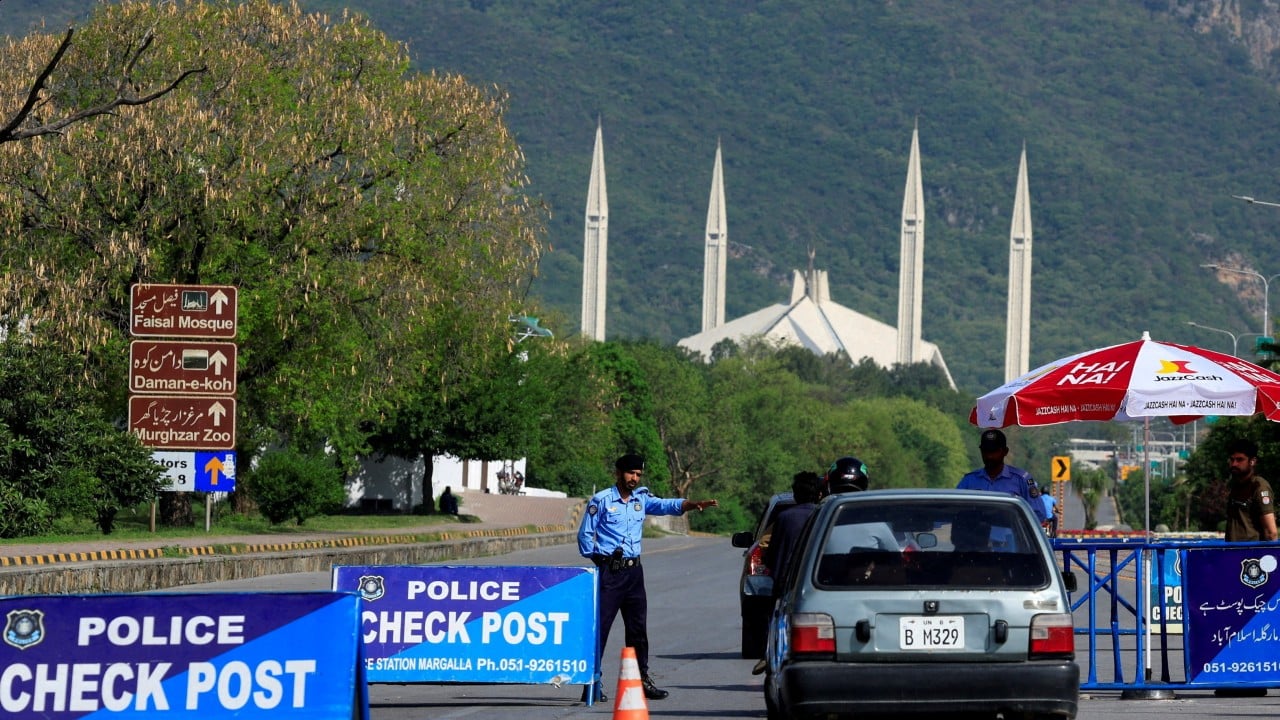
Trump had previously announced that US negotiators would head to Pakistan on Monday with the intention of holding further talks on ending the war, but Iran has not confirmed its participation.
Zhang Chuchu, deputy director of the Centre for Middle Eastern Studies at Fudan University, said that if the coming second round of talks was to fail, the risk of the conflict spilling further into the Gulf of Oman would be “very high”.
The last talks went for about 21 hours and failed to reach a peace deal, with Washington and Tehran remaining far apart on managing the Strait of Hormuz and addressing Iran’s nuclear programme.
However, Zhang said a “bargaining space” still existed.
“Both sides have previously shown a willingness to make concessions, including US pressure on Israel for a brief truce,” Zhang explained, adding that both sides were now employing a “fight while talking” strategy amid a constant danger of strategic miscalculation.
Li Weijian, a researcher at the Shanghai Institutes for International Studies, said the possibility of the war spreading was real and that “it is not the preferred choice”.
“If the fire spreads, the matter becomes too large to control,” Li said. “This is not something the US, the international community or even Iran wants to see, as it would effectively mean burning all bridges.”
Li argued that domestic considerations were tempering the desire for a broader war.
Trump, a Republican, was likely to be “calculating the impact of his actions on the coming [US] midterm elections, seeking a diplomatic ‘bargaining chip’ while avoiding a quagmire that Democrats could exploit”, he added.
Similarly, Li continued, Tehran was “navigating internal friction” between the powerful Islamic Revolutionary Guard Corps (IRGC) and more pragmatic domestic factions.
Despite the recent violence, there were signs that the door to diplomacy had not been bolted shut.
Zhu Yongbiao, director of the Centre for Afghanistan Studies at Lanzhou University, characterised the rhetoric from the US and Iran as psychological warfare.
“This does not mean they are flipping the table entirely,” Zhu said. “It is a form of maximum pressure before negotiations.”
Even if the parties met in Islamabad, the complex “fight-talk” dynamic was likely to continue, he added.
As military tensions simmer, Tehran has shifted the battle to legal and economic arenas, seeking to institutionalise its control over the Strait of Hormuz.
On the same day as the naval engagement, state-run IRIB TV reported that the IRGC Navy had opened the “Larak Corridor”, a new transit route through the Strait of Hormuz as the country’s parliament nears finalising a law to restrict the waterway.
The legislation would ban all Israel-linked vessels and require “belligerent states” or those owing Iran reparations to seek security clearance before passage.
In addition, the bill stipulates that transit tolls be paid in Iranian rials, with 30 per cent of revenue allocated to the military and 70 per cent to domestic welfare.
Zhang described the corridor as a “temporary measure” designed to guide international shipping into Iranian territorial waters.
However, she warned that such a move was a double-edged sword, as the corridor itself could become a “trigger for conflict” and lead to direct surface engagements.
As the Wednesday deadline approached, the situation between the US and Iran appeared to be one of military posturing yet cautious optimism.
Li suggested that while a perfect resolution was unlikely to emerge immediately from the next round of discussions, the parties could move closer to a deal.
“Both sides will show a little something to ensure the other sees a glimmer of hope,” he said.