
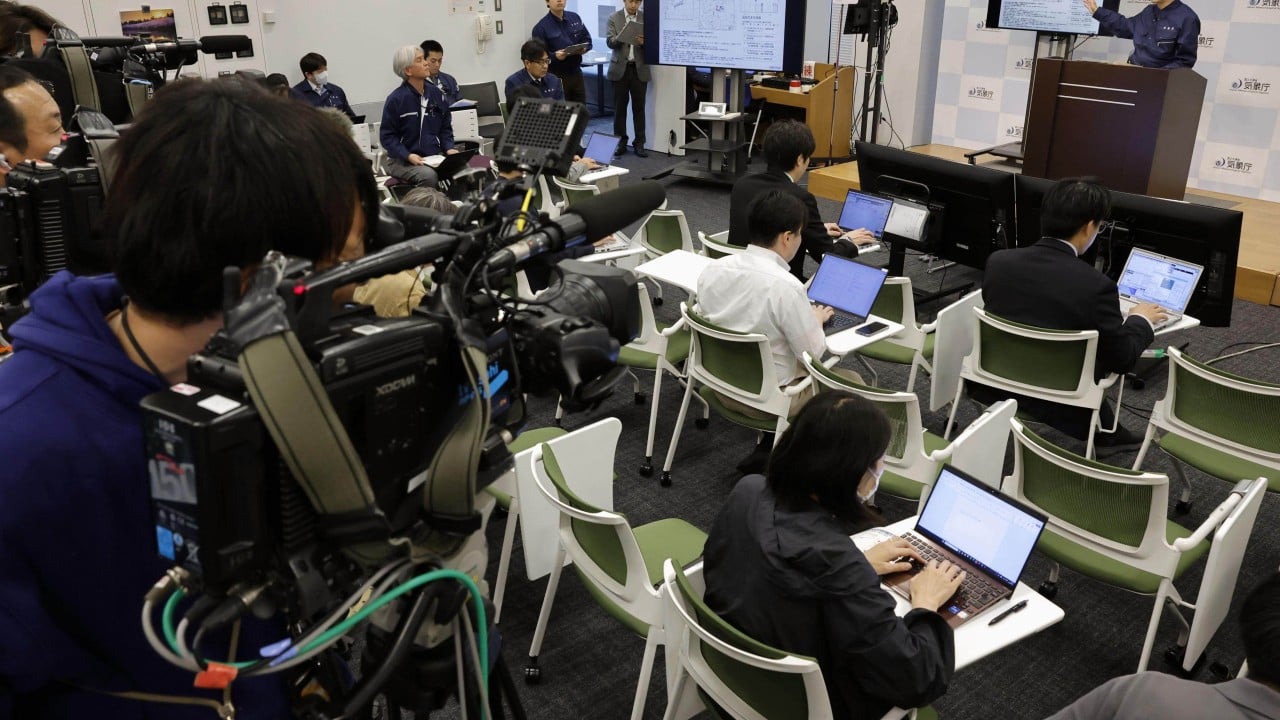
A tsunami warning was issued for northeast and northern Japan after an earthquake with a magnitude of 7.5 struck at 4.53pm on Monday.
The epicentre of the quake, which had a depth of 10km (six miles), was off the Sanriku Coast, The Japan News reported.
Japan’s Meteorological Agency (JMA) issued a tsunami warning for Hokkaido, Aomori and Iwate prefectures, with waves as high as three metres (10 feet) expected.
The quake measured an “upper 5” on Japan’s seismic intensity scale of zero to 7, strong enough to make it difficult for people to move around. In many cases, unreinforced concrete-block walls collapse.
The tremor was strong enough to shake large buildings as far as Tokyo, hundreds of kilometres away.
Authorities advised that the waves were already approaching coastal areas, according to national broadcaster NHK.
“Evacuate immediately from coastal regions and riverside areas to a safer place such as high ground or an evacuation building,” the JMA said, warning that damage due to tsunami waves was expected.
“Tsunami waves are expected to hit repeatedly. Do not leave safe ground until the warning is lifted.”
NHK footage did not show any immediate visible damage around several ports in Iwate.
Prime Minister Sanae Takaichi’s office said it had set up a crisis management team.
“For those of you who live in areas for which the warnings have been issued, please evacuate to higher, safer places such as higher ground,” Takaichi told reporters, adding that the government was trying to confirm whether there were any casualties or property damage.
The Tokyo-Aomori bullet train has halted operations.
Japan is one of the world’s most seismically active countries, sitting on top of four major tectonic plates along the western edge of the Pacific “Ring of Fire”.
The archipelago, home to around 125 million people, typically experiences around 1,500 jolts every year and accounts for about 18 per cent of the world’s earthquakes.
The vast majority are mild, although the damage they cause varies according to their location and the depth below the Earth’s surface at which they strike.
Japan is haunted by the memory of a massive 9.0-magnitude undersea quake in 2011, which triggered a tsunami that killed around 18,500 people and caused a devastating meltdown at the Fukushima nuclear plant.
In 2024, the JMA issued its first special advisory of a possible “megaquake” along the Nankai Trough.
This 800km undersea trench is where the Philippine Sea oceanic tectonic plate is “subducting” – or slowly slipping – underneath the continental plate that Japan sits atop.
The government has said a quake in the Nankai Trough and subsequent tsunami could kill as many as 298,000 people and cause up to US$2 trillion in damage.
The JMA lifted the 2024 advisory after a week but it led to panic buying of staples like rice and prompted holidaymakers to cancel hotel reservations.
It issued a week-long second “megaquake” advisory in December 2025, after a magnitude-7.5 tremor struck off the northern coast.
The December 8 quake triggered tsunami waves of up to 70cm (28 inches) and injured more than 40 people, but no major damage was reported.
Reporting by Agence France-Presse, Kyodo, Reuters. Additional reporting by SCMP’s Asia desk