
A reported US pullback in intelligence-sharing with South Korea has exposed a new trust gap between the allies after Unification Minister Chung Dong-young publicly mentioned a suspected North Korean uranium-enrichment site.
Washington viewed Chung’s remark as disclosing sensitive information about Kusong – a site long discussed in outside analyses, but not previously identified publicly by a South Korean official in such terms – and responded by reducing the intelligence it shared with Seoul, according to the Hankyoreh newspaper.
The allegation, first reported by the Hankyoreh and partially denied by Seoul, quickly grew beyond a dispute over one remark, feeding wider questions about trust between Washington and Seoul as they try to coordinate policy on Pyongyang.
US authorities cut the volume of intelligence provided to Seoul by an estimated 50 to 100 pages a day over the past week, the newspaper reported on Sunday, citing an unidentified senior source.
“This is a serious problem. We need to resolve this quickly,” the source said.
US officials have reportedly lodged protests with the South Korean government through multiple channels.
In response, Chung said on Monday: “While explaining government policies, I highlighted the seriousness of the North Korean nuclear issue. It is deeply regrettable to frame this as an intelligence leak.”
He argued that Kusong had already been mentioned in media reports and publicly available sources, including a 2016 report by the US-based Institute for Science and International Security, which identified a suspected early-stage nuclear facility in the area.
Chung added that he had previously mentioned Kusong during his confirmation hearing at the National Assembly in July last year.
“No one raised an issue at that time. It is puzzling why this is suddenly becoming a problem now,” he said.
He also criticised the conservative opposition People Power Party, which has called for his resignation, labelling the situation a “diplomatic disaster”.
“I hope everything is judged based on national interest,” Chung said, accusing the opposition of inflaming tensions by portraying the issue as a crisis in the US-South Korea alliance amid an already volatile global security environment.
“There have been intermittent cases of limited intelligence sharing in the past.”
He expressed hope that the matter would be resolved through communication between the allies.
The Unification Ministry said it had “sufficiently” explained the situation to Washington.
“We understand that they have accepted the explanation,” spokeswoman Jang Yoon-jung told reporters last week.
Koh Yu-hwan, professor emeritus at Dongguk University, said suspicions about Kusong hosting a uranium enrichment facility had existed for years.
“Kusong is believed to be among several nuclear-related sites publicly identified by former US President Donald Trump at his 2019 Hanoi summit with North Korean leader Kim Jong-un,” Koh said.
“However, this marks the first time a South Korean government official has publicly mentioned it.”
He said Chung might have had access to new intelligence and suggested the US move was intended as a “warning” against further leaks.
“If Kusong draws media attention, Trump could face criticism if he seeks to reopen dialogue with North Korea’s nuclear programme while simultaneously confronting Iran over its enriched uranium stockpile,” Koh said.
Yang Moo-jin, a professor at the University of North Korean Studies, said Washington might be attempting to “rein in” Chung, who had advocated for Seoul to be more proactive in engaging Pyongyang.
Chung has called for South Korea to assert greater sovereignty over parts of the demilitarised zone, which remains under the control of the US-led United Nations Command.
He has also promoted expanded inter-Korean dialogue and exchanges, while reportedly declining to participate in some regular policy coordination meetings with US officials and South Korea’s foreign ministry.
In late 2025, the US and South Korea launched new director-general-level consultations on North Korea policy, replacing the 2018–2021 working group framework.
That earlier working group had faced criticism from some in Seoul, who claimed US officials used it to exert influence even over humanitarian initiatives not subject to UN sanctions.
The group also reportedly objected to inter-Korean infrastructure projects such as railway and road connections.
“Minister Chung appears to believe the working group hindered inter-Korean relations at a critical moment,” Koh said.
Chung has been at the centre of tensions between rival factions within South Korea’s foreign policy establishment: the “Jajupa”, which supports greater independence in dealing with North Korea, and the “Dongmaengpa”, which emphasises close coordination with Washington.
He is widely seen as aligned with the Jajupa camp, while Wi Sung-lac, President Lee Jae Myung’s top security adviser, is associated with the Dongmaengpa faction.
Yang said the temporary reduction in intelligence sharing could persist due to bureaucratic delays, though critics are using the situation to highlight US dissatisfaction.
“However, this issue could deepen divisions between the two factions within the National Security Council,” he said.
Meanwhile, North Korean leader Kim Jong-un labelled South Korea the “most hostile, permanent enemy” during a party congress in February, signalling little willingness to resume dialogue.
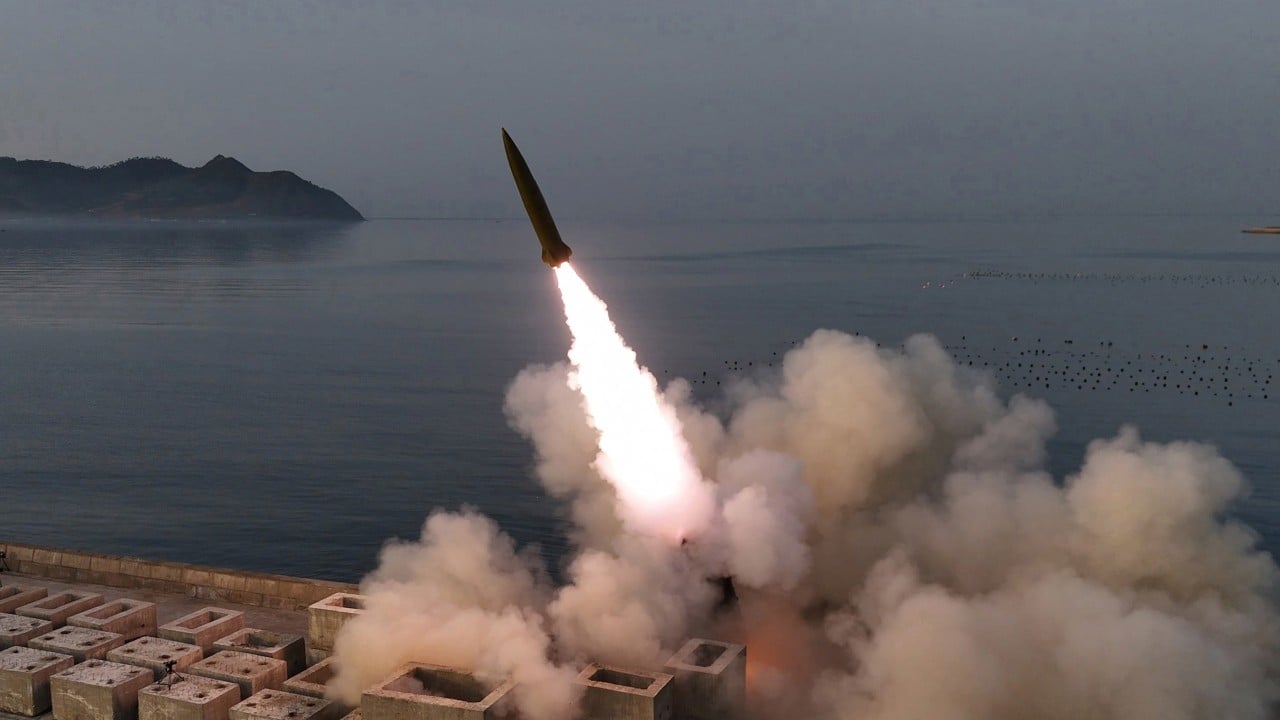
On Sunday, accompanied by his daughter Kim Ju-ae, he oversaw a test of cluster munitions during a ballistic missile launch.
According to state media, five missiles struck a target area about 136km (85 miles) away with “very high density”, demonstrating their combat capability.
Kim expressed “great satisfaction” with the test, calling it significant for enhancing both high-density and precision strike capabilities.