
A cautious reset in India-China relations is taking root, according to analysts, with the two rivals increasingly walling off their border disputes from expanding cooperation on trade, security and multilateral diplomacy.
The clearest marker yet came last week in New Delhi, where the two sides held their first-ever bilateral consultations focused exclusively on the Shanghai Cooperation Organisation (SCO), the Eurasian security bloc that also includes Russia, Iran, Pakistan and four Central Asian states.
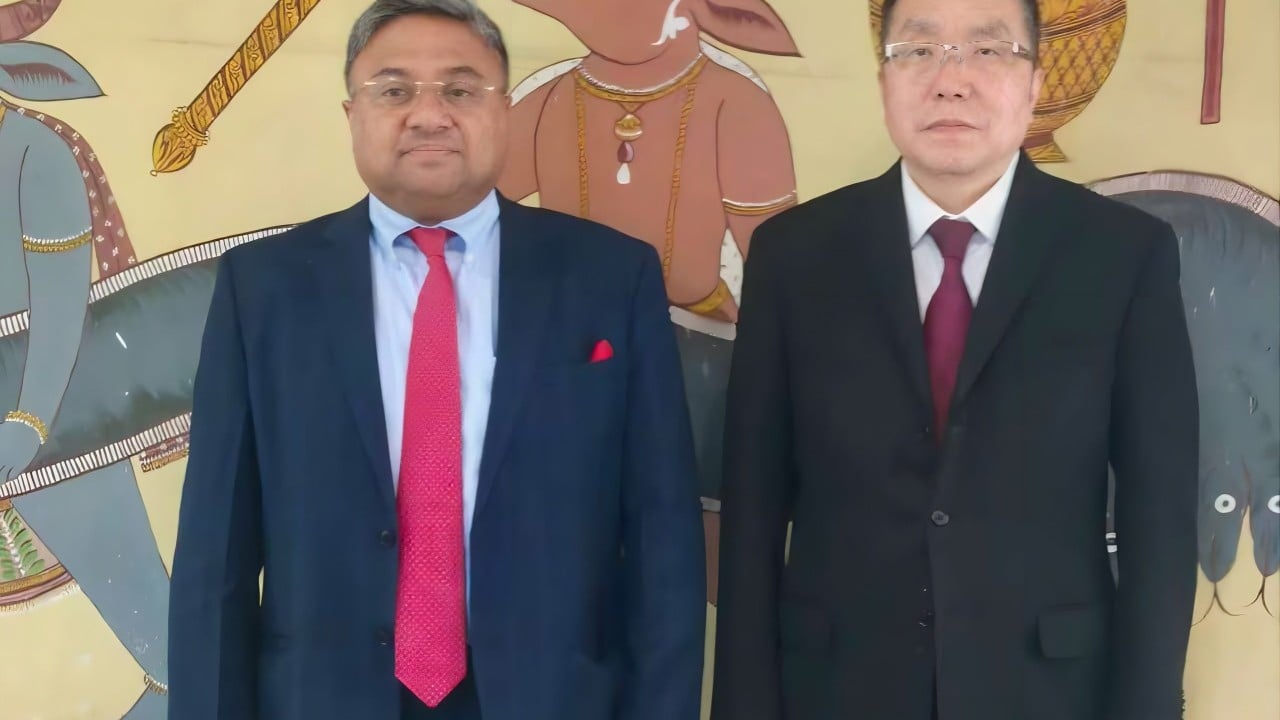
The two-day meeting was led by Alok Amitabh Dimri, India’s SCO national coordinator, and his Chinese counterpart Yan Wenbin. It is being read as the latest institutional step in a wider diplomatic reset that began in 2024 with the disengagement of Indian and Chinese troops from key friction points such as Depsang and Demchok along the Line of Actual Control, the two countries’ disputed 3,500km (2,175-mile) Himalayan border.
Atul Kumar, a fellow at the Delhi-based Observer Research Foundation’s strategic studies programme, said the SCO bilateral meeting signalled a compartmentalisation of India-China ties, with border disputes being decoupled from multilateral cooperation.
He said this shift allowed Delhi to engage in Eurasian security and trade talks without ceding ground to Beijing or Islamabad, even as it maintained its military posture along the border.
“While India refuses to endorse the Belt and Road Initiative, it remains keen on other cooperative avenues,” Kumar said. “Both nations are increasingly viewing a less hostile relationship as a hedge against Washington’s regional unpredictability.”
According to India’s Ministry of External Affairs, the two sides exchanged views on the implementation of SCO leaders’ decisions and the organisation’s future course, reviewed cooperation on security, trade, connectivity and people-to-people ties, and agreed to continue consultations.
Ambassador Yan Wenbin, the Chinese Government Special Representative on Shanghai Cooperation Organization (SCO) Affairs and China’s National Coordinator for SCO Affairs, visited India and held bilateral consultation on SCO matters with his Indian counterpart Ambassador Alok… pic.twitter.com/1naVnLGxaW
— Xu Feihong (@China_Amb_India) April 18, 2026
Even as the diplomatic track advances, nearly 60,000 troops from each side remain deployed along the Line of Actual Control: a legacy of clashes in Galwan Valley in 2020 – the deadliest border incident in 45 years – which led to the deaths of at least 20 Indian soldiers and four Chinese troops and triggered years of military commander-level talks before the disengagement in 2024.
India’s trade deficit with China has also ballooned despite its push for self-reliance, hitting a record high of more than US$112 billion in the 2025-26 financial year.
Analysts said India’s tougher post-Galwan stance – tying progress on trade and broader ties to resolving the border stand-off – ultimately pushed China towards de-escalation.
China realises that India is a huge market and a prolonged stalemate is financially hurting them
M.S. Prathibha, Indian analyst
“China realises that India is a huge market and a prolonged stalemate is financially hurting them,” said M.S. Prathibha, an associate fellow at the Institute for Defence Studies and Analyses, adding this had ultimately led to the 2024 border agreement.
“That is why, despite no bilateral engagements, communication channels were open on multilateral platforms like SCO and Brics.”
Saheli Chattaraj, an assistant professor of Chinese studies at Somaiya Vidyavihar University in Mumbai, said the resumption of structured SCO consultations reflected a “carefully calibrated and state-managed reset”, rather than a full normalisation.
Chinese policymakers and scholars had consistently framed ties in terms of gradual stabilisation, she said, pointing to President Xi Jinping’s SCO speech in Tianjin last year calling for “the dragon and the elephant dancing together”.
Academic writing from institutions such as the Chinese Academy of Social Sciences echoed that tone, she said, urging both sides to manage their differences while expanding consensus and handling thorny issues such as the boundary dispute separately from cooperation on trade, multilateral forums and regional security.
Chattaraj said the SCO meeting signalled “a slow but steady reset, but one that is deliberately cautious, reversible and bounded by enduring strategic mistrust”.
“In essence, it represents a return to managed coexistence,” she added.
Ivan Lidarev, a visiting research fellow at the National University of Singapore’s Institute of South Asian Studies who specialises in China-India relations, said the Dimri-Yan meeting hardly signified a reset on its own, but reflected “the growing momentum behind improving China-India relations and the revival of China-India cooperation within the SCO”.
“Delhi sought to use SCO to soft balance Beijing and even constrain the organisation’s development,” he said, adding that Indian Prime Minister Narendra Modi’s visit to the SCO summit in Tianjin last year “signified greater Indian involvement with the SCO” and “the Dimri-Yan meeting is a product of this greater Indian involvement”.
Lidarev said the agreements reached on the border and Chinese export restrictions during Chinese Foreign Minister Wang Yi’s visit to India played a key role in the thaw, and that Modi’s Tianjin visit marked the full restoration of normal relations between the two sides, opening the door to a new period of greater engagement.
“However, a complete reset between Delhi and Beijing requires a much greater and much more positive transformation of the relationship, as well as much greater mutual trust. None of the fundamental issues dividing the two sides has been resolved. The recent controversy about Beijing’s renaming of locations in disputed Arunachal Pradesh underscores this fact,” he said.
“Instead, the recent progress in China-India relations reflects a desire to move relations forward and make mutually beneficial economic and political gains while managing the underlying rivalry and the issues that drive it.”
On April 12, India reiterated its rejection of China’s attempts to assign “fictitious names to places which form part of the territory of India”, responding to Beijing’s establishment of a third new county in its Xinjiang region. Delhi’s foreign ministry described such moves as “mischievous”, warning that they “detract” from the ongoing normalisation process.
Lidarev said the growing international instability caused by US President Donald Trump and the “great damage” he had done to US-India relations, particularly last year, had pushed Delhi and Beijing closer together.
“The energy, economic and political crises caused by the Iran war have further incentivised both sides to keep their crucial relationship in good shape. India, in particular, needs better relations with China as the weaker party in this relationship, especially as its vital partnership with the US has been greatly strained,” he said.
“Moreover, Delhi has been hit much worse by the ongoing energy crisis and put in an uncomfortable diplomatic position by Pakistan’s emergence as a mediator in the Iran war.”