
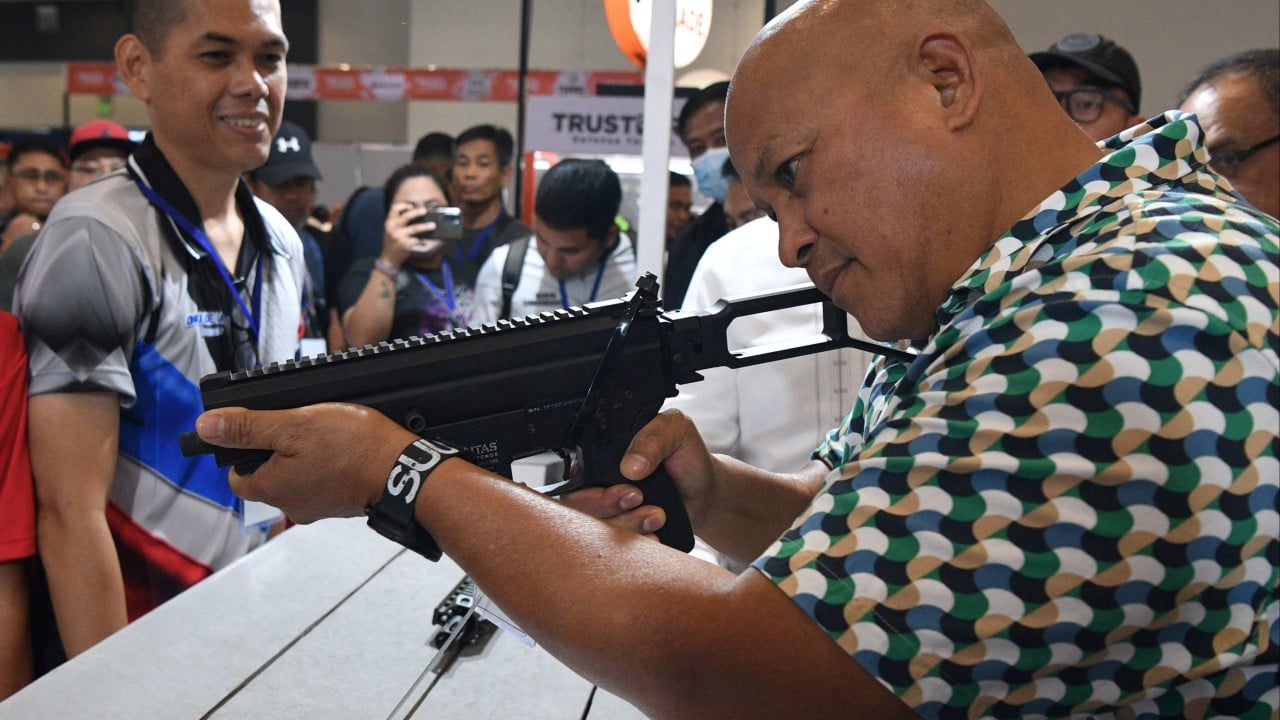
Ronald “Bato” Dela Rosa was once one of the most visible faces of Rodrigo Duterte’s deadly war on drugs, a tough-talking national police chief who was seen as the hatchet man carrying out the former Philippine president’s crackdown against alleged criminals of the narcotics trade.
Now a senator, Dela Rosa has somewhat fallen off the radar – for six months, he has not appeared for work after reports circulated that he could face arrest in connection with the International Criminal Court’s crimes against humanity case against Duterte.
Dela Rosa has, however, continued to receive his salary, prompting civil society groups and other critics to ask why an elected lawmaker can stay away from work and still be paid with public funds.
As chairman of the Senate Committee on National Defence and Security, Peace, Unification and Reconciliation, he was supposed to sponsor the 2026 budget of the Department of National Defence and the Armed Forces of the Philippines. The plenary process was delayed due to his absence.
This could also affect the impeachment trial of Vice-President Sara Duterte-Carpio, another close ally of his and the daughter of the former president, where senators are expected to sit as judges.
Dela Rosa, who was re-elected last year, has not appeared in the chamber since November 11, after reports circulated that he could be arrested as a “co-conspirator” in the ICC case against Duterte.
Last year, shortly after Duterte was arrested and flown to detention in The Hague, Dela Rosa said he was thinking of going into hiding.
In a report on March 25 last year, the Bilyonaryo news channel said the senator confided to reporters that he was trying out various disguises, including caps and jackets, to evade detection.
On April 23, the three-member pretrial chamber of the ICC named Dela Rosa among Duterte’s alleged co-perpetrators, saying the two men shared a “common plan” to “neutralise” alleged criminals in the Philippines through violent crimes, including murder.
The ICC said Dela Rosa was chief of the Davao City Police from January 2012 to October 2013, and chief of the Philippine National Police from July 2016 to April 2018, when the country was still under the court’s jurisdiction.
On April 26, Senator Panfilo Lacson said Dela Rosa was still receiving a monthly salary of 237,000 pesos (US$3,900). According to the Ibon Foundation, an economic think tank, the national average monthly minimum wage is 11,000 pesos.
Senators have mostly shrugged off public criticism of Dela Rosa’s absence for months.
Duterte’s former foreign secretary, Senator Alan Peter Cayetano, told reporters last month that Dela Rosa wanted to attend the Senate’s sessions. Defending Dela Rosa’s absence, Cayetano said: “What’s the problem? There’s a threat to him, that there’s no assurance the government will protect his rights.”
In March, Senate ethics committee chair J.V. Ejercito said that “you cannot find [absenteeism as a ground for sanctioning a senator] anywhere in our rules”.
Even as Dela Rosa remained absent from the Senate, he made one formal request through its offices.
According to Senate Secretary Mark Llandro Mendoza, Dela Rosa wrote to Senate President Vicente Sotto III on March 12 seeking permission for his family to use the Senate Mansion in Baguio City from March 26 to 29.
The request, which Sotto referred to Mendoza, said the mansion would be used to accommodate Dela Rosa’s family during the CSAFP Cup 2026, a shooting competition held in Baguio.
Mendoza said the request could not be granted because the mansion was undergoing repairs, and that official policy required a senator’s family to be accompanied by the senator when using the facility.
In February, a civil society group filed an ethics complaint against Dela Rosa.
According to the group Wag Kang KuCorrupt (Don’t Be Corrupt), “the continued failure of a sitting senator to report for work and perform the functions of his office constitutes not only a clear dereliction of duty, but also a grave abuse of the privilege entrusted to him by the Filipino people”.
Economics professor and former finance undersecretary Cielo Magno, a co-convenor of the group, said in an interview: “I think public sentiment is clear that the rules which apply to ordinary people should also apply to elected officials.”
She noted how “Senator Bato really has no official explanation for why he suddenly disappeared, so it’s tantamount to an abandonment of position, and for us there’s a clear violation of the ethical standards for government employees and public officials”.
One of the group’s officials, Barry Gutierrez, a law professor and former congressman, said in an interview that “more than anything else, the issue is a moral one”.
“Millions of Filipinos labour under a system that strips them of wages if they are absent from work. Why should an elected representative, paid from the public coffers, not be held to at least the same standard?” he said.
On Monday, Ejercito told reporters he had asked Dela Rosa to comment on a proposed amendment to the Upper House’s rules that would deny pay to absentee members.
“Maybe just to be fair, it would be good [for him] to sacrifice the allowance and salary specifically because [with] ordinary workers, it’s no work, no pay. It has to apply to all,” said Ejercito, adding that he had received assurances from Dela Rosa that he would voluntarily waive his pay during his absence.
Sotto did not reply to requests for comments when asked whether he would allow Dela Rosa to sit as a senator-judge via Zoom. The Senate president earlier said he would recommend to the ethics committee that it ask Dela Rosa’s views on the ethics complaint.
Since the Senate reconvened following the restoration of Congress in 1987, two senators have been given a slap on the wrist by the Senate ethics committee over statements they made, merely getting mild admonitions.
In another instance, Lacson, who went into hiding for 14 months from 2010 to 2011, even got away without censure.
According to Gutierrez, “regardless of the outcome in the ethics committee or on the Senate floor, this matter should be officially and publicly raised. If senators refuse to act on it, then voters should take that into consideration the next time those involved run for re-election.”
He said past similar cases in which errant senators escaped punishment should not be the basis for proceedings now. “Rather, previous inaction should be a challenge for this Senate to do better,” he added.
Ejercito, however, pointed out one potential hitch: even if the Senate wanted to amend the ethics rules, all senators have to be physically present to vote on it, including Dela Rosa.
“We can never expect Bato to vote in favour of something that will penalise him, right?” Magno said.
Even if Dela Rosa were to waive his salary, Magno said her group believed “this has to be institutionalised, it cannot be done voluntarily”.
The economist said “now there’s greater demand for our legislators to be accountable to the public. So even if before, they were just blatantly doing it, now we want stricter policies so that the position is not abused”.