
For decades, the Strait of Hormuz has been a narrow passage with a big footprint. Whenever it comes under tension, the world is reminded that energy security is less a policy construct than an everyday reality for Asia’s economies, factories and prices. For China, Japan, South Korea, India and Southeast Asia, it has always been more than just a Middle Eastern problem. It is an Asian economic issue.
This is why we should not interpret the latest Gulf tensions solely in terms of naval forces, sanctions and deterrence. Rather, it is a question of whether Asia can rely on a security regime in which oil supplies are vulnerable to political disruption and the world’s largest energy producers and consumers have little sway over escalation.
For China and the Gulf states, there should be a more ambitious energy deal: one that maintains a stable oil trade but eventually brings the cooperation focus back to renewables, storage, electric vehicles, industrial localisation and green finance.
China and the Arab world are ready for such a transition. In 2024, China-Arab trade reached US$407.4 billion, making China the Arab world’s largest trading partner. Last year, China’s trade with Arab League nations hit a record high of US$241.6 billion in the first seven months. No longer based solely on oil, China-Arab relations now include infrastructure, information technology, ports and logistics, manufacturing and even green energy.
Gulf states have incentive to speed up this shift. Saudi Arabia, the United Arab Emirates and others are looking to diversify their economies from oil, attract hi-tech manufacturing and position themselves for a future where oil and gas no longer underpin national development.
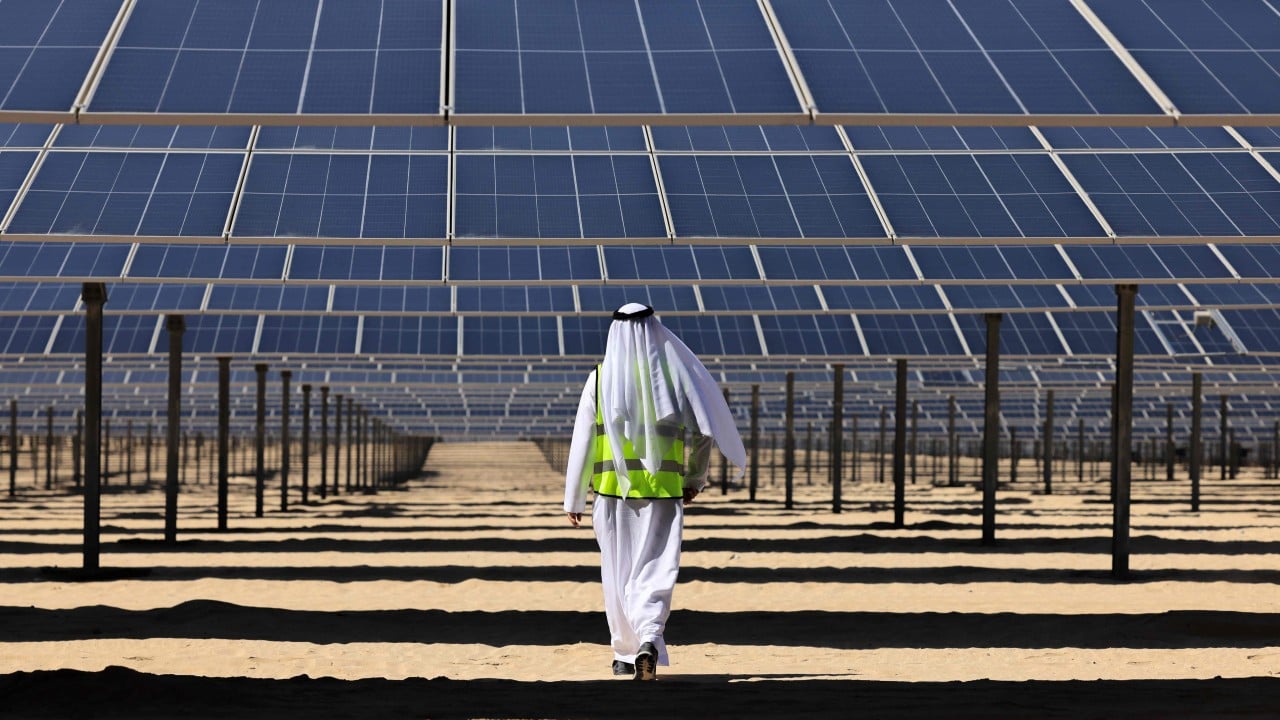
China is a key player in solar panels, batteries, electric vehicles and grid technologies. The International Energy Agency estimates global spending on electricity generation at US$1.5 trillion last year, some 50 per cent greater than investment in oil, natural gas and coal supply combined. This is a power shift in global energy.
For China, the takeaway is not that it should take America’s place as the Gulf’s defence contractor. This would be expensive, dangerous and contrary to China’s focus on economic engagement. Rather, China should help diminish the importance of the chokepoint. Each photovoltaic array, battery manufacturing plant, hydrogen project, smart grid and electric vehicle supply chain created between China and the Gulf helps reduce the strategic importance of oil routes.
This is not to say oil will be eliminated from China-Gulf relations. It will be crucial for decades. But the political significance of energy relations can evolve. A partnership premised on oil imports can be fragile. A relationship built around oil, renewables, industrial parks, technology transfer, port connectivity and local jobs is more stable. It gives the Gulf states a greater presence in the industries of the future and allows China greater access to the markets and partners of the future.
The much-mooted China-Gulf Cooperation Council free-trade agreement, under negotiation since 2004, should be seen in this light. China recently implored the Gulf states to finalise the agreement amid challenges to free trade in an increasingly protectionist world. Beyond eliminating tariffs, the agreement should be a stepping stone to the next phase of China-Gulf cooperation, with clear provisions relating to renewable energy, digital trade, green standards, investment protection, industrial localisation and supply chain security.
Here, Hong Kong can play a part. As China’s most international financial centre, Hong Kong can link Gulf finance with Asia’s green projects. Gulf sovereign wealth funds seek long-term investments other than in oil and gas. Chinese companies need capital, legal certainty and growth platforms. Hong Kong can offer a platform for green bonds, infrastructure finance, dispute resolution and other services to support China-Middle East partnerships. This would give the city a role in one of the key economic corridors of the 2020s.
The challenge is political language. Middle East discussions are often framed as US vs China. Gulf states do not want to be dependent on one country over another. They want strategic flexibility. China needs to realise this. Its strength in the region is not about getting countries to take sides. It comes from providing development skills, infrastructure know-how, manufacturing know-how and diplomatic language that affirms sovereignty.
This is why China shouldn’t overreach. China cannot fix all problems in the Middle East, nor should it take more than it can deliver. But it can help de-escalate, promote economic integration and contribute to viable energy alternatives. The China-brokered peace deal between Saudi Arabia and Iran showed Beijing’s ability to help when players are open to dialogue. The next move is not high-profile diplomacy everywhere, but low-key institution-building in commerce, energy and development.
The Strait of Hormuz will be a critical chokepoint. No slogan will change geography. But policy can change vulnerability. If China and the Gulf states treat the moment as a chance to talk about oil security, they will have missed the point. If they use it to propel a strategic energy and industrial relationship, they can make vulnerability a stepping stone to sustainability.
This has profound implications for Asia. Energy security will be determined not just by who has the navy. It will also be determined by who develops the technologies, funds the projects and sets trade rules in a post-oil world. China and the Gulf have the resources, markets and strategic interests to build this. The Strait of Hormuz should be a reminder to build a new energy order before the next crisis.