
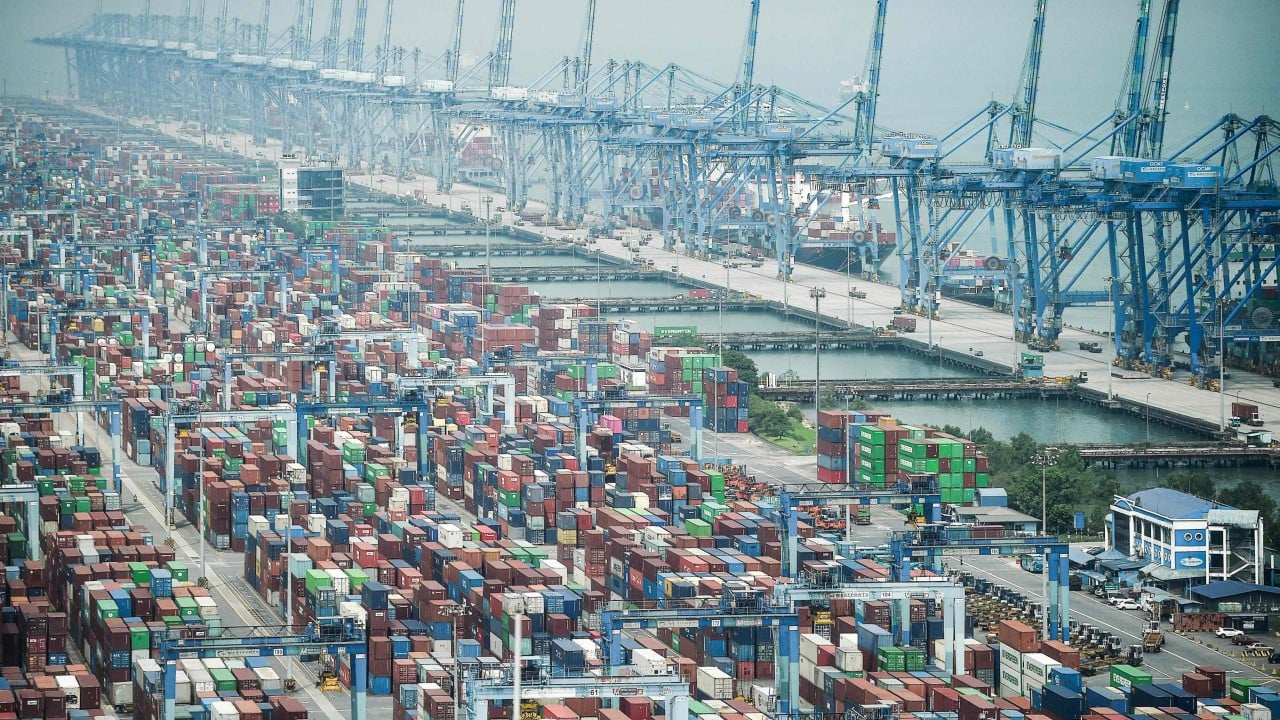
Malaysia’s busiest container port has started refusing Middle East-bound cargo unless shipping lines can guarantee prompt pickup, in one of the clearest signs yet that the Gulf crisis is working its way past oil and into the everyday trade that moves across Asia.
Longer transit times, missed sailings and sharply higher insurance premiums are now rippling across the region’s logistics chain, with wine, spirits and other time-sensitive goods acting as an early indicator of disruption that analysts say will eventually push up prices on shop shelves and restaurant tables.
The Strait of Hormuz has been largely shut since late February, when the US and Israeli war on Iran triggered a blockade that brought shipping through the waterway to a near standstill.
The narrow waterway between Iran and Oman is the only sea route out of the Persian Gulf and normally carries about a quarter of the world’s seaborne oil, along with a fifth of its liquefied natural gas.
A brief reopening earlier this month collapsed on Saturday, when Iran re-closed the strait in response to a US naval blockade of Iranian ports.
The strain is already visible at the logistics level.
Olivier Daull, chief executive of Hillebrand Gori Asia-Pacific, said congestion in Singapore and Malaysia’s Tanjung Pelepas and Port Klang remained a challenge as Middle East cargo was diverted through the same hubs used by time-sensitive exports from Australia and New Zealand.
Daull said this was creating a “congestion multiplier”, resulting in longer vessel queues and mounting scheduling pressure across multiple trade lanes.
“Longer transit times and missed connections are increasingly common as transshipment hubs struggle with congestion,” he said. “Costs are also rising sharply, with emergency fuel surcharges already lifting freight rates, and now peak season surcharges are being introduced across key export lanes.”
A veteran in the alcoholic beverages industry based in Malaysia, who asked not to be named to protect business relationships, said the Gulf disruption was already being felt across the industry.
The executive, who has worked in the sector since the early 1990s, said shipping times had lengthened and freight costs had risen, making deliveries harder to predict and inventory planning more difficult.
“We’re trying to keep things as normal as possible, and we hope this turns out to be a short-term disruption rather than a prolonged one,” he said.
Wine and spirits have long served as an early warning system for global shipping stress, experts say. The category moves almost entirely in containers rather than on bulk tankers, placing it in the same transshipment queues as everyday consumer goods, and tight festive delivery windows leave little room to absorb delays.
Malaysian port operators are already adjusting, turning away Middle East-bound containers to avoid clogging up storage yards.
Westports Holdings Berhad in Port Klang, which has an annual capacity of 14 million TEUs (20-foot equivalent units), has been feeling the strain from wider regional congestion since December, according to group managing director Eddie Lee.
Lee said Westports had begun rejecting ad hoc vessel calls, especially for Middle East-bound boxes, unless carriers could confirm prompt cargo pickup.
“A year ago, we would have said yes because this is additional revenue, but recently we have prioritised our regular customers,” he said.
He said congestion elsewhere in Southeast Asia, particularly in Singapore, had started to spill over into Port Klang.
To avoid backlogs and overcrowded yards, some vessels were being turned away.
“When our yard is congested, everything slows down, and productivity is affected, which then hits vessel turnaround,” he said.
Beyond delays, Lee said port operators were also facing higher operating costs as uncertainty and rising energy prices fed through the system.
Port equipment still relied heavily on diesel, he said, leaving terminal operators exposed to any jump in fuel prices linked to the Gulf crisis.
“Contractor costs and overall energy prices have gone up, and this is the biggest challenge for all terminal operators in the region,” he said.
Marco Tieman, chief executive of LBB International, a supply chain strategy consultancy and research firm, said oil was not only an energy source but also an input in many industrial and consumer products, meaning higher prices could quickly feed into inflation.
“The first warning sign is usually higher transport costs, followed by rising raw material prices and, eventually, more expensive consumer products,” Tieman said.
“With 80 per cent of global trade moving by sea, the disruption will not be limited to wine and spirits. It will affect a much wider range of goods.”
Higher risks, higher premiums
Insurance costs are also rising. Marsh Asia says war-risk premiums now range from 3 to 5 per cent of insured value, depending on cargo type and vessel profile, with overall costs also shaped by whether ships can still be chartered at viable rates.
Michael Walls, managing director and head of marine, cargo and logistics at the insurance broker and risk adviser, said with the Strait of Hormuz affected, the wide premium variability also required conditions linked to vessel nationality, ownership structure, cargo type and Iranian clearance requirements.
“Cargo insurance is increasingly conditional, requiring advance disclosure of cargo, charterers and insurance details before underwriters will confirm cover.”
Walls said time-sensitive and high-value cargo insurance could become a major factor in routing, sourcing and inventory decisions.
Premkumar Rajagopal, professor of supply chain and president of Malaysia University of Science and Technology, said the disruption translated into higher costs for importers and producers much faster than for consumers.
“Importers tend to feel the impact almost immediately, as higher surcharges and freight rates quickly push up the cost of bringing goods into the country,” he said.
The disruption is exposing how vulnerable much of Southeast Asia remains to external shocks, with several economies heavily reliant on trade and the smooth movement of goods, according to geopolitical analysts.
Jaideep Singh, an analyst at the Institute of Strategic and International Studies Malaysia, said the war in Iran was affecting Southeast Asia mainly through energy and supply-chain shocks, especially given the region’s heavy reliance on trade and the movement of goods.
“The broader damage would come if disruption persisted for months as higher raw material costs and weaker demand started feeding through more sectors,” he said.