
Chinese Big Tech firms from Huawei Technologies’ spin-off Honor to Alibaba Group Holding are moving to the forefront of the country’s robotics push as Beijing seeks to spur growth in the sector.
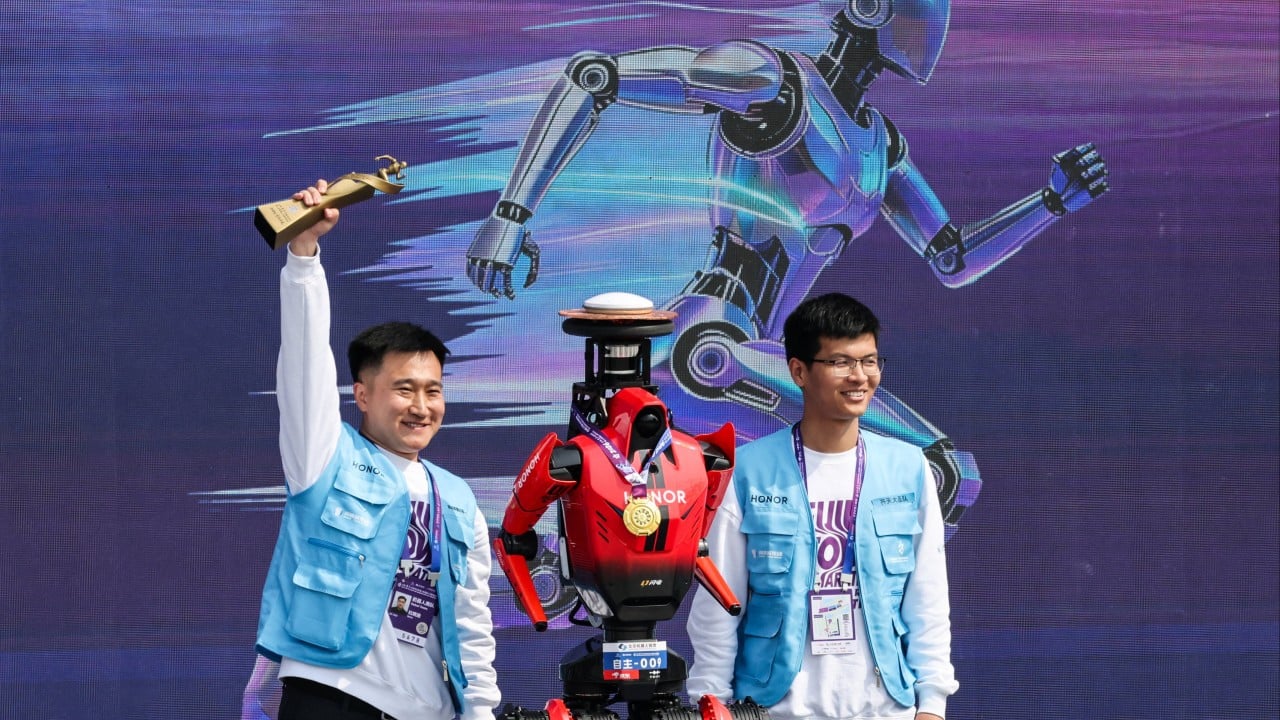
Honor, which separated from Huawei in 2020 to focus on smartphones and wearables and only expanded into robotics last year, emerged as the surprise gold medal winner at the second Beijing humanoid half-marathon on Sunday, besting the country’s robotics darlings from Unitree to X-Humanoid.
Its Lightning humanoid model crossed the finish line in 50 minutes and 26 seconds, eclipsing the human world record of 57:20 set by Ugandan Jacob Kiplimo.
The performance underscores how Chinese tech companies are jumping on the robotics bandwagon. While not competing in the race, Chinese e-commerce behemoth Alibaba’s online mapping unit Amap debuted a quadruped robot called Tutu, capable of navigating open fields autonomously.
Du Xiaodi, an engineer from the winning team, credited Lightning’s success to structural durability, self-developed electric motors and advanced liquid cooling systems adapted from smartphone technology. He added that while the country’s robotics industry was still at an early stage, its growth would drive advances in other sectors such as manufacturing.
The half-marathon champion model would be deployed across Honor’s offline retail shops to help sell smartphones and “improve retail efficiency”, Du said.
Lightning’s finish was faster than last year’s winning time of two hours and 40 minutes by a Tiangong model from the Beijing Humanoid Robot Innovation Center, underscoring the rapid progress in the sector over the past year.
Amap’s robotic dog is equipped with sensors, cameras and in-house AI models, including ABot-M0 and ABot-N0, which act as its “brain” and “legs”. These enable it to understand commands and execute complex tasks autonomously.
The Alibaba unit touted its potential as a robotic guide dog to address the severe shortage in China, where there were some 17 million visually impaired people but only 400 active guide dogs, the company said in a statement. Alibaba owns the South China Morning Post.
Tutu’s debut came days after arch rival JD.com announced plans to build an “embodied intelligence supply chain” to help the robotics industry address data shortages.
Industry experts said the advancements were driven by policy and investment support, as well as breakthroughs in artificial intelligence. Liu Xiangquan, a robotics professor at Beijing Information Science and Technology University, said local governments had rushed to back the sector as a strategic priority.
A surge of investments and advances in AI models, which are boosting robots’ perception and decision-making, has also contributed to the sector’s growth.
Cai Jizheng, head of the Robotics and Smart Manufacturing Industry Bureau of the Beijing Economic-Technological Development Area, also known as Beijing E-Town, said the district government viewed robotics as a key industry and had pledged comprehensive services and an ecosystem to support firms setting up in the area.
“We aim to create a very favourable ecosystem for our robotics companies,” Cai said.