
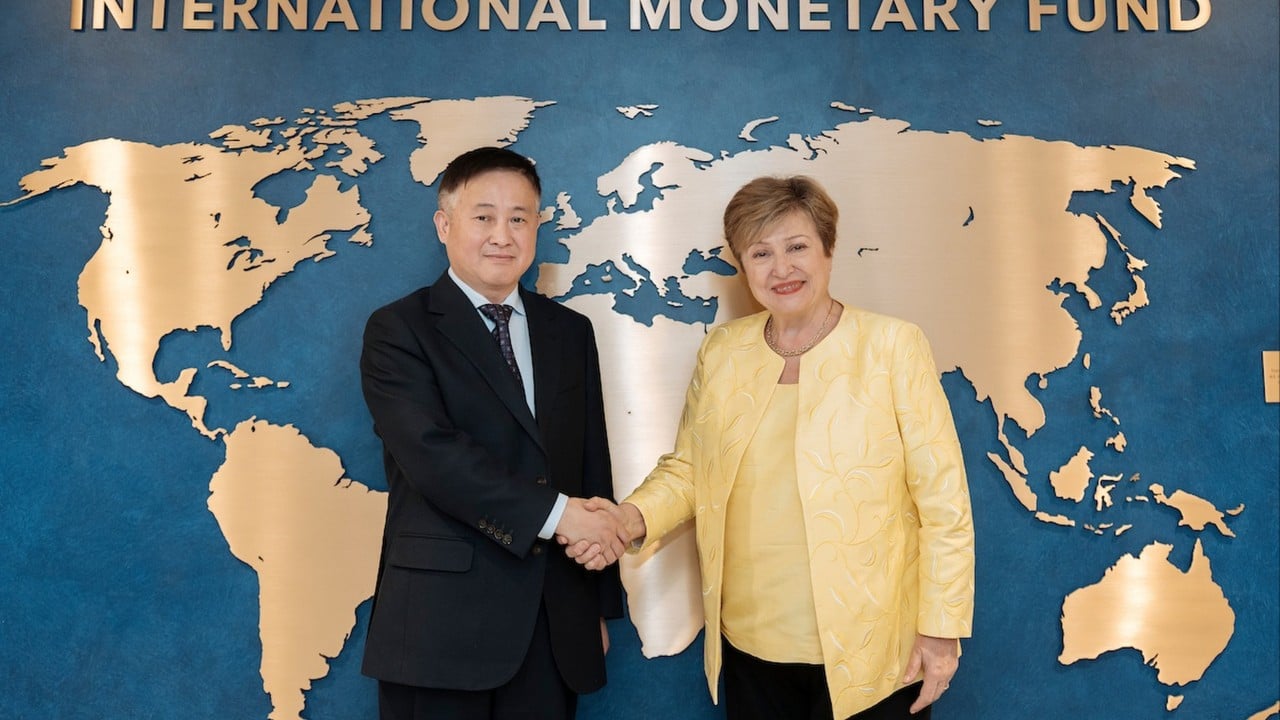
China’s central bank chief has urged the IMF to serve as a bulwark against “rising unilateralism”, at a time when escalating trade restrictions and an intensified Middle East conflict threaten energy and food security.
The International Monetary Fund should “take a clear stand against protectionism and defend multilateralism”, People’s Bank of China governor Pan Gongsheng said in a statement to the fund’s International Monetary and Financial Committee, for its 53rd meeting, held on Thursday and Friday in Washington.
“The recent intensification of geopolitical conflicts has further dragged down global economic growth, exacerbated volatility in financial markets and undermined global financial stability,” Pan said.
Pan said China wants the IMF to strengthen surveillance of budgetary risks facing “major advanced economies”, and of the spillover effects of those risks.
“It should be emphasised that trade protectionism cannot resolve global imbalances, and that stable, rational and predictable cooperation is extremely valuable,” his statement showed.
Pan’s voice joins a growing chorus of concerns about the global economy amid the US-Israeli war on Iran and an intensifying energy crisis. Since February 28, military strikes have effectively closed the Strait of Hormuz, through which transits about one-fifth of the world’s oil and liquefied natural gas. The resulting price spikes and supply shortages are expected to disproportionately hurt developing countries without strategic fuel reserves.
I think it’s unlikely they’re going to do anything drastic
Liang Yan, Willamette University
On the trade front, US tariffs like those imposed across most of the world last year could continue to pose a risk, as President Donald Trump in February was exploring new ways to raise them, and many of Washington’s tariff-reduction deals with individual countries are temporary.
The IMF should “provide tailored policy recommendations in response to mounting risks, promote stronger communication and coordination on macroeconomic policies among member countries, and safeguard global economic and financial stability”, Pan said.
The IMF was also asked to complete a quota-share realignment as soon as possible to “reflect the relative weights of its members in the global economy and to strengthen the representation of emerging-market and developing countries”.
IMF rules assign quotas to the 191 member countries to determine each one’s financial contributions, voting rights and access to funding. Quota sizes are based on each member’s relative economic size as determined by international reserves, gross domestic product and other criteria.
Changing quotas takes an 85 per cent majority of the IMF Board of Governors, and the US has about 17 per cent of the votes.
Because of the US’ especially large quota, China may find it tough to compel the IMF to take Pan’s suggested course of action, said Liang Yan, a professor of economics at Willamette University in the US.
Last year, Chinese leaders accused the US of protectionism and unilateralism as Trump’s tariffs rose sharply.
“It’s definitely very difficult, because the US is the largest contributor to the IMF in terms of the quota, and the US Treasury has a lot of say in how it works,” Liang said. “I think it’s unlikely they’re going to do anything drastic.”
China may hope such speeches “rally Global South support” within the IMF membership, Liang speculated.