
Asia’s governments have spent years promising to protect the seas that feed their people, shelter their coasts and support some of the world’s richest marine life.
World Ocean Day on Monday will put those promises back in the public spotlight, but the more consequential test will come days later in Mombasa, Kenya, where governments, donors, companies and conservation groups will gather for the 11th annual Our Ocean Conference from June 16 to 18.
The conference has become a key stage for global ocean diplomacy: countries and organisations use it to announce new pledges regarding marine protection, pollution, fisheries and climate-finance pledges, while past commitments are expected to be tracked through annual progress reporting.
Ocean policy specialists and conservation advocates said this year’s question for Asia was not whether leaders could produce more promises, but whether they could turn a growing stack of commitments into funded, enforceable protection before warming seas, illegal fishing, plastic pollution and coastal development further eroded marine ecosystems.
The credibility test is becoming more urgent as governments across the region move beyond traditional conservation pledges into more complex commitments tied to blue carbon, carbon markets and national development plans.
“Ambition still runs way ahead of delivery,” said Kim Gabrielli, CEO of Worldview International Foundation (WIF), which works on mangrove restoration and blue carbon projects in Asia.
“Moving from dialogue to delivery is on everybody’s lips ahead of the Our Ocean Conference. Asia is the heart of that gap.”
Gabrielli said while Asian governments’ pledges were real and finance was starting to move, progress remained too slow, pointing to Indonesia’s flagship pledge to restore 600,000 hectares of mangroves as an example.
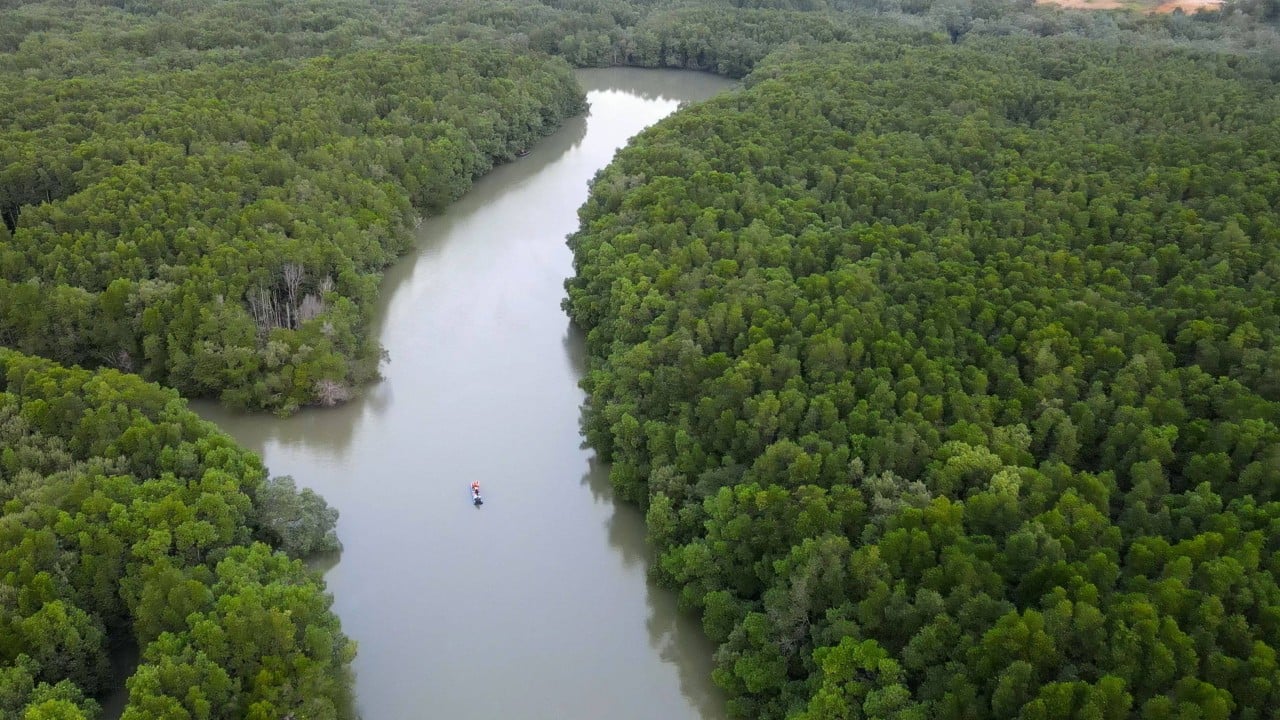
Mangroves are central to the region’s ocean agenda because they protect coastlines, support fisheries and store large amounts of carbon in their roots and surrounding soil.
That stored carbon is known as blue carbon, a term used for carbon absorbed and held by coastal and marine ecosystems such as mangrove forests, seagrass meadows and tidal marshes.
As governments and investors look for nature-based climate solutions, restored mangroves can also be turned into carbon credits – making them potential financial assets as well as ecological buffers.
While only about 150,000 hectares had been restored by the end of 2024, Gabrielli said Indonesia had launched 17 blue carbon sites aimed at speeding up implementation.
“The ambition was never the problem – slow governance and delivery were,” he said.
In Malaysia, WIF is working on planting the first-ever blue carbon project in Sarawak.
Gabrielli said for countries such as Indonesia and Malaysia, where pledges were made nationally, decisions over coastlines, land and permits were managed at the state level, and the two rarely moved quickly together.
The same delivery gap shapes the wider ocean agenda in Asia, where governments are moving towards more complex promises tied to finance, carbon markets and national development plans.
The 2025 Our Ocean Conference produced more than 260 commitments worth US$9.1 billion, including South Korea’s US$2.65 billion Korea Blue Action Plan that aimed to expand the country’s role in marine protection and sustainable ocean management.
Tom Pickerell, global director of the Ocean Programme at the World Resources Institute, said such pledges would be judged by implementation rather than symbolism.
One test will be South Korea’s entry into the 100 Per Cent Alliance, a global initiative that asks coastal and ocean states to sustainably manage all waters under their national jurisdiction by 2030.
South Korea was one of the first two countries to join the alliance at the UN Ocean Conference last year, committing to develop a Sustainable Ocean Plan – essentially a national road map for balancing ocean protection, economic use and climate goals.
“Implementation will be critical, ensuring that all ocean stakeholders are aligned,” Pickerell said.
“The Our Ocean Conference is an important mechanism for this – all commitment-makers are asked to provide transparent, accurate progress reporting on the status of their commitments on an annual basis.”
He said momentum on ocean pledges had grown significantly across Asia over the past decade, but while those commitments were real, they were only partially matched by the financing flows and governance systems needed to deliver them at scale.
A recent World Resources Institute stocktake of 10 years of Our Ocean Conference commitments showed that, globally, ocean actors had pledged about US$160 billion since 2014, yet only US$23.8 billion had been fully disbursed.
Across Asia, governments have pursued global targets such as protecting 30 per cent of the ocean by 2030, while marine protected areas have become a central pillar of national ocean commitments.
However, experts said this segment was the least well-funded area of ocean action, receiving only US$6.7 billion in pledged finance.
“This points to a structural issue that is particularly visible in Asia because governments are often able to announce new protected areas, but far less able to finance their effective management, enforcement and long-term sustainability,” Pickerell said.
For blue carbon projects, the credibility test is not only whether pledges are funded, tracked or reported, but also whether the push to turn coastal ecosystems into climate assets protects the coastal communities that depend on the sea for survival.
Stephanie Juwana, programme director at the Indonesia Ocean Justice Initiative, said Jakarta was moving in the right direction by revising regulations to support high-integrity carbon credits, but gaps remained.
She warned of risks if blue carbon projects moved ahead before regulatory systems, safeguards, monitoring and enforcement mechanisms were fully established.
“Effective monitoring, accountability and safeguards would ultimately determine whether the system was credible,” she said.