
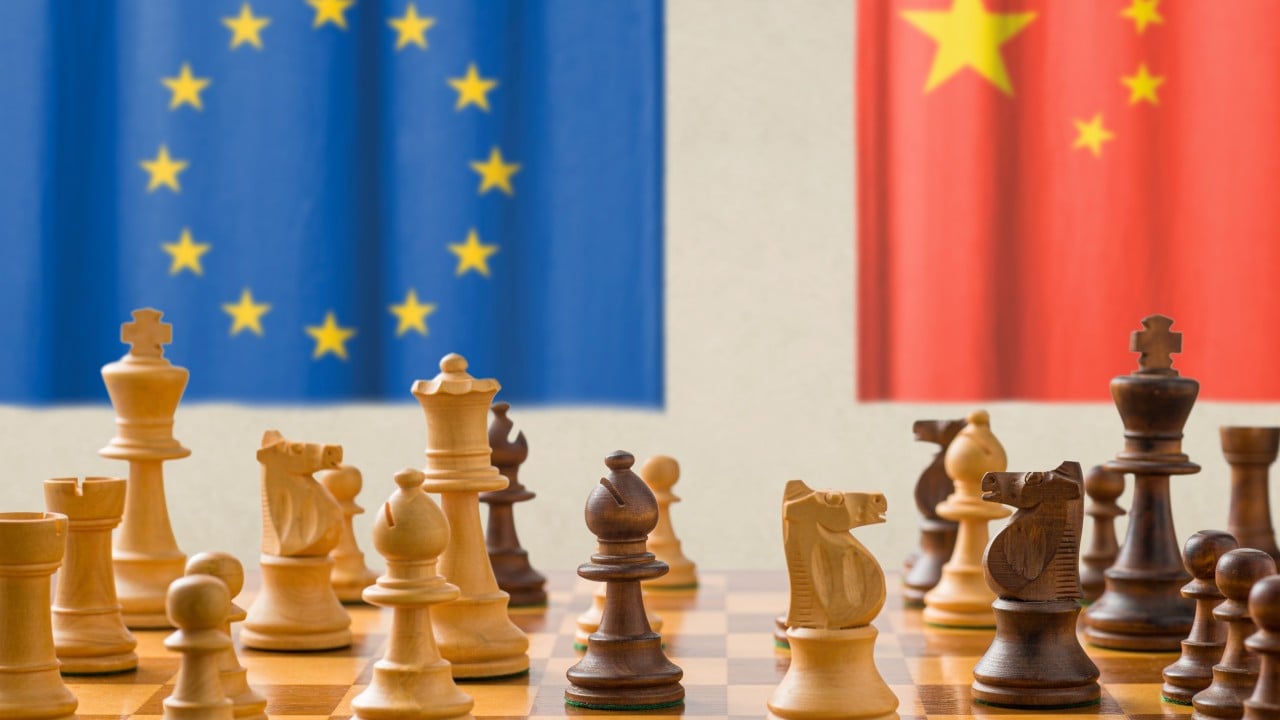
The EU’s trade chief has confirmed publicly for the first time that the bloc is considering a specific rule to compel companies to diversify their suppliers, as Europe looks to unwind its dependencies on China.
“Diversification now requires a dedicated instrument,” commissioner for trade and economic security Maros Sefcovic said on Friday, adding that he would model it on the manner in which the EU reduced its reliance on Russian energy following its invasion of Ukraine in 2022.
“Recent industrial cases, in particular supplies of chips and rare earths, have reinforced my conviction that a step change is necessary. We understand the urgency for critical minerals, but every high-risk sector must be weaned off single-supplier dependence,” Sefcovic said, in a speech at the Brussels Economic Security Forum.
The remarks appeared to allude to Beijing’s export controls on critical minerals and semiconductors amid a China-US trade war and a dispute with Netherlands-based chipmaker Nexperia last year. Each round of controls brought parts of European industry to the brink of pausing production.
The Slovakian official said he would bring his recommendations to the European Council meeting of EU national leaders on June 18 and 19.
“What you can expect from us is that we kind of mapped out the situation, and I would say the assessment of the overall relationship with China will be presented to the 27 heads of state and government, and I believe that after that we will get political guidance on what concrete tools we should focus on,” Sefcovic said.
He acknowledged that certain elements of other policy proposals, including the Industrial Accelerator Act proposed earlier this year, might assist with the diversification drive.
In comments to reporters on the sidelines of the event – including the South China Morning Post – he said that the introduction of a separate legal instrument had not yet been fully confirmed, adding that he would prefer that companies have at least three suppliers.
When it briefs member states at the leaders’ meeting, the European Commission is expected to promote the more frequent use of safeguard measures when imports surge.
Speaking at the same forum on Thursday, chief trade enforcement officer Denis Redonnet said “traditional trade instruments will inevitably, at some point, reach their limit,” referring to anti-dumping and anti-subsidy probes.
He said these “tend to be product-specific [and] narrow in scope, whereas some distortions are affecting entire segments of value chains” and that they “come late as a remedy in the cycle of distortions”.
Safeguards, on the other hand, can be used to target broader sectors and can be in place about twice as quickly as the other measures.
The month ahead could prove to be a decisive one for the future of the relationship, as the EU looks to tackle what it sees as a “China shock” to its industry, while simultaneously ramping up engagement with Beijing to avoid further descent into trade war.
Last week, the EU’s 27 commissioners backed a more assertive path forward on China policy, as the union looks to tackle the impact on the European manufacturing sector of the Asian giant’s industrial overcapacity and state subsidies.
This week, the Organisation for Economic Co-operation and Development estimated that China’s subsidies were three to eight times higher between 2005 and 2024 than those of the organisation’s wealthy member states.
At the leaders’ summit, European Commission President Ursula von der Leyen will present a range of scenarios for a spiralling trade dispute with China, and possible tools the bloc could deploy as it steps up its trade action.
Before that, she will coordinate with the United States and other rich countries at the Group of 7 meeting in Evian, France, where the agenda will focus on “macroeconomic imbalances”. The spillover effects of China’s manufacturing surplus, the US’ overinvestment and Europe’s chronic underinvestment will be discussed.
Beijing has threatened to retaliate against a range of EU proposals designed to bolster the bloc’s industry and shore up security concerns, many of which will affect Chinese firms directly. These include the Industrial Accelerator Act, which contains “Made in Europe” provisions and a cybersecurity act that would eventually ban Chinese firms including Huawei and ZTE from key hi-tech sectors.
Behind the scenes, the European Commission has been gaming out escalatory scenarios in seminars, as it looks to assess how it could counterpunch against Beijing’s expected retaliation. This is in line with the EU’s economic security planning, through which it has been identifying levers and chokepoints that can be weaponised against its trade rivals.
But while Brussels is increasingly determined to take firm action against what it sees as the market-distorting impact of China’s economic policies, its leadership is equally eager to manage the differences carefully through diplomatic engagement – even if senior sources are doubtful that Beijing is likely to cede any ground in negotiations.
On Thursday, Sefcovic met with Chinese trade envoy Li Chenggang on the sidelines of an OECD conference in Paris, the first of several face-to-face engagements between the sides in June. Commerce Minister Wang Wentao is expected in the Belgian capital on June 28 and 29. Wang’s deputy minister overseeing Europe, Ling Ji, will meet the EU’s new director general for trade, Ditte Juul Jorgensen, on June 9, EU sources confirmed.
On Thursday in Paris, Sefcovic confirmed that technical teams from each side would travel to prepare for “concrete outcomes” at the ministerial summit.
There is an awareness in Brussels of how challenging it will be to unpick some of the bloc’s dependencies on China, a fact emphasised by an item on the agenda for an ambassadors’ meeting on Friday.
Envoys planned to discuss the removal of Chinese chipmaker Yangzhou Yangjie Electronics from a list of firms sanctioned over their alleged support for the Russian military in its invasion of Ukraine. Multiple sources said there was expected to be at least a partial relaxation of restrictions after carmakers complained that they were running low on chips and needed access to the company’s products.
mo
w
ir
t
me
Z
d
a
J
s”
ba
needed access to the company.