
Taiwan’s main opposition leader said cross-strait peace can be maintained as long as Taipei did not move towards “de jure independence”, during her trip in the United States.
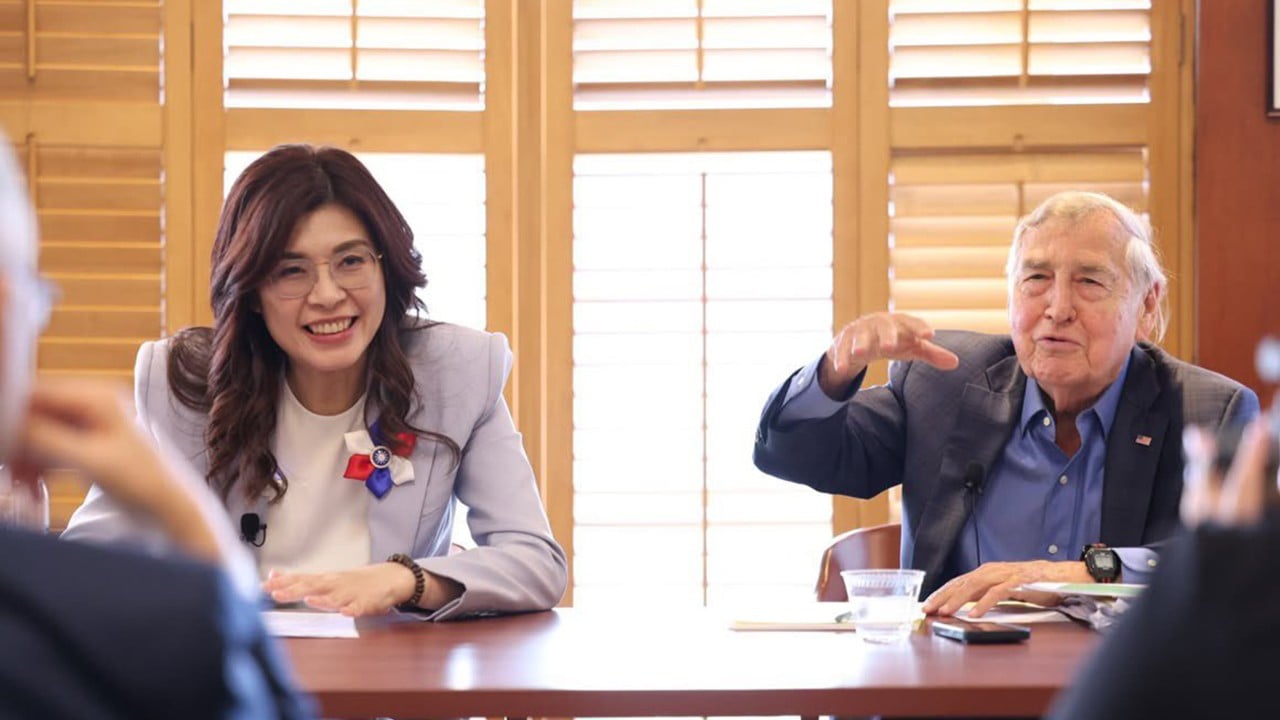
Cheng Li-wun, chairwoman of the Kuomintang (KMT), attended a closed-door seminar at Harvard University’s John F. Kennedy School of Government on Thursday, according to a KMT statement on Friday.
Cheng told the seminar that peace and stability across the Taiwan Strait, which she described as the greatest common denominator with US and regional interests, could be sustained “as long as Taiwan does not cross the red line of ‘de jure independence’”, a KMT statement said.
A “credible military deterrent” and “a smooth and sincere framework for dialogue” were both important to preventing conflict, Cheng added, according to the statement.
Beijing views Taiwan as part of China to be reunited with the mainland, by force if necessary. Most countries, including the US, do not recognise Taiwan as an independent state, but Washington opposes any attempt to change the status quo by force and is committed to supplying the island with defensive weapons.
“De jure independence” usually refers to using legal means to assert, explicitly or implicitly, that Taiwan and mainland China are two separate countries.
In January, Taiwan’s ruling Democratic Progressive Party (DPP) floated renaming a cross-strait law the “Taiwan and the People’s Republic of China (PRC) Relations Act” instead of the current name referring to mainland China as “the Mainland Area”.
DPP lawmakers withdrew it after Beijing labelled the proposal as an attempt at “de jure independence” and warned it would heighten the risk of war.
In Friday’s statement, the KMT said Cheng had used Thursday’s Kennedy School seminar to criticise the DPP administration’s special defence budget as a “black-box budget” that could not deliver real defensive capability for Taiwan.
Cheng said the KMT would continue to oppose the budget.
Washington has repeatedly called on Taipei to largely increase its defence spending.
Cheng has shown some flexibility on the issue, backing a scaled-down special budget – a move many analysts attribute to pressure from Washington – and arguing that individual US arms deals should be handled case by case.
In early May, the KMT and the smaller opposition Taiwan People’s Party backed a NT$780 billion (US$24.69 billion) special defence budget, far below the NT$1.25 trillion proposed by the DPP but more than double the baseline Cheng had earlier put forward.
The Thursday seminar was moderated by Graham Allison, founding dean of the Kennedy School, and attended by its students.
The KMT statement quoted Allison as saying that the Taiwan Strait would face “catastrophe” without a foundation of peace.
Allison is famous for the “Thucydides Trap” theory that a rising power and an established hegemony are destined for war.
The theory has gained notable attention over the years among Chinese leadership and was cited by Chinese President Xi Jinping during his meeting with US President Donald Trump in Beijing last month.
In Boston on Thursday, Cheng also met Massachusetts Lieutenant Governor Kim Driscoll, the KMT said. The two called for stronger economic and academic cooperation between Taiwan and the state, according to a KMT press release.
On the same day, Cheng visited Harvard’s Fairbank Centre for Chinese Studies and held a seminar with more than 20 scholars, the KMT said.
There, Cheng criticised the DPP’s moves to downplay Taiwan’s historical links with mainland China in education, according to a statement.
Cross-strait relations have deteriorated since the independence-leaning DPP came to power in 2016.
Ties worsened further when William Lai Ching-te, whom Beijing has branded a “stubborn separatist”, was elected leader in 2024.
Beijing has repeatedly accused the Lai administration of inflaming cross-strait tensions by weakening historical ties with the mainland and “whitewashing” Japan’s colonial history over the island.
Cheng arrived in Boston on Wednesday evening after a three-day stay in San Francisco, with further stops planned for New York and Washington, in the first trip to the US by a KMT leader in nearly two years.
She made a high-profile trip to mainland China in April, where she met Xi, who urged patience on reunification and called for more cross-strait exchanges. It was the first meeting between Communist Party and KMT leaders in a decade.
Days later, Beijing announced a package of 10 measures aimed at promoting exchanges with Taiwan, in what appeared to be a show of political support for Cheng.
The mainland-leaning KMT’s next chance to return to power will come in the 2028 election.
At a Taiwanese-American dinner in San Francisco on Tuesday, Cheng said cross-strait peace could only be achieved if the KMT governed from 2028.