
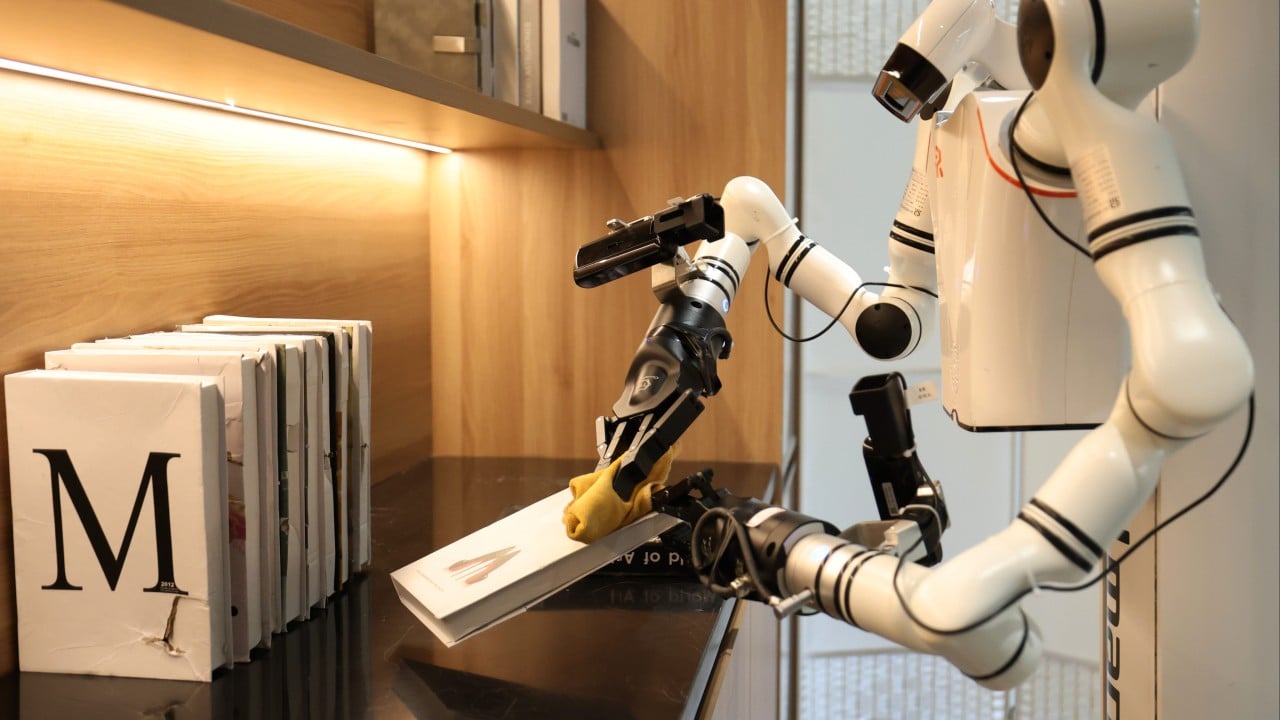
A team of Chinese researchers has claimed a breakthrough in training robots in real-world home environments, tackling a long-standing data bottleneck in the field and potentially accelerating the adoption of robots at home.
Kairos-HomeWorld was the world’s first unified framework capable of generating coherent, accurate and simulation-ready home environments using simple text prompts, according to researchers from Ace Robotics, a start-up backed by Hong Kong-listed artificial intelligence company SenseTime, the Multimedia Laboratory at Chinese University of Hong Kong and Shenzhen Loop Area Institute.
The framework is designed to break the constraints of conventional indoor scene generation, which has long been confined to single-room layouts and limited interactivity.
Instead, Kairos-HomeWorld generates whole home-scale and object-level residential scenes on a scale that can be used to train domestic robots as well as humanoids.
“These high-fidelity, large-scale simulations provide a robust foundation for advancing embodied intelligence applications and accelerating real-world robot training,” Ace Robotics said in an announcement on Friday.
The Kairos-HomeWorld framework works on a four-stage process that starts from floor plan construction and progresses through two-dimensions-to-three-dimensions and furniture layout generation. It then moves to the refinement stage before final object-level generation, with each generated scene incorporating an average of more than 15 manipulable objects.
The platform is intended to address a persistent bottleneck in embodied intelligence: the scarcity of high-quality, diverse real-world training environments for household robots.
By generating synthetic but physically accurate homes at scale, the system aims to reduce reliance on costly real-world data collection.
Researchers attributed the framework’s capability to a unique data set that contains 300,000 actual floor plans, sourced from real-world property listings and automatically processed. It also includes 5,000 fully furnished and simulation-ready homes and 50,000 physics-enabled interactive object assets.
The data set, already open-sourced, is tailored to Chinese households, spanning about 30-square-metre studio apartments to residences exceeding 200 square metres, capturing key architectural features including north-south cross-ventilated layouts, enclosed kitchens, dedicated service balconies, wet-and-dry-separated bathrooms and entryway storage.
Prompt the platform to “generate a 90-square-metre two-bedroom apartment in neo-Chinese style” and it will first create a realistic layout with proper zoning and ventilation, then add coherent furnishings and design details. The final step is to assign physical properties so the scene is fully interactive and simulation-ready.
Researchers expect the platform to significantly bring down costs and improve efficiency for household robot training, paving the way for faster adoption of domestic humanoids as China’s rapidly evolving robotics sector attracts growing interest from more entrants.
At a separate corporate event on Friday, Chinese tech giant Huawei Technologies unveiled an embodied intelligence platform, a one-stop solution for robotics developers that supports the entire development process, from data generation to model training and simulation.
Huawei also announced that its CloudRobo would start public testing by the end of June, with the platform providing the cloud infrastructure, models and tools needed to develop, train and deploy intelligent robots.