
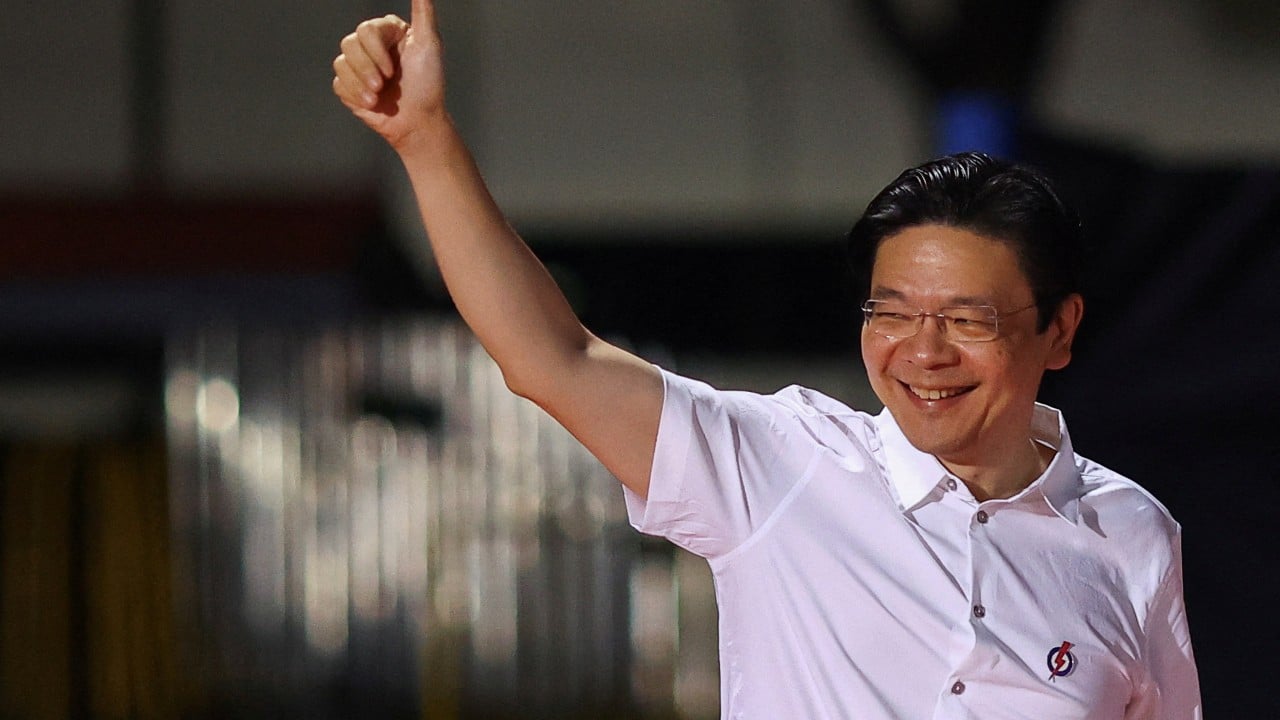
With Singapore facing a global energy crisis due to the conflict in the Middle East, the “storm clouds” that Prime Minister Lawrence Wong warned of at an election rally last year now appear to be an understatement.
Under the scorching midday sun at a lunchtime speech in the heart of the city, Singapore’s leader last April urged voters to re-elect his tested People’s Action Party (PAP), arguing that voting for the opposition would weaken his team’s ability to navigate coming headwinds.
On top of surging oil and gas prices wrought by the ongoing Iran war, fears of an artificial intelligence revolution replacing jobs continue to weigh heavily on citizens and policymakers.
“Wong has his work cut out for him given that he has to unequivocally demonstrate that he and his team are more than equal to the task of navigating Singapore through treacherous geopolitical waters,” said Eugene Tan, a political observer and associate professor of law at Singapore Management University.
“For sure, the current polycrisis is a double-edged sword for the PAP government.”
Singapore imports 95 per cent of its energy, with its status as a transport and business hub dependent on ensuring reliable and resilient energy supply. Authorities had to mitigate the inevitable increase in costs of living, an issue likely to last for the government’s entire term, Tan stressed.
Last May, Singapore’s electorate answered Wong’s call at the ballot, as he led the PAP to a resounding 65.57 per cent vote share, winning 87 out of the 97 seats on offer, while main rival the Workers’ Party (WP) held on to its 10 elected seats.
“The events of the past year have validated the core premise of Wong’s GE2025 campaign, though it is arguable whether this was more by circumstance than design,” said Nydia Ngiow, managing director at BowerGroupAsia.
Ngiow noted that Wong’s government acted swiftly across volatile external developments such as the US tariffs, escalating US-China tensions, the Middle East conflict and disruptions to the Strait of Hormuz, guided by a consistent, principled approach.
“The speed of the response to the energy crisis was precisely what Wong promised voters a strong mandate would deliver,” Ngiow said.
This was seen by the way the government brought forward several Budget 2026 measures during the last parliamentary session, providing earlier relief to households and businesses before the full weight of rising energy costs could be felt, she noted.
New faces
Wong’s electoral success also allowed him to usher in a large crop of new faces. They in turn had made an impression with their diverse views, observers said.
Elvin Ong, an assistant professor of political science at the National University of Singapore (NUS), told This Week in Asia that several new backbenchers from the PAP had interesting proposals that “might have previously been associated with opposition party parliamentarians”.
A clear example, Ong said, was PAP’s Shawn Loh, a former budget director with the finance ministry. Loh proposed that basic childcare, infant care and student care should be free for all Singaporeans, and called for increases in silver support payouts for the elderly.
“Such policies urging the government to spend more fiscally, or better yet, give things away for free, are usually associated with opposition party parliamentarians,” Ong said, adding that such proposals would typically be derided as “populist” or “financially irresponsible”.
This Week in Asia reached out to Loh for comment but was referred to the PAP, which declined any interviews with its newcomer MPs.
WP newcomer Kenneth Tiong has also called for more diverse voices in parliament to help Singapore navigate troubled waters.
Tiong said the 2025 election results, in the shadow of Trump’s Liberation Day tariffs, showed that Singaporeans wanted stability and that applied in WP-held wards where the party performed strongly, while smaller parties fared worse.
“That was simply the desire for credible opposition. I think the slate of people that we had was very, very credible,” Tiong told This Week in Asia.
He listed WP candidates such as start-up founder Michael Thng and senior counsel Harpreet Singh as having the ability to enrich discussions in parliament if they had been voted in.
On points raised in parliament, Tiong noted he had proposed in February that Singapore should stop viewing gold as a “legacy asset” and instead treat it as a strategic industrial pillar. Chee Hong Tat, deputy chairman of the Monetary Authority of Singapore, agreed and said MAS was already studying this.
Six weeks later, MAS and the Singapore Bullion Market Association announced a plan to develop Singapore as a gold trading and vaulting centre, specifically including services for foreign central banks, one of the pillars Tiong had advocated for in his motion.
Tiong said while it was unlikely his proposals resulted in the new plan, which would have been some time in the making, “it shows that our party does actually have good ideas. No one has a monopoly on good ideas and I think the WP can also be the intellectual author of a lot of Singapore policy”.
A pet issue for Tiong is greater regional integration, especially in light of the energy crisis which will accelerate the adoption of clean energy, including nuclear reactors and other energy infrastructure in Southeast Asia.
Singapore, he says, can play a catalytic role in infrastructure areas such as cross-border and domestic energy distribution.
“It’s not necessarily the case that voting for more of the PAP candidates will lead to better outcomes, so I think there’s definitely a positive diversity. We’re making a very positive contribution to parliament so far,” Tiong added.
Regarding Foreign Minister Vivian Balakrishnan’s clarification that Singapore would not on principle negotiate with Iran for safe passage through the Strait of Hormuz, Tiong noted that the comment prompted a question from WP MP Fadli Fawzi.
Yet, Tiong’s parliamentary performance has not always been smooth sailing. In November last year, during an exchange with Chee on Singapore’s family office regime and whether it opened the country to money launderers, Chee asked if the WP was advocating for a zero-risk approach and closing Singapore off.
Tiong dismissed the question as rhetorical and meaningless, and when prompted by Speaker Seah Kian Peng, he said Chee was asking a “stupid question”. Tiong apologised after Seah said such language was beneath the dignity of the House.
“It is very difficult beforehand to know what the […] out-of-bound markers are regarding language, because every speaker is different,” Tiong said.
“I accept the spirit of what the Speaker said, but I have plenty of synonyms … I don’t regret it because I learned something new that I would not have been able to learn beforehand.”
‘Intimately tied to Singh’
While the PAP enjoyed a vote-share climb of some four percentage points, the election also saw the consolidation of opposition supporters behind the WP, which retained all 10 of its seats and reclaimed the non-constituency MP seats allocated to the narrowest losers.
Yet the past year also saw the removal of WP leader Pritam Singh as Leader of the Opposition after he was convicted and fined for lying to a parliamentary committee investigating lies that his former MP Raeesah Khan told in parliament.
The WP’s central executive committee issued a formal letter of reprimand to Singh last week following the court’s findings. The committee considered that Singh had no intention to “act in a manner contrary to the principles, aims, or objects of the party, or prejudicial to the welfare of the party, and his actions ultimately reflected judgment calls that he had to make”.
When asked about the party’s handling of Singh, Tiong said due process was sought and followed and he had “full confidence in Pritam Singh as the leader of the Workers’ Party”. He added: “People can conclude what they want to conclude.”
Tan said Singh’s case showed that he and the WP could not be held accountable and lacked the standing or legitimacy to champion more checks and balances.
“In a perverse way, the WP has become personality-based like most of the smaller opposition parties where the party vehicle operates as the alter ego of their leaders. For now, the fate of the WP is too intimately tied to that of Singh.”
Despite this, Ong said he expected the party’s overall credibility perception to remain high in the near future. He cited a post-election survey from the Institute of Policy Studies last year that suggested the WP’s credibility perception was the highest relative to other opposition parties, almost matching the PAP’s.
Experts also noted that Wong’s predecessor, Senior Minister Lee Hsien Loong, had curtailed his public appearances, reflecting a deliberate step back from day-to-day governance.
This meant the pressure was on Wong to deliver, especially with regard to cost-of-living woes.
“This shifted the centre of gravity with Wong no longer simply perceived as continuing Lee’s leadership but beginning to make a distinct mark of his own, while preserving the policy continuity and stability that are Singapore’s hallmarks,” Ngiow said
“That said, if household budgets remain squeezed despite successive packages, the narrative that a strong mandate delivers tangible economic security will come under pressure ahead of the next election cycle.”
Still, analysts are confident the PAP will continue to be dominant at least for the next decade, as it continues to steady the ship amid the geopolitical storm.
“It’s more a case of the PAP losing its dominance through its own doing,” Tan said.