
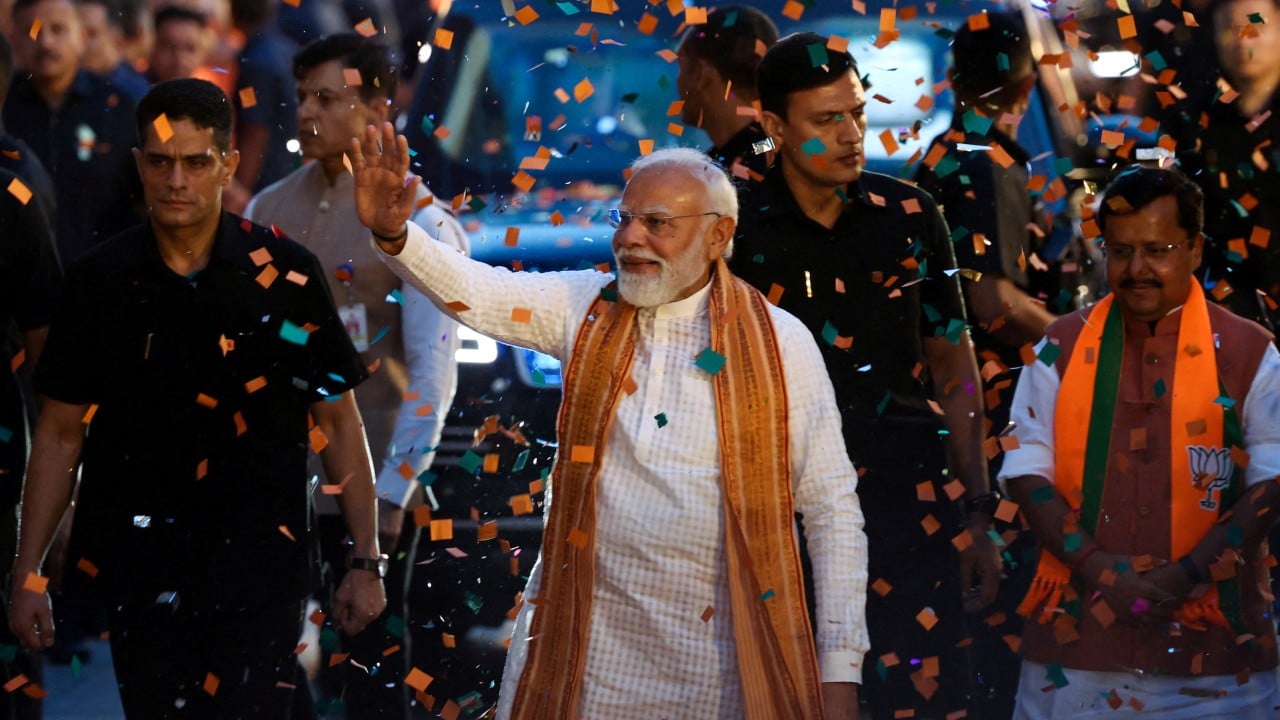
After his party’s stunning conquest of West Bengal, Narendra Modi stands at a juncture that would have seemed implausible mere months ago.
The prime minister who lost his parliamentary majority in 2024, briefly inviting talk of a weakened leader, now controls roughly 70 per cent of India’s state legislatures through his ruling coalition, the National Democratic Alliance.
The Bharatiya Janata Party’s (BJP) sweep of West Bengal, winning 207 of 294 assembly seats and ending three consecutive terms of Mamata Banerjee’s Trinamool Congress, represents what analysts call the conquest of the party’s final frontier.
For years, West Bengal was an electoral nut the BJP could not crack: a place where leftist tradition, fierce regional identity and Banerjee’s formidable political machinery formed what seemed like an impenetrable wall of resistance.
That wall has now crumbled, sending tremors through New Delhi, Dhaka and what remains of India’s political opposition.
Two years ago, it all looked very different. In 2024, the BJP lost its outright Lok Sabha (parliamentary) majority at the national level for the first time under Modi, forcing it into a coalition arrangement.
Since then, however, the party has won state-level elections in Maharashtra, Haryana, Delhi, Bihar – and now, West Bengal.
“Not all the losses that the BJP suffered in Lok Sabha elections have been neutralised, but there is now icing on the cake,” said Nilanjan Mukhopadhyay, an independent political commentator.
No other political party has had this kind of grip over power
Nilanjan Mukhopadhyay, political commentator
Together with Monday’s confirmation of a landslide BJP victory in Assam’s legislative assembly election, Modi’s party has secured a consolidation of control almost without modern precedent.
“No other political party has had this kind of grip over power,” Mukhopadhyay said, barring the national Congress party’s hegemonic years in the 1950s and ‘60s.
Congress dominated post-independence India as a “catch-all” movement, its authority resting on the moral capital of the struggle for freedom and the absence of credible alternatives.
Its decline in recent years left a vacuum the BJP has methodically filled. West Bengal, presided over for the past 15 years by Banerjee’s Trinamool Congress – itself originating as a breakaway faction of the national Congress party – was one of the last significant holdouts.
But it has now fallen.
Defiance in defeat
Most analysts had predicted that the Trinamool Congress would return to power, albeit with a stronger BJP in the opposition.
Banerjee is not going quietly, however. Although her party’s tally collapsed from 215 seats to 80, and she lost her own constituency, she emerged from the wreckage combative and unrepentant.
She claimed roughly 100 seats had been forcibly taken from her party and accused the Election Commission of bias, though she offered no supporting evidence. “I will not resign, I did not lose,” she told reporters afterwards. “Morally, we won the election.”
Her allegations fed into broader complaints raised by multiple opposition parties over the “special intensive revision” of voter rolls, a process they claim was used to delete legitimate voters en masse while inserting fictitious names to tilt outcomes.
The Election Commission has not publicly addressed the allegations in detail.
The voter roll controversy was also inseparable from the campaign’s most combustible theme: illegal immigration from Bangladesh.
The BJP campaigned hard on the allegation that the Trinamool Congress had been lax on border security, calling undocumented migration both a national security threat and a demographic challenge to Hindu-majority India.
Critics argued the voter-rolls revision process was used to purge ethnic Bengali Muslim voters under the cover of weeding out illegal immigrants, blurring the line between electoral management and communal politics.
Kingshuk Nag, an author and political commentator, expects Hindu nationalist ideology to gain greater prominence in West Bengal following the BJP’s victory.
Figures such as Shyama Prasad Mukherjee – a Hindutva activist and barrister who founded the BJP’s ideological predecessor, the Bharatiya Jana Sangh, in 1951 – were likely to now take centre stage, he said.
The Dhaka dilemma
The BJP’s victory in West Bengal could also create a diplomatic headache for Delhi.
Any aggressive push to identify, detain or expel illegal migrants risks damaging India’s ties with Bangladesh’s new government, led by Prime Minister Tarique Rahman’s Bangladesh Nationalist Party, which took office in February after a prolonged period of instability.
Delhi had maintained close ties with Bangladesh’s long-serving former prime minister Sheikh Hasina, until she was ousted in August 2024 following weeks of violent student-led protests and mass demonstrations, and subsequently sentenced to death in absentia for crimes against humanity.
Hasina, 78, has been living in self-exile in India ever since. Dhaka has repeatedly sought her extradition, with Delhi recently agreeing to review the request.
India has been working to stabilise ties with its neighbour in other ways too, including by supplying diesel through the India-Bangladesh Friendship Pipeline to ease fuel shortages caused by the US-Israel war on Iran that has crimped energy supplies across Asia.
Bangladesh has previously officially denied or played down claims that large-scale, systemic migration into India exists, leaving little diplomatic space for joint enforcement.
Priyajit Debsarkar, a London-based author and independent geopolitical analyst, said that illegal migration was a shared problem that was intertwined with human trafficking and cross-border smuggling.
“Both governments at the international level should work together to resolve the issue,” he said, calling for a framework “to establish a free flow of trade and commerce between the two neighbours along with a robust mechanism for people-to-people contact”.
“There could be some visible changes and equal gains for both of them,” he added.