
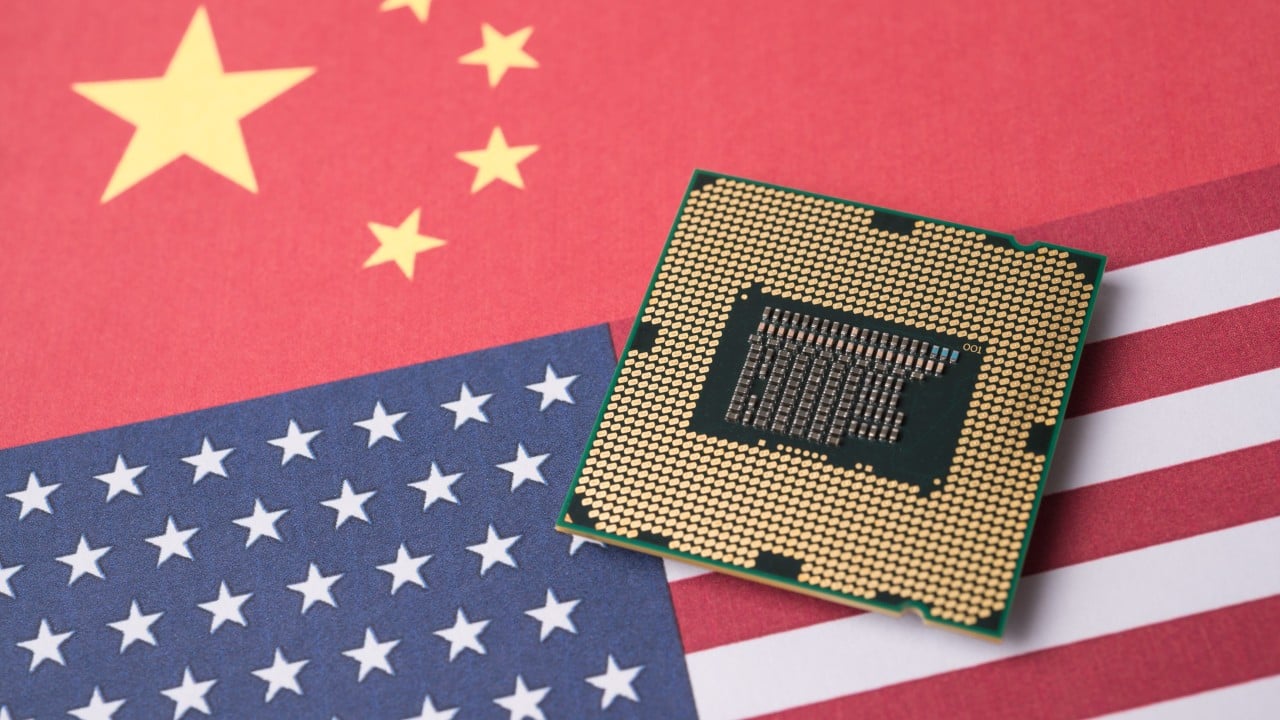
China’s Ministry of Commerce has lashed out at Washington’s latest guidance on advanced artificial intelligence chip exports, accusing the United States of abusing export controls and disrupting the global semiconductor supply chain.
But trade lawyers and industry insiders said the actual fallout over the new document could be far more limited than the geopolitical fireworks suggest.
The US Bureau of Industry and Security (BIS) issued guidance on May 31, stating licences would be required to export advanced computing items to entities headquartered in mainland China or Macau – or whose parent companies are based there – even when those entities operate outside Chinese territory.
The move has triggered intense industry scrutiny. Increasingly blocked from accessing Nvidia’s top-tier silicon at home, Chinese tech firms have pivoted overseas, turning to data centres in Southeast Asia to secure the computing power needed to train next-generation AI models.
Here is what you need to know about Washington’s latest regulatory salvo.
Is this a new restriction?
Not exactly.
According to BIS guidance, the licensing requirement is not a fresh mandate; it was originally introduced in November 2023. The new document simply clarifies that it remains active for Chinese-headquartered companies operating abroad, after the BIS stated last year that it would pause enforcement on certain elements of the Biden administration’s AI Diffusion rule.
“This is a rule clarification. There is no change,” said Dai Menghao, an export-control lawyer at King & Wood Mallesons, noting that some market participants had misunderstood the scope of existing restrictions.
Overseas subsidiaries of Chinese firms were already barred from freely buying advanced AI chips under pre-existing US frameworks, Dai added.
In short, Washington is not building a new wall – it is merely reminding Chinese firms that using offshore subsidiaries will not grant them an easy detour around the current one.
Why does it still matter?
The clarification strikes at a critical lifeline for China’s tech sector. Offshore computing has emerged as an important workaround for mainland AI firms starved of Nvidia’s cutting-edge hardware.
Financial Times reported last year that Alibaba and ByteDance were among the Chinese tech firms training their latest large language models in Southeast Asian data centres to access Nvidia chips. Alibaba owns the South China Morning Post.
The legal interpretation of the rules, however, is complex. Dai said that whether a company was considered “headquartered” in China depended not only on ownership structure but also on where management and business decisions were made.
That means the guidance could affect some corporate structures more directly than others.
Are there still loopholes?
Some US national security specialists and market analysts believe so.
Chris McGuire, a former US State Department official, wrote on X that BIS’ previous non-enforcement posture could have allowed the overseas subsidiaries of Chinese firms to buy advanced Nvidia Blackwell chips without a licence.
He argued the latest guidance would again make such shipments clearly illegal, but said it still did not fully address other risks, such as whether foundries like Taiwan Semiconductor Manufacturing Company (TSMC) had to conduct enhanced due diligence on AI chip orders that could benefit Chinese companies.
Gavekal Technologies took a similar view in a recent note, saying the guidance might have a limited practical impact even if strictly enforced. Chinese firms could continue to access restricted computing power through overseas cloud services provided by non-Chinese entities, it said, while some Chinese AI chip companies might be able to make restricted chips at the likes of TSMC and Samsung through intermediaries, though the scale remained unclear.
A senior executive involved in Nvidia’s China supply chain told Gavekal that the latest guidance would not have a major impact, as it had already become difficult to obtain B300 and other advanced Nvidia chips since March, with server makers increasingly wary of shipping to Chinese-owned entities. The executive also noted that Beijing had not approved H200 imports.
How does this affect Nvidia’s H200 chips?
The guidance comes as Nvidia’s H200 sales to China remain uncertain.
Washington has moved to review H200 licence applications for China on a case-by-case basis, but Nvidia has said it had not yet generated revenue from such sales and remained uncertain as to whether shipments would be allowed into the country.
For Chinese AI companies, that means access to top-tier US chips remains constrained on two fronts: direct imports into China still require licences and regulatory approval, while overseas subsidiaries face renewed scrutiny under the BIS guidance.