
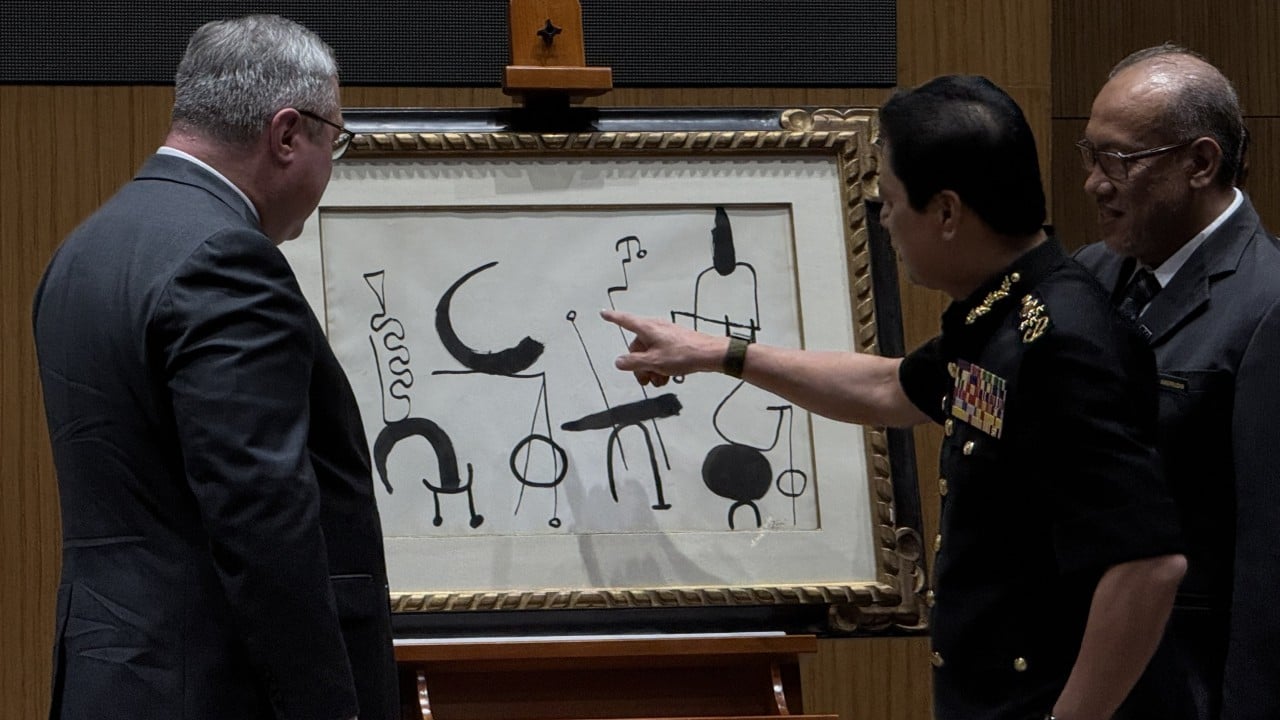
Four paintings linked to one of the world’s most audacious financial frauds stood on easels at Malaysia’s anti-corruption headquarters on Wednesday: a Picasso, a Miro, a Balthus and an Ultrillo – all allegedly bought with money stolen from the Malaysian people.
The unveiling of the works at the Malaysian Anti-Corruption Commission’s (MACC) headquarters in Putrajaya marked the first public showing of artworks recovered from the multibillion-dollar Malaysia Development Berhad (1MDB) scandal since they were repatriated from New York last month.
Traced through Sotheby’s auction house and flown back to Malaysia on April 14, the canvases arrived in wooden crates and were unpacked under controlled lighting and temperature conditions supervised by the National Art Gallery.
Their combined estimated value – about US$198,125 – is modest by the standards of the scandal that produced them. Yet their symbolism is anything but.
No matter how large the amount stolen through this scandal, every cent belonging to the people must be returned
Azam Baki, MACC chief commissioner
Together, they represent one strand in a web of corruption that US investigators say looted more than US$4.5 billion from Malaysia’s sovereign wealth fund between 2009 and 2014, funnelling the proceeds into luxury real estate, superyachts, Hollywood film deals and the art collections of the well-connected.
“This is a betrayal of the people’s money,” MACC chief commissioner Azam Baki told reporters on Wednesday. “No matter how large the amount stolen through this scandal, every cent belonging to the people must be returned.”
Azam said Malaysia had so far clawed back 31.3 billion ringgit (US$7.9 billion) in 1MDB-linked assets – equivalent to 74.5 per cent of the 42 billion ringgit identified as misappropriated – which he described as “one of the highest recovery rates in the world” for a financial crime of such scale.
He credited the US Department of Justice, the FBI and foreign authorities for helping navigate the multijurisdictional legal maze that lay behind the decade-long recovery effort. “Without their cooperation, we could not recover these assets,” he said.
The four recovered works – Joan Miro’s Composition (1953), Maurice Utrillo’s Maison de rendez-vous de chasse de Henri IV, rue Saint-Vincent, Montmartre (1934) , Balthus’ Etude pour femme couchee (1948) and Pablo Picasso’s L’Ecuyere et les clowns (1961) – were authenticated and cleared through strict shipping protocols before being put on display.
Within “the next four or five days”, Azam said they would be handed over to the National Art Gallery, where they might eventually be opened to the public.
“People can come and view the paintings and remember the history of the 1MDB scandal,” he said.
“This is for the government to keep, so people can remember … But if the government or the [finance] ministry wants to sell or auction the paintings, that is up to them.”
The Monet trail
The four canvases are far from the last items on Malaysia’s recovery wish list.
Another eight artworks linked to the scandal are still being pursued, including pieces by Henri Matisse, Alexander Calder, Salvador Dali, and a second Picasso estimated to be worth some US$1.27 million alone.
Authorities are also pursuing proceeds from the sale of Claude Monet’s Vetheuil au Soleil, offloaded in Switzerland for around €25.2 million (US$29.5 million), with those funds currently under seizure proceedings in the United States.
The artworks were linked to Jasmine Loo Ai Swan, a former 1MDB lawyer and close associate of fugitive financier Low Taek Jho, better known as Jho Low, the man US prosecutors have characterised as the mastermind behind the entire scheme.
Investigators believe Loo received roughly US$26 million in 1MDB-linked funds routed through accounts in Switzerland, Singapore and the US before they were allegedly used to acquire luxury properties and art. Loo returned to Malaysia in 2023 and has since cooperated with authorities. Low remains a fugitive.
The 1MDB scandal led to the downfall of Najib Razak’s government in 2018 and triggered multiple international investigations.
Najib, who founded 1MDB in 2009 and chaired its advisory board, has consistently denied any wrongdoing. He has been imprisoned since 2022 following a final failed appeal in a corruption case linked to SRC International – a former subsidiary of 1MDB – and in December last year received a further 15-year sentence in a separate 1MDB-related trial, a conviction he is appealing.