
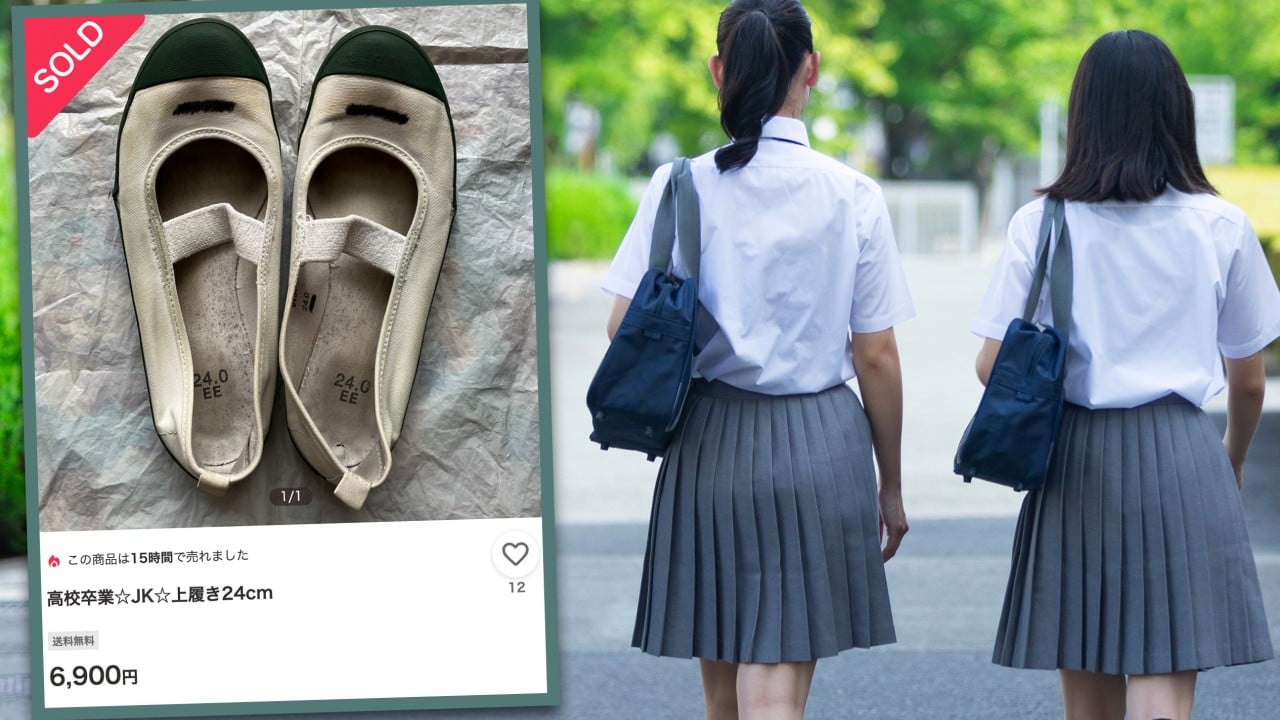
Battered school indoor shoes, reportedly worn by graduating schoolgirls, have appeared in online shops in Japan, sparking fierce criticism over the fetishisation of young women.
Removing outdoor shoes before entering homes, schools, companies and other public buildings is a deeply rooted custom in the country, tied to cleanliness and respect for shared spaces.
Known as uwabaki, Japan’s traditional indoor shoes are typically white and shaped like ballet flats.
At schools, from kindergarten through to university, students usually change into these indoor shoes at entrance lockers. Their pairs are often marked with names, class details or small personal designs.
During the graduation season, student shoes often appear on flea-market apps, usually unused or in good condition.
The listings now under fire are different.
One stained pair of indoor shoes, shipped from Saitama prefecture, was listed for 6,900 yen (US$44) and described as “graduation commemorative shoes”.
Its description read: “Used for three years. There are marks where the name on the upper part of the shoe has been erased.”
Some worn pairs have reportedly fetched as much as 50,000 yen (US$320) after repeated auctions.
One internet commentator, @tkzwgrs, noted that buyers appeared to favour shoes with name embroidery still visible and clear signs of wear.
The appeal reportedly grows if a girl’s hand or fingers appear in the product image.
Some buyers refer to the worn footwear as “JK original shoes”.
JK is Japanese shorthand for joshi kosei, or schoolgirls. In online subcultures, the term is often associated with school uniforms, campus items and youth-coded imagery.
Japan’s Gendai Media reported that some purchases may be driven by collecting or sexual interests, including a focus on the shoes’ smell or implied association with adolescence.
One supporter defended the trade, writing: “There is no difference between a train model collector buying a model train and someone who likes schoolgirls’ indoor shoes buying a pair.”
“As long as the seller has not had any unpleasant experience, the transaction does not violate the law.”
Critics, however, say the appeal lies not in the shoes themselves but in the commodified image of the schoolgirl behind them.
“The horrifying fact is that girls’ belongings are being sexualised, while personal details such as their names, classes and schools are being exposed,” one online user wrote.
In some cases, the pupils themselves may not be behind the sales.
Japan’s Bengo4 News previously reported the case of a 21-year-old woman who said her mother made her wear old indoor shoes when she was in secondary school and pose for photographs showing her legs.
The shoes and images were later listed together on a second-hand trading website.
Experts told the outlet the case could amount to child sexual abuse.
In March, Mercari, one of Japan’s largest second-hand trading platforms, banned listings deemed to fall under burusera, a term associated with the fetishised sale of used items belonging to young women.
Its official account said the ban was not limited to uniforms but could also apply to textbooks, stationery and other school-related items.
Similar controversies have surfaced before.
In the 1990s, so-called burusera shops, which sold used schoolgirl uniforms, swimsuits and underwear, became a major social concern in Japan.
After the trade was linked to widespread stalking, voyeurism and other sexual offences, local governments introduced laws to restrict or ban the sale of such items.