
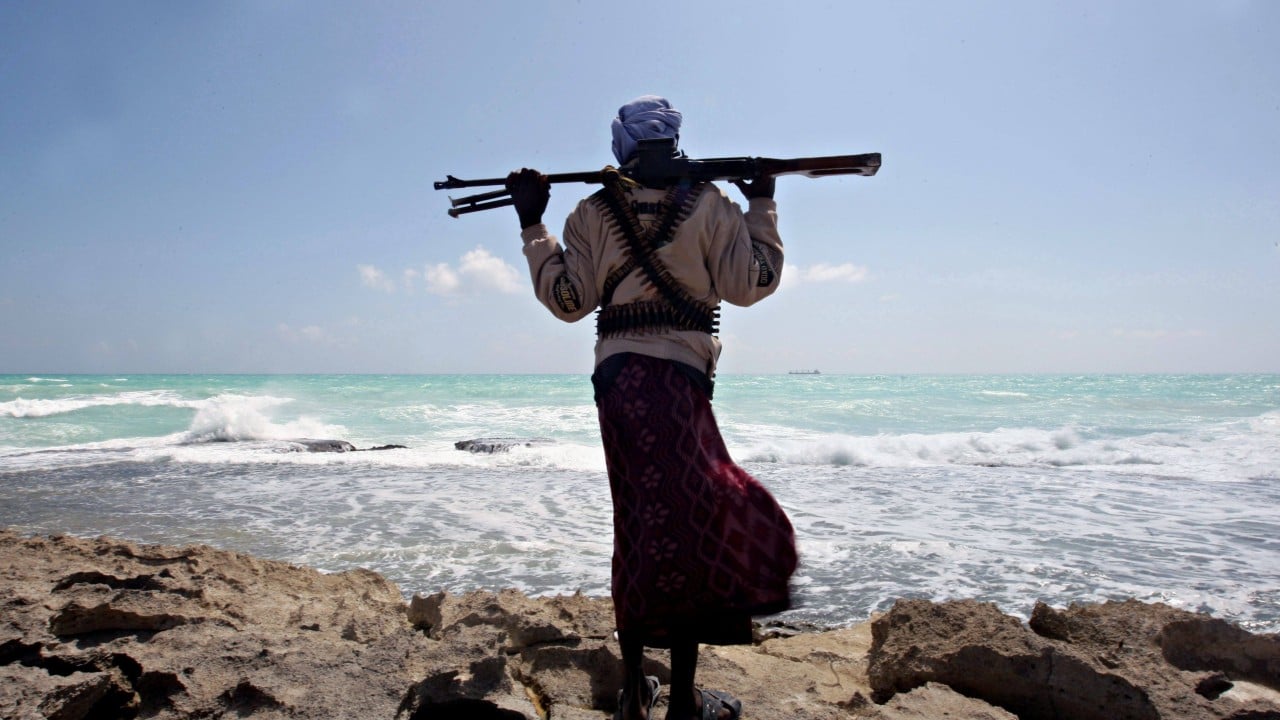
A chilling voice note from her husband was all the warning Indonesian housewife Shanty Shanaya received of his impending kidnapping in some of the world’s most treacherous waters.
“I’m about to be attacked,” her 33-year-old husband, Captain Ashari Samadikun, said in the April 21 voice note threaded with fear as a group he assumed to be pirates approached.
He was captaining the Palau-flagged MT Honour 25 tanker, which was carrying fuel from Oman to Somalia – a route once notorious for pirates who appear to be staging a comeback timed with the movement of navy ships to the Strait of Hormuz 1,700km to the north.
“I started crying. It was like I had been hit by a bolt of lightning,” Shanaya, who lives in Gowa Regency in South Sulawesi, told This Week in Asia. “I couldn’t believe what he had just said.”
The 26-year-old desperately messaged back, but received no reply. Then his phone appeared to be switched off.
For three days, the mother of two young daughters, aged six and four, could do nothing but wait and pray. Then, out of the blue, she got a video call from her husband.
“I could see him sitting on the ship, looking well, but surrounded by pirates who were all heavily armed,” Shanaya said. “He told me that he was OK, and that the crew were being allowed to eat and pray. I was just stunned.”
Samadikun told his wife the pirates were forcing the crew – four Indonesians, 10 Pakistanis and a citizen each from Sri Lanka, Myanmar and India – to camp on the vessel’s bridge.
Shanaya said she understood that the Somali pirates were holding the crew for ransom, but was unsure how much they were seeking.
Nearly two weeks after the April 24 video call, she has heard nothing more from him.
Talking to pirates
According to the Pakistani embassy in Djibouti, the MT Honour 25 is now anchored off the coast of Eyl, an ancient port town in autonomous Puntland at the tip of the Horn of Africa.
In fractured Somalia, Puntland is beyond the reach of the central government and is instead governed by armed militias.
Like Samadikun, Second Officer Adi Faizal is also from South Sulawesi, while Chief Officer Wahudinanto is from Central Java and crew member Fiki Mutakin from West Java.
Indonesia’s Foreign Ministry has acknowledged the hijacking.
“Efforts are focused on engagement with local authorities, community leaders and shipping companies,” Heni Hamidah, the ministry’s director for citizen protection, said on April 30.
The Indonesian crew members “so far … are reported to be in good condition”, she added.
On Monday, Indonesian lawmakers urged the government to get the seafarers home swiftly and safely.
“Diplomatic efforts must be maximised, not only through bilateral channels with Somali authorities but also through international cooperation, considering this is a transnational organised crime,” Yudha Novanza Utama, a member of the House of Representatives Commission overseeing defence, said in a statement.
“The state must be fully present to ensure the safety of all citizens in emergency situations like this.”
Data from UK Maritime Trade Operations showed four vessels – including the MT Honour 25 – were targeted in the latter part of April in waters near the Horn of Africa.
The zone was notorious for piracy that peaked in the early to mid-2000s, but was pegged back after naval patrols from the EU, Nato and the Combined Maritime Forces moved in.
Pirates wielding rocket launchers and automatic weapons have seized hundreds of ships, taking thousands of crew members hostage for weeks, months or even years. These heavily armed Somali fishers, now bandits, seek cash, gold and cryptocurrency payments in exchange for the crew’s release.
In 2012, a Taiwan-owned and Omani-flagged fishing boat, the FV Naham 3, fell victim to one of the longest-ever hijackings in maritime history when it was seized by Somali pirates off the Seychelles with 29 crew members aboard, including five Indonesians.
Four of the Indonesian crew were released almost five years later. One died of illness while being held captive on the ship. The pirates claimed they received a US$2 million ransom for the crew, although authorities never confirmed this – an omerta to avoid encouraging more hijackings and to appease shipping insurers who increased premiums on what became the world’s most dangerous shipping route.
Indonesian lawmaker Utama said the US-Israel war on Iran meant that pirates could be taking advantage of the movement of naval assets from the Horn of Africa to the flashpoint Strait of Hormuz.
“We are seeing gaps in the global maritime security system when international focus becomes fragmented,” he told reporters. “This situation is being exploited by pirate groups that have long operated through organised patterns and networks.”
Powerless in Puntland
Yohanes Sulaiman, an associate professor in international relations at Jenderal Achmad Yani University in Cimahi, said anchoring the vessel near Puntland complicated the process of getting the Indonesian sailors back.
“In general, if things happen to workers, the Indonesian government will lobby the other country’s government. In this case though, the Somalian government cannot do anything. They don’t have the power,” he said.
The Al-Shabaab Islamist group controls a huge swathe of territory while Somaliland, a state in Somalia, has already declared independence completely outside the control of the Mogadishu government.
“Puntland, while still in Somalia, is literally doing its own thing, and Somali pirates are in areas outside the government’s control.”
As authorities pick through the daunting task of negotiating the release of the ship and its crew, the captain’s wife Shanaya says she hopes the Indonesian crew will be treated well as they are Muslim.
“My husband told me that when they came aboard, he said ‘Don’t shoot, I’m Muslim’. I am very hopeful that they won’t hurt him because they are also Muslim,” she said.
But as the days stretch on, the anxiety is deepening.
“He is such a good father and husband, very responsible and always thinking about me and the children. He was always asking about our health when he called and about his parents.”
Samadikun had been at sea for years, but only joined his new company, the Wharf Chartering Company, in January this year. It was his first role captaining a ship and he had twice carried fuel through Somali waters using different sea routes.
However, Shanaya said that, to her knowledge, military vessels had previously escorted her husband’s boat along the sea route close to Somalia to ensure the safety of the cargo and the crew.
She was unsure why, on their last journey, they had apparently not received an escort. The responsibility for securing the crew’s release lay with the vessel operator, she said.
“They didn’t get them a proper escort and they should have known how dangerous it was,” she said. “I hope the Indonesian government will help the company negotiate their release. So far the response from the government has been good.”