
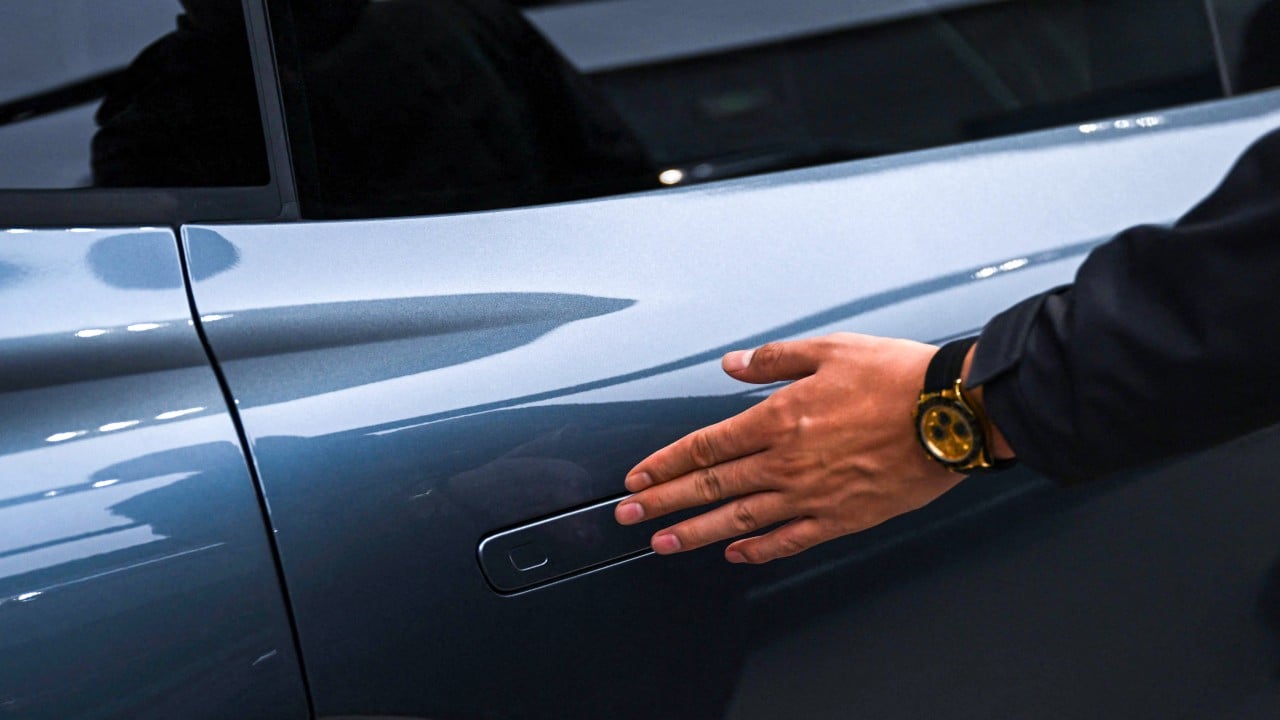
Hong Kong is set to ban electric vehicles equipped solely with electronic door handles, as authorities seek to align with mainland China’s decision to mandate physical manual releases on all new cars from 2027 to mitigate safety hazards.
Secretary for Transport and Logistics Mable Chan said on Wednesday the government was closely monitoring the latest technical breakthroughs and regulatory shifts on the mainland and abroad to ensure the city’s road users were protected by the most up-to-date safeguards.
Responding to an inquiry from Ben Chan Hang-pan, chairman of the Legislative Council’s transport panel, the transport chief highlighted a new mandatory national standard published by the mainland that the city was considering adopting.
She was referring to the GB 48001-2026 standard titled, “Safety technical requirements for automotive door handle”.
“[The standard] requires that mechanical door handles be installed on both the interior and exterior of doors for vehicles sold from 2027 onwards, focusing on addressing issues such as failure in operating door handles after accidents,” she said.
“The Transport Department has consulted the trade on the relevant requirements, with a view to updating related local vehicle safety standards in a timely manner and ensuring that the vehicle standards in Hong Kong remain current.”
All vehicles sold in Hong Kong that are equipped with electronic door locks must have a manual override mechanism, according to regulations, to ensure passengers inside can open the doors manually in case of a power failure that renders the electronic locking system inoperable.
“Currently, all relevant vehicles comply with the requirements,” she said, adding that the department intensified oversight last May by reminding the industry that all imported vehicles must feature manual door releases.
Since October 2025, manufacturers have also been mandated to provide buyers with clear instructions on how to operate concealed manual locks to ensure emergency preparedness, according to Chan.
Ringo Lee Yiu-pui, governor and honorary life president of the Hong Kong, China Automobile Association, said that EV owners would not need to upgrade their cars even if the city aligned with the national standard.
“The national standard only mandates that cars manufactured from 2027 onwards be equipped with manual releases both inside and out,” Lee said.
He added that while current electric vehicles had long featured internal manual releases that function even when power was cut, a major limitation persisted as these systems were generally only accessible from the inside.
“This leaves the exterior without a corresponding mechanism for first responders to use in an emergency. That is ultimately what the national standard is all about,” Lee said.
Lee said that motorists must take proactive safety measures, emphasising that whether purchasing a new or used EV, owners must consult the service manual to understand how the internal interlocking mechanisms operate.
“This is crucial because sales representatives often fail to explain these features, and the internal manual releases are typically only available on the front doors rather than all four,” he said.
Lee also suggested implementing subsidiary legislation requiring EV motorists to carry two spring-loaded glass breakers on board.
“When accidents happen, even manual locks could malfunction. It’s not an expensive gadget and could save lives during an emergency,” he said.
Currently, EVs account for more than 70 per cent of all newly registered private cars in Hong Kong.
As of February 2026, the city’s total EV population reached 156,000, representing about 17.2 per cent of all vehicles on the road.
According to the Environmental Protection Department, Hong Kong recorded 7,160 EVs in the first two months this year.
While Tesla maintained its lead with an 18 per cent cumulative market share, Chinese brands were gaining ground.
During the first two months, BYD and Zeekr emerged as competitors, capturing 17.5 and 11.5 per cent of the market, respectively.