
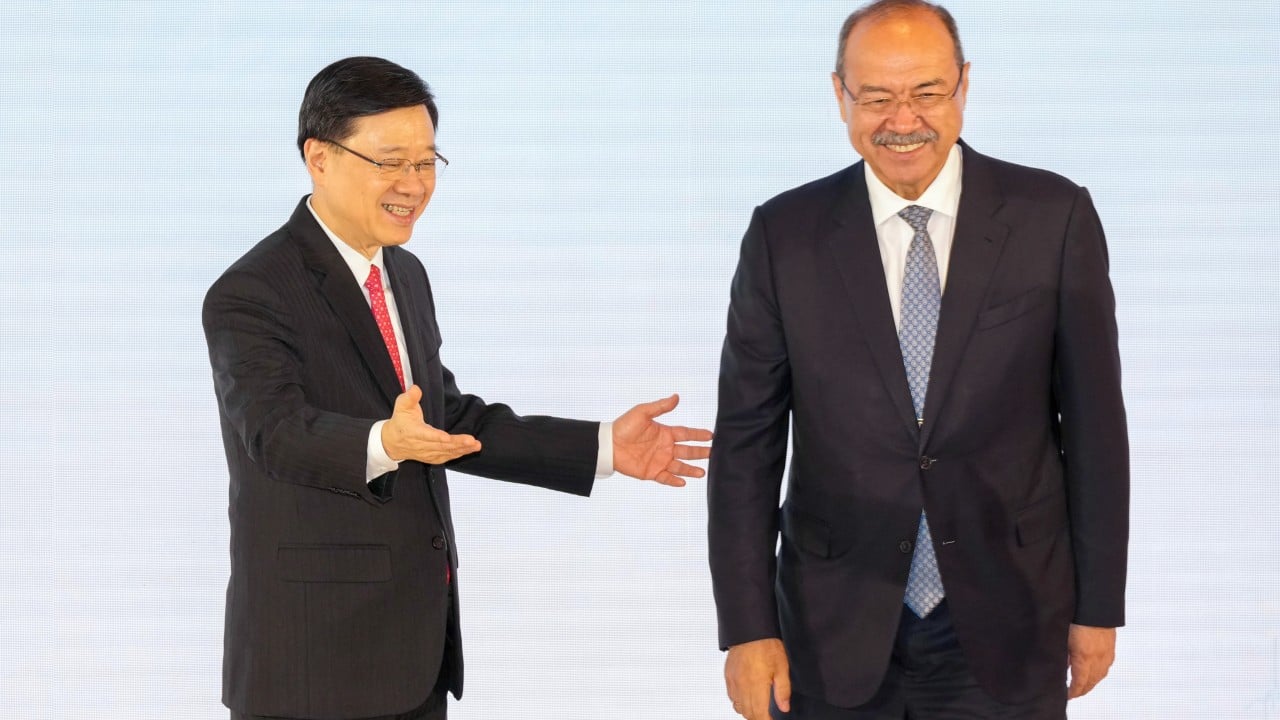
The leaders of Hong Kong and Uzbekistan met on Wednesday to strengthen trade ties, as China and the Central Asian country signed 15 bilateral agreements covering areas such as infrastructure, healthcare and metal production.
At a meeting at Government House with Uzbek Prime Minister Abdullah Nigmatovich Aripov, Chief Executive John Lee Ka-chiu pledged to expand Hong Kong’s presence in Belt and Road Initiative markets and strengthen cooperation.
Speaking later at a forum and exhibition with the Uzbek business and government delegation, Lee said Aripov’s presence “spoke volumes” about the strength of ties between Uzbekistan and China.
“I am confident that today’s Uzbekistan-China (Hong Kong) Economic Forum will set our two economies, and our two peoples, together on a far-reaching and mutually rewarding partnership,” Lee said.
He said intergovernmental ties were growing stronger and encouraged Uzbek businesses to set up regional offices, list on the stock exchange, and make use of professional services in Hong Kong.
Lee also pointed to government scholarships offered specifically to students from Belt and Road Initiative countries, including Uzbekistan, to study at the city’s post-secondary institutions, helping to further promote people-to-people ties.
Aripov invited investment from Hong Kong and mainland China, noting that bilateral trade had tripled over the past five years.
He said he was confident trade could reach US$20 billion, with the mining industry playing a vital role in the country’s economy as one of the fastest-growing sectors, that had more than US$2 billion in planned investment.
Aripov added that the country had transformed from an electricity importer into an exporter within three years, thanks to “the significant development in green energy” as part of a broader reform initiative.
The bilateral agreements included the construction of a 150-megawatt energy storage system in the Samarkand region and the development of Navoi International Airport into a cargo hub.
A series of deals were also signed in the healthcare sector, including projects to expand cataract treatment services, prevent insect-borne diseases, and develop medical education.
There were also agreements on the “mining and processing of non-ferrous metals” project in Surkhandarya, as well as technical support for localising aluminium wheel production.
In addition to the government-to-government meeting, a business delegation showcased products and services.
Mirakhmedov Sanjar, CEO of MSA Family Winery, showcased Uzbek-produced wines, including Riesling, Cabernet Sauvignon and pomegranate varieties, for both domestic and export markets.
“Hong Kong is very interesting to me. There’s no wine tax, and people have the money to spend on wines. We’re interested in presenting different vintages, not a mass market, aiming at fine dining restaurants,” he told the South China Morning Post.
He said he hoped to enter local and mainland markets as early as next year, adding that he was in talks with “a great export company” in the city and was also in contact with the Hong Kong General Chamber of Commerce.
A high-level Hong Kong delegation is understood to be visiting Uzbekistan and Kazakhstan soon.