
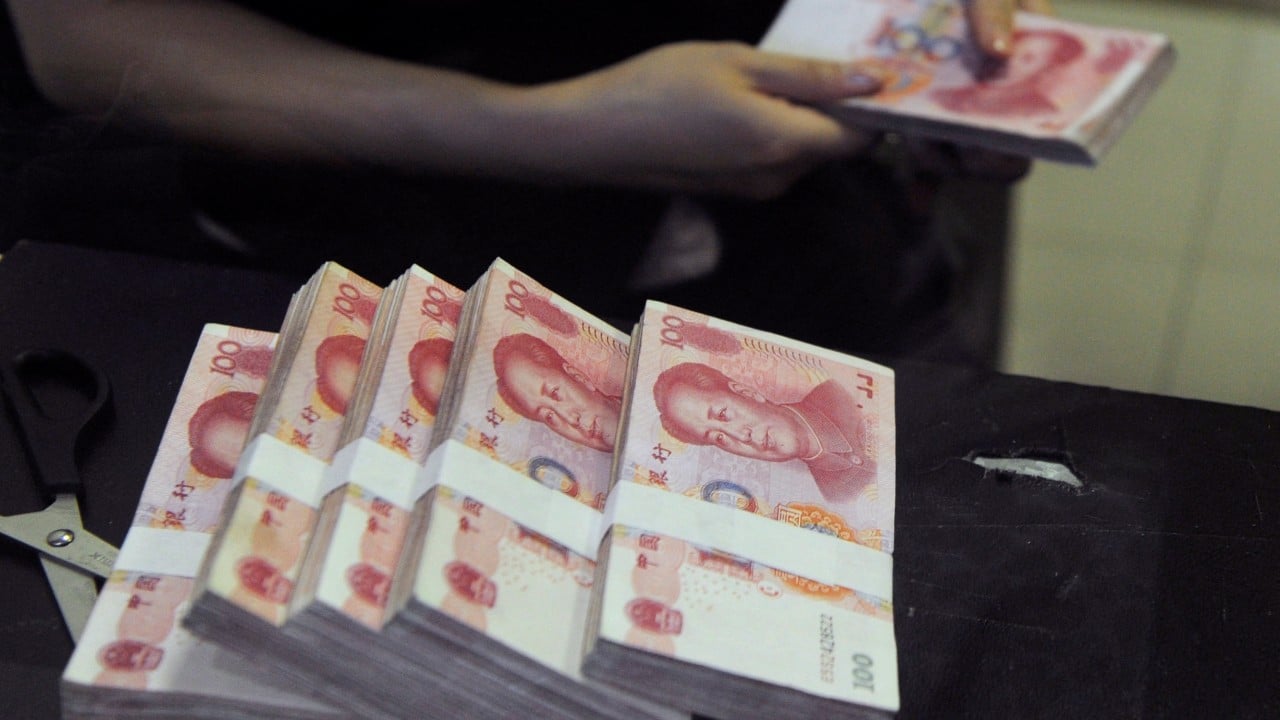
China and Russia have largely moved away from the US dollar in bilateral trade settlement, with most transactions now settled in their own currencies. Yet cross-border payment bottlenecks persist as Chinese banks carefully manage their exposure to Washington’s sanctions regime, according to a senior Russian banker.
At the heart of the friction is a stark balancing act facing Chinese lenders: how to ease trade with Russia while safeguarding access to the US dollar-based global financial system – a tension that some analysts believe highlights the practical limits of de-dollarisation.
“In practice, we are seeing constantly occurring gaps within the payment infrastructure,” said Alexander Vedyakhin, first deputy chairman of the management board at Sberbank, Russia’s largest bank.
“Payment routes are becoming many times more complex, requiring the inclusion of additional intermediary banks, which often reject payments without providing a detailed explanation of the reasons.”
Speaking at the St. Petersburg International Economic Forum 2026 on Wednesday, Vedyakhin noted that Chinese banks had been forced to balance risks to avoid falling victim to secondary sanctions, limiting Russian lenders’ access to direct banking channels.
Unlike primary sanctions, which directly target Russian individuals and entities, secondary sanctions allow Washington to penalise foreign financial institutions for easing certain transactions involving targeted Russian parties. The risk has increased significantly since late 2023, when the US expanded those measures to curb Russia’s war economy in Ukraine.
“Choosing a partner bank and forming payment chains has become a challenge with an asterisk for banks – focused on managing operational and compliance risks, rather than simply searching for favourable rates and fast payment routes,” Vedyakhin said.
The remarks broadly reflected the reality of Russia-China payments, analysts said, as Chinese banks had tightened compliance controls to minimise exposure.
“The intensity of US secondary sanctions targeting entities linked to its military-industrial base … drives aggressive de-risking by Chinese banks,” said Alicia Garcia-Herrero, chief economist for the Asia-Pacific region at French investment bank Natixis.
Processing times sometimes stretched to weeks while transactions were often routed through multiple intermediary banks, she added. “Larger banks use CIPS [Cross-border Interbank Payment System] more actively, but the overall infrastructure remains inefficient and costly compared with pre-2022 channels.”
Matteo Giovannini, a senior finance manager at the Industrial and Commercial Bank of China, said the risk of secondary sanctions was often determined by counterparties and underlying transactions rather than the currency used. This had prompted many Chinese banks to exercise “extreme caution”, he added.
“As a result, payment chains have become more complex, slower and less predictable,” said Giovannini, who is also a non-resident associate fellow at the Centre for China and Globalisation in Beijing.
These risks had pushed Russia to embrace an increasingly indirect and fragmented cross-border payment architecture, according to analysts.
Aleksei Chigadaev, an associate fellow at the New Eurasian Strategies Centre, said Russian lenders were abandoning direct transfers for a hybrid payment network to avoid what he called an “uncertainty tax” – where funds are delayed for weeks or inexplicably returned by major Chinese banks.
Russia’s experience shows that alternative currencies can reduce some vulnerabilities but cannot fully offset sanctions-related constraints
Matteo Giovannini, Industrial and Commercial Bank of China
Instead of transparent routing, banks now relied on internal netting systems to offset import and export flows, alongside specialised payment agents in “buffer” locations such as Hong Kong and the United Arab Emirates, Chigadaev said.
Businesses were planning operations and contracts on the assumption that direct payments were now “more the exception than the rule,” he added, noting that what began as a temporary fix had become institutionalised, pushing a significant share of bilateral financial flows into a “semi-shadow of private agreements”.
While Chinese and Russian officials have frequently stated that more than 90 per cent of bilateral trade is now settled in roubles and yuan, Giovannini noted Russia’s experience had highlighted “a common misconception in discussions about de-dollarisation”.
“Reducing dependence on the dollar does not automatically eliminate financial frictions,” he said, noting that international payments depend not only on currency, but also on banking relationships, compliance frameworks, trust and access to financial infrastructure.
“Russia’s experience shows that alternative currencies can reduce some vulnerabilities but cannot fully offset sanctions-related constraints.”
For Garcia-Herrero, these pressures reflected a broader balancing act in Beijing’s approach to Russia: maintaining strategic support while remaining careful to protect its own financial system and wider trade interests. “Expect incremental improvements via CIPS and bilateral tweaks, but persistent gaps, delays and workarounds will likely remain as long as the sanctions threat stays credible and broad,” she said.
“China is managing the trade-off, not eliminating it.”
Additional reporting by Kandy Wong and Coco Feng