
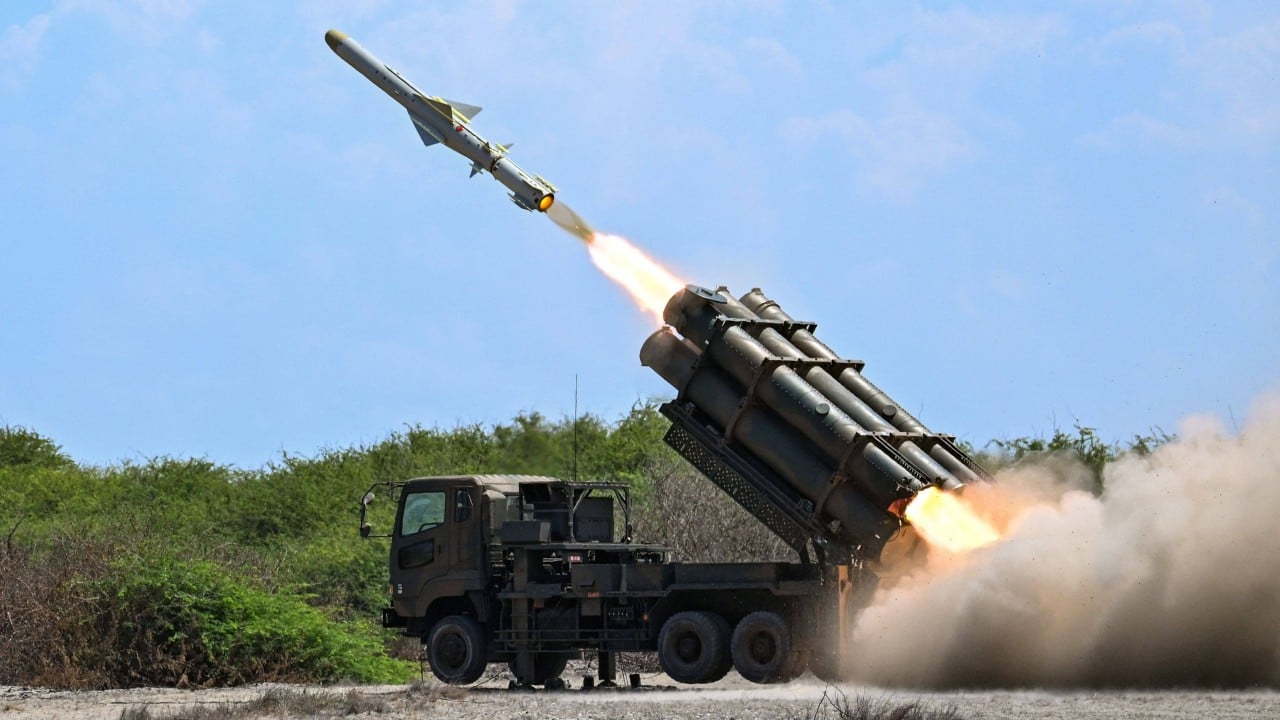
China condemned what it called Japan’s first “offensive missile” test overseas in eight decades, saying Tokyo’s “neo-militarism” and intensified arms race had gained momentum and threatened regional stability.
During the “Balikatan 2026” joint drill led by the United States and the Philippines on Wednesday, Japanese forces fired a Type 88 surface-to-ship missile in the Philippines.
According to China, it was the first time Japan had launched an “offensive” weapon abroad since World War II. The missile can be used for both offensive and defensive purposes, but deploying it outside Japanese territory can be seen as an offensive posture.
Chinese foreign ministry spokesman Lin Jian said it marked a significant departure from Japan’s post-war pacifist stance.
“Japan’s right-wing forces are pushing for an accelerated ‘remilitarisation’ process,” Lin said, adding that Tokyo was constantly overstepping its “exclusively defence-oriented” policy and violating international and domestic legal constraints.
He pointed to Japan’s wartime history of aggression against Southeast Asian countries, including the Philippines.
“The former aggressor has not only failed to deeply reflect on its historical crimes but has instead dispatched military forces overseas and launched offensive missiles under the guise of so-called ‘security cooperation’,” he said.
“A serious deficit in history education and fundamental errors in historical perspective, coupled with strategic schemes for military build-up and war preparation, have allowed Japan’s ‘neo-militarism’ to gain momentum and become a scourge, threatening regional peace and stability.”
Relations between the two East Asian neighbours have been frosty. Tensions soared in November following remarks about Taiwan by Japanese Prime Minister Sanae Takaichi, who said Japan might militarily intervene in a cross-strait conflict. Since then, Beijing has repeatedly accused Japan of “reviving militarism”.
Tokyo in recent years has also stepped up defence and security ties with countries in the first island chain in the Pacific – a key military chokepoint to contain China.
It has also overhauled overseas arms transfer regulations, a move analysts said paved the way for the country to export high-end weapons and defence platforms.
On April 27, Takaichi convened an expert meeting on overhauling the country’s major security policies, citing China as a major geopolitical threat.
China on Thursday submitted a document to the United Nations accusing Japan of maintaining the technical capability to achieve a “nuclear breakout” within a short period.
The Type 88 is a subsonic, mobile anti-ship missile developed in the 1980s with a 180km (112-mile) range. While its capabilities are unlikely to pose much of a challenge to the modern Chinese navy, its overseas deployment is a symbol of a major strategic shift.
In the same exercise, the US Army used its Typhon medium-range missile system to launch a Tomahawk cruise missile on Tuesday. This marked the first test conducted in the Philippines since the land-based Typhon system – capable of firing both Tomahawk and SM-6 missiles – was deployed to the country in April 2024. It was also the first time the US military had launched a Tomahawk cruise missile from Philippine territory.
The Typhon system employs a ground-based vertical launch system to fire the US Navy’s SM-6 and Tomahawk cruise missiles, enabling strikes against a wide range of targets at ranges between 500km and 2,000km. This capability positions the system to potentially engage targets inside mainland China when operated from the Philippines.