
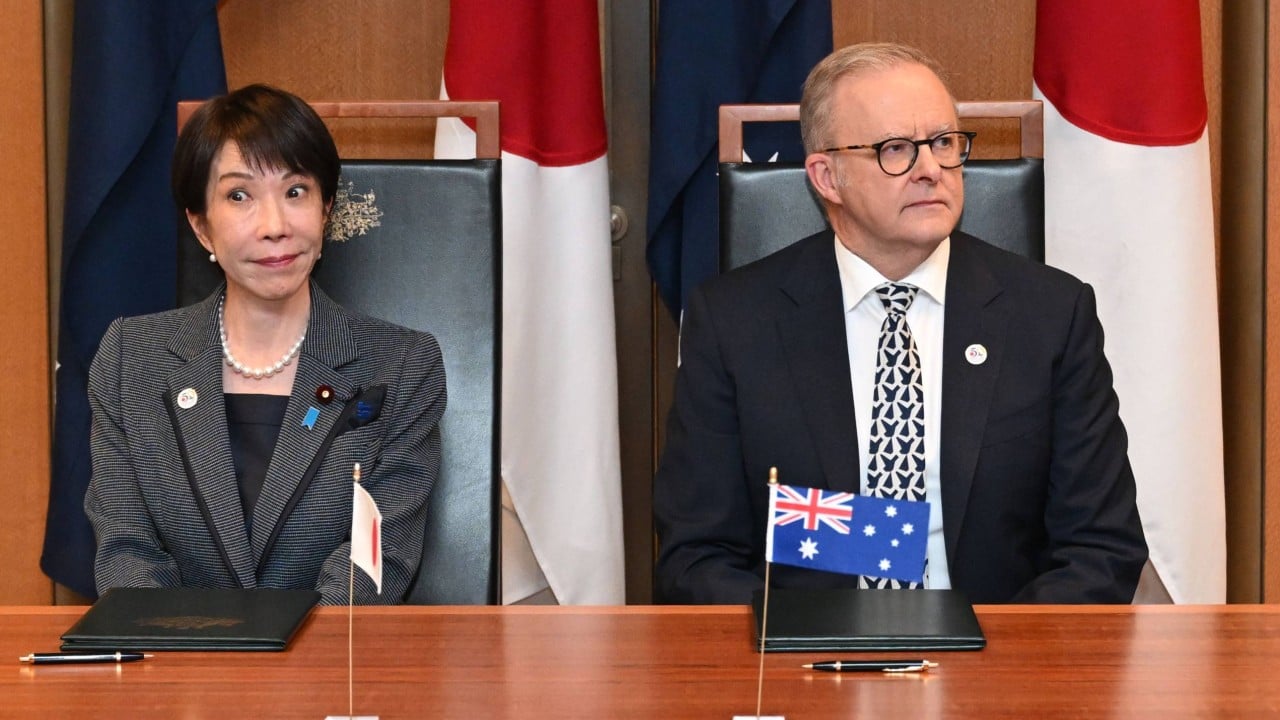
Japan’s prime minister touched down in Australia on Sunday with a set of shared anxieties – about Trump, China and the fragility of supply chains that the two insular nations have long relied upon – to which she sought some small relief.
By the time she departed, Sanae Takaichi and Australian Prime Minister Anthony Albanese had signed an economic security pact, unlocked nearly US$1 billion in critical minerals funding and laid the groundwork for what observers describe as the most comprehensive defence arrangement the two have ever forged.
The centrepiece of her three-day visit was the Australia-Japan Joint Declaration on Economic Security Cooperation, which commits both governments to coordinating responses to economic coercion: a provision analysts say is aimed squarely at Beijing and Washington alike.
Under the agreement, Canberra has committed up to A$1.3 billion (US$935.8 million) in support for critical minerals projects with Japanese involvement, potentially supplying resources including nickel, graphite and rare earths to Tokyo.
“Australia and Japan are taking action to protect our economies from future economic shocks and uncertainty,” Albanese said in a statement.
“By working together, we will achieve more secure and resilient supply chains that will benefit Australian and Japanese businesses and consumers now and into the future.”
Ian Hall, a professor of international relations at Australia’s Griffith University, said Takaichi’s visit “very clearly” signalled that Tokyo wanted its partnership with Canberra to be “properly strategic”, driven by what he called “shared anxieties” about the behaviour of both US President Donald Trump and China, compounded by ongoing disruptions to energy supplies.
“Tokyo is also keen to see Australia accelerate efforts to build a resilient and reliable critical minerals industry and to work together on issues of shared concern, like artificial intelligence,” Hall added.
The US-Israel war on Iran and ensuing near-total closure of the Strait of Hormuz have throttled energy flows to the Asia-Pacific, leaving Japan – which imports about 95 per cent of its crude oil from the Middle East – acutely exposed.
Takaichi told reporters on Monday that Tokyo and Canberra would “closely communicate with each other in responding with a sense of urgency” to the strait’s closure and its knock-on effects.
Meanwhile, China’s dominance in critical minerals has become an area of concern for both countries.
Earlier this year, Beijing tightened export restrictions on hi-tech metals such as gallium, germanium to Japan amid tensions over Takaichi’s Taiwan remarks, in a blow to the neighbouring nation’s advanced manufacturing sector.
This followed years of Chinese import embargoes imposed on Australian coal, barley and Japanese seafood, and the months of turmoil caused by Trump’s “reciprocal” tariff regime on exports to the US.
Australia and Japan, both middle powers, have learned, at cost, what supply-chain dependency looks like when a great power turns hostile.
The ‘quasi-alliance’
Though the economic dimension of their talks was undoubtedly significant, analysts say the two leaders’ joint statement on “enhanced defence and security cooperation” could prove more impactful in the long run.
In it, Takaichi and Albanese instructed their ministers to explore ways to “further elevate and institutionalise” security cooperation ahead of their next summit – diplomatic language that hints at a deepening of what some have described as their burgeoning “quasi-alliance”.
Security specialist Rintaro Inoue, a research fellow at Institute of Geoeconomics think tank in Tokyo, said the two sides appeared to be moving towards “a more comprehensive defence arrangement” that would give their military relationship a legal and institutional foundation – potentially including the development of combined facilities on Australian soil, beyond the range of adversaries’ missiles.
“At the same time, such an arrangement would likely stop short of creating a mutual defence obligation,” Inoue said.
Last month, Australia and Japan signed contracts for the first three of a US$7.2 billion order of Mogami-class frigates, with Mitsubishi Heavy Industries set to build the first of the vessels in Japan before Australia constructs a further eight at a shipyard in Western Australia.
For Ryosuke Hanada, a PhD candidate in Japanese foreign and security policy at Australia’s Macquarie University, Takaichi’s visit was ultimately about stabilisation and locking in a dependable partner as the strategic environment grows more volatile.
“The aim [is to] share a common direction for maintaining a free and open order in the face of China’s aggressive actions,” he said, adding that for Tokyo, close ties with Canberra offered a hedge against overdependence on either Washington or Beijing.
Australia, for its part, stands to gain not only in defence-industrial terms but in the export of coal, iron ore and liquefied natural gas, which form the bedrock of its trade relationship with Japan.
Takaichi arrived in Australia fresh from Vietnam, where she had similarly pressed for regional supply chains to be fortified against external disruption.