
North Korean ruler Kim Jong-un’s recent display of nuclear-processing capabilities appears timed with reports of an impending visit by China’s leader and fuelled by insecurities about Seoul’s nuclear submarine talks with Washington.
Analysts also say that mounting trilateral talks involving the United States, Japan and South Korea have galvanised Kim into doubling down on Pyongyang’s status as a nuclear-armed state.
The state-run Korean Central News Agency (KCNA) announced on Friday that Xi Jinping would “pay a state visit” to North Korea on Monday and Tuesday at Kim’s invitation.
The brief dispatch provided no further details of the trip, which will mark the Chinese leader’s first visit to North Korea in nearly seven years.
The pair last met in September, when Kim travelled to Beijing for the 80th anniversary of China’s Victory Day. Russian President Vladimir Putin was also at the military parade.
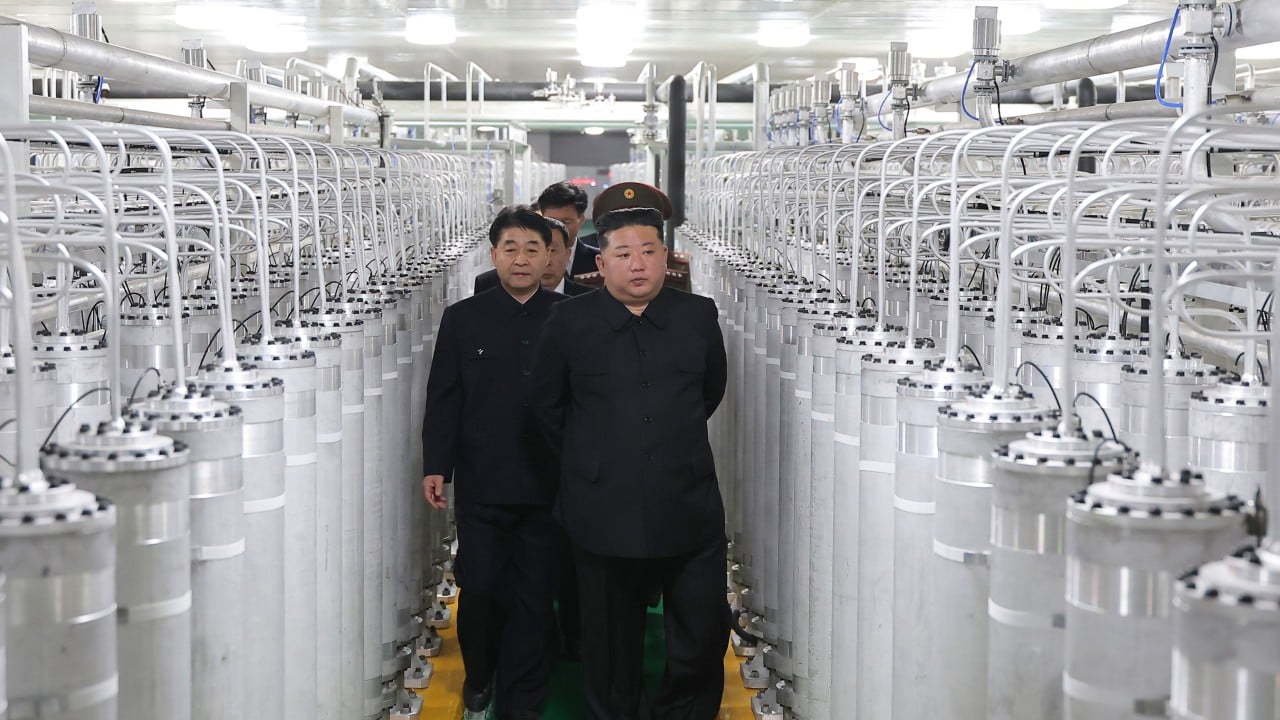
The announcement came a day after KCNA reported that Kim had visited a newly launched nuclear-material production facility earlier this week, highlighting the country’s advances in producing fissile material and nuclear weapons.
Kim also vowed to “exponentially” strengthen the country’s nuclear arsenal during the visit, KCNA said, without disclosing the facility’s location or other details.
South Korea’s defence ministry later said at a press briefing it believed the facility was a newly built uranium-enrichment plant, as claimed by its rival.
North Korea is currently believed to operate uranium-enrichment facilities at three sites – Yongbyon, Kangson and Kusong.
Photographs released by North Korean state media showed rows of cylindrical centrifuges, used to enrich uranium, packed tightly inside the facility.
Observers say the facility is most likely a newly opened plant within the Yongbyon nuclear complex, although it could also be a previously undisclosed fourth enrichment site.
Kim has said the country’s “weapons-grade nuclear material production capacity more than doubled” over the past five years, while stressing “potential threats and unpredictable long-term crises” to legitimise the build-up.
His remarks made clear that Pyongyang has no intention of scaling back its nuclear ambitions, according to observers.
Pyongyang’s Ninth Party Congress, held earlier this year, also adopted a new five-year plan that includes expanding nuclear-material production capacity and increasing the number of nuclear weapons in North Korea’s arsenal.
‘Irreversible reality’
Analysts say Kim is sending signals to both the US and China ahead of Xi’s planned visit, particularly as halting Iran’s nuclear programme has become a key rationale for American military action in the Middle East.
“The message is clear: North Korea will not succumb to any pressure, including military threats from the US, to abandon its well-developed nuclear arsenal,” Oh Gyeong-seob, a senior research fellow at the Korea Institute for National Unification, told This Week in Asia.
“North Korea is also seeking to justify its nuclear build-up by pointing to South Korea’s efforts to develop nuclear-powered submarines in cooperation with the US.”
Earlier this week, Washington and Seoul discussed cooperation on South Korea’s plans to build nuclear-powered submarines and secure civilian uranium-enrichment and spent-fuel reprocessing capabilities.
Oh said US efforts to strengthen trilateral security cooperation with South Korea and Japan were also contributing to Pyongyang’s sense of insecurity, particularly after the recent Xi-Trump summit where both leaders agreed on the goal of North Korean denuclearisation.
“By showcasing its enhanced nuclear capabilities, North Korea is seeking to impress upon the world, ahead of President Xi’s visit to Pyongyang, that its status as a nuclear-armed state is an irreversible reality,” he said.
North Korea is estimated to have assembled about 50 nuclear warheads as of January 2024 and possesses enough fissile material for an estimated 70 to 90 nuclear weapons, according to a report published by the Arms Control Association in June that year.
Lim Eul-chul, a professor at the Institute for Far Eastern Studies at Kyungnam University, said that as South Korea-US discussions on nuclear-powered submarines advanced, Pyongyang was likely to accelerate both the qualitative and quantitative expansion of its nuclear deterrent.
“This cycle of tit-for-tat escalation will only heighten tensions, with North Korea quickening its nuclear build-up in response to stronger deterrence measures by Seoul and Washington,” he warned.
Yang Moo-jin, a professor at the University of North Korean Studies, agreed that North Korea’s open display of its nuclear capability signalled its intent that “denuclearisation is no longer a subject for negotiation”.
On Xi’s coming visit, Yang said securing Beijing’s support and understanding remained essential for North Korea as it pursued the strategic objectives outlined at the party congress.
“As North Korea’s growing closeness with Russia could make China uncomfortable, Pyongyang recognises the importance of carefully managing its relationship with Beijing,” he said.
“At the same time, North Korea is expected to remain firm in its nuclear policy, maintaining its commitment to strengthening what it calls its ‘self-defensive nuclear deterrent’.”
This could include continued increases in nuclear-material production, the expansion and deployment of nuclear weapons, and further efforts to justify the strengthening of its nuclear forces, Yang said.
Meanwhile, China is seeking to maintain its position as an indispensable mediator while expanding its influence over developments on the Korean peninsula ahead of any future US-North Korea dialogue, according to Yang.
Xi’s visit would also help “prevent North Korea from drifting further from [Beijing’s] orbit”, Yang said. “China continues to view North Korea as a strategic buffer against US efforts to contain China and against the strengthening of trilateral security cooperation among the US, South Korea and Japan.”