
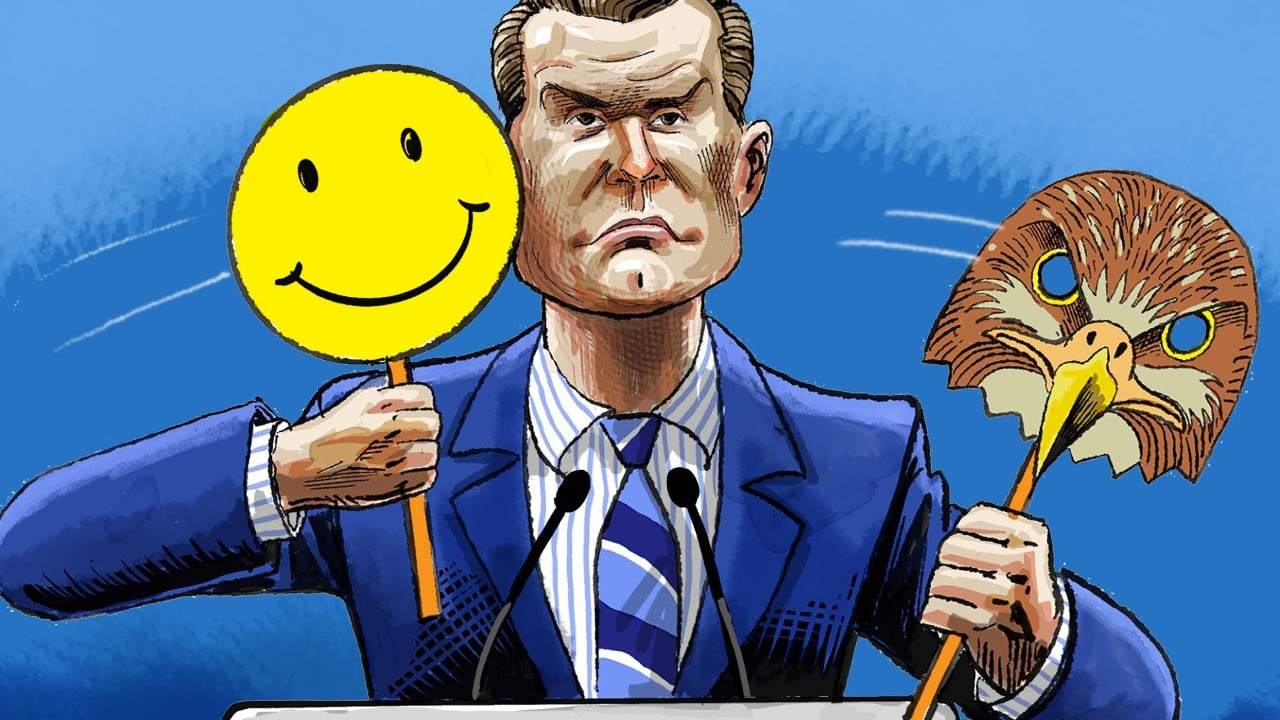
Listening to US Defence Secretary Pete Hegseth at the recently concluded Shangri-La Dialogue in Singapore, I thought of the iconic Sichuan opera act of face-changing, where performers switch masks in an instant.
Last year, Hegseth’s speech at the event was filled with blatant attacks on China. This year, he put on a completely different face, declaring that: “Under President Trump’s leadership, relations between the United States and China are better than they’ve been in many years.”
Why this 180-degree turn? The answer lies in Donald Trump’s recent visit to Beijing, hailed by him as a “tremendous success”. If unwavering loyalty is the foremost requirement from Trump, then Hegseth’s performance, as one of his top lieutenants, perfectly embodied this ethos.
Hegseth’s speech did not mention Taiwan. Again, this was no surprise. Trump, it seemed, had little to say on the Taiwan issue in Beijing. On his way back, he said he had not yet decided on US arms sales to Taiwan, that “we’re supposed to travel 9,500 miles (about 15,300km) to fight a war. I’m not looking for that”.
Washington will find it increasingly hard to sell arms to Taiwan. As the China-US power gap narrows, Beijing now has a spectrum of retaliatory tools: cancelling pre-agreed bulk purchases from US firms, imposing sanctions on American defence contractors, or staging larger, more frequent and complex military exercises around the island.
Beijing can even deploy all three tactics simultaneously in a coordinated counterstrike to maximise pain on the US. Washington will ultimately be forced to assess if these arms sales, while lucrative, draw the US into an unwinnable military conflict.
In his speech, Hegseth noted that the US military was meeting more frequently with its Chinese counterparts. This is good news if true. Formal military dialogue mechanisms have been scarce. A host of once-established channels – including talks between both countries’ joint chiefs of staff and dialogues between the two armies – had been suspended. If fully restored, how could these old bottles be filled with new wine?
At the 2024 Lima meeting, President Xi Jinping and then US president Joe Biden agreed that nuclear command and control must remain under human oversight. While Trump is keen to dismiss any Biden legacy, he has no grounds for opposing this accord. The drone attacks of Russia and Ukraine show how artificial intelligence is advancing at breakneck speed on the battlefield. As the dominant AI powers, China and the US ought to take the lead in establishing binding norms governing the military application of this technology.
Old ideological ghosts haunted Hegseth’s remarks. His implicit narratives framing China as a hegemonic power and raising concerns over China’s military build-up are clearly visible. But this argument carries little persuasive weight when Trump’s America has threatened allies and partners, and launched wars. It is no surprise China’s global approval ratings have climbed to surpass America’s in some polls. According to an analysis in Foreign Affairs magazine, China is “winning by waiting”.
No American ally and partner in the region will answer Hegseth’s call to raise their defence budgets to 3.5 per cent of their gross domestic product. Japan has poured extensive resources into boosting its military budget yet only managed to reach an estimated 2 per cent of its GDP, while South Korea, boasting the highest figure among regional allies, is at just 2.8 per cent.
An alliance system can resemble a criminal gang, with the boss calling the shots and underlings obeying unquestioningly, yet this arrangement hinges on the boss bearing the bulk of the responsibility and paying most of the costs. Hegseth’s warning against a “free ride” and his talk of increasing the defence “burden sharing” violate this unspoken rule.
Several times, Hegseth spoke of the importance of being “strong, quiet, clear”. It’s not clear what he means – though “strong” may be the most straightforward concept of the three to understand. One wonders, however, how his strongly worded suggestion of “less Shangri-La, more ships, more subs” went down with the organisers of the annual defence forum.
Hegseth also vowed to be “clear about our intentions, our priorities and our ability to deliver on the administration’s goals”. He spoke of pairing military with “clarity of intent”, promising to be “intentional about how and when we communicate” and to “lead first and foremost with actions”.
Does America’s war on Iran show “clarity of intent”? No one knows exactly why Trump launched a military strike against Iran, never mind the speculation he was goaded into operations by Israeli Prime Minister Benjamin Netanyahu.
The most nebulous of the three terms is “quiet”. My hunch is this: how can the world’s sole supranational power suddenly decide to become quiet? The first priority in America’s national strategy now is the western hemisphere. The so-called Donroe doctrine suggests a strategic retreat from the rest of the world; however, we are seeing exactly the opposite.
Much has been said about whether America is in decline. If, as appears, it is becoming more reckless and unpredictable, then, yes, it is in decline. The question then is how much more dangerous America can become. Is Cuba the next target?
The most important outcome of Trump’s Beijing visit is a consensus on “constructive strategic stability”. In this regard, it is not strange that Hegseth’s address contained more gestures of goodwill towards China than some of his predecessors, but stability is never static. The challenge is how it can be maintained amid the fierce competition.