
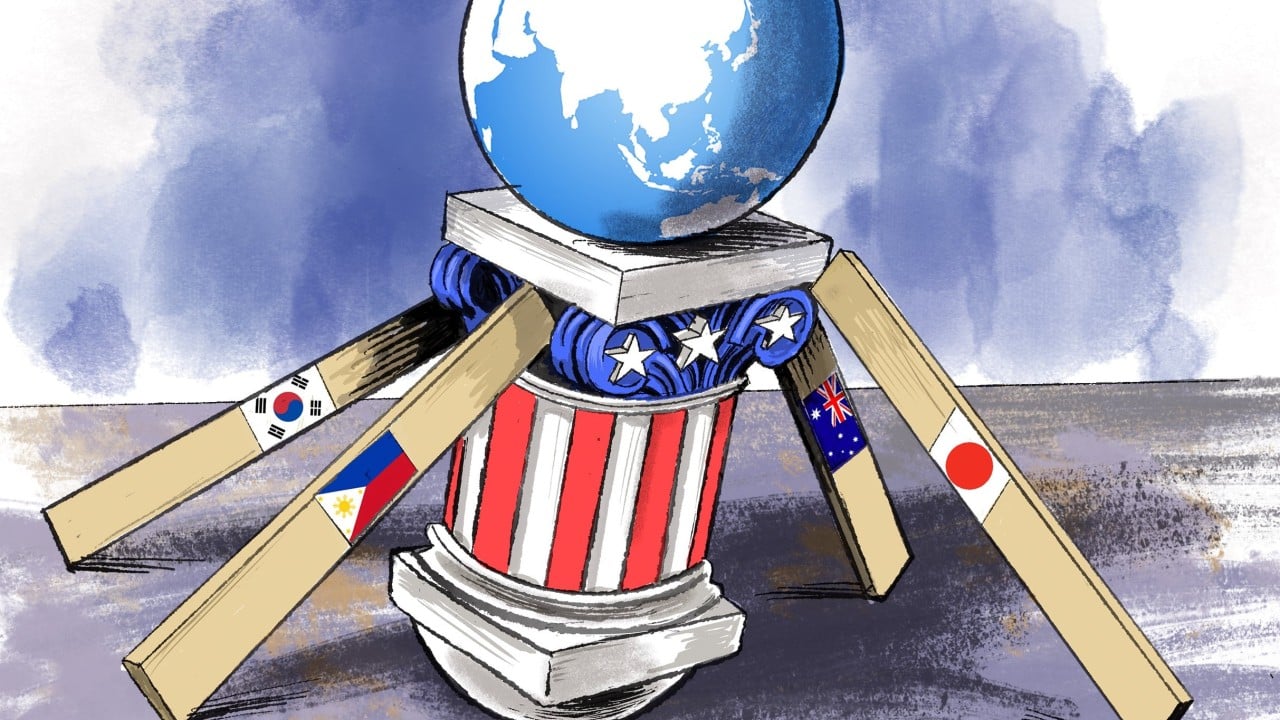
“In an increasingly severe security environment, no single country can now protect its own peace and security alone,” declared Japanese Prime Minister Sanae Takaichi last month, signalling a major shift in Tokyo’s defence posture.
“Under the new system, we will strategically promote equipment transfers while making even more rigorous and cautious judgments on whether transfers are permissible,” she added, confirming long-running speculation that Tokyo would relax decades-old restrictions on exports of high-end military equipment.
Thanks to its post-war pacifist constitution, Japan previously limited military equipment exports to non-lethal categories, namely for transport, rescue, surveillance, minesweeping and early warning systems purposes. Though Tokyo will still refrain from sending armaments to nations engaged in conflict, as many as 17 major defence partners can now benefit from Japan’s cutting-edge military technology.
Takaichi’s cabinet chief, Minoru Kihara, clarified the policy is “intended to safeguard Japan’s security and further contribute to the peace and stability of the region”.
The announcement came a day into the annual Philippine-US Balikatan exercises, in which Japan, for the first time in history, has deployed a massive combat mission composed of 1,400 members of Japan’s Self-Defence Forces.
The war games featuring more than 17,000 troops from seven nations saw Tokyo also deploying major platforms such as the Type 88 surface-to-ship missile system, a US-2 amphibious aircraft, C-130H transport aircraft, the JS Ise warship, JS Shimokita landing ship and the destroyer JS Ikazuchi. To solidify relations with Manila, the host of the exercises and this year’s Association of Southeast Asian Nations (Asean) chair, Tokyo announced a state visit by Philippine President Ferdinand Marcos Jnr.
This is less the re-emergence of Japan as a military power, given its shrinking economy and population, and more a major reconfiguration in the regional security architecture.
Uncertain about Washington’s reliability as an ally and a pillar of a rules-based international order, US allies are coming together to cooperate strategically in anticipation of a more fluid and multipolar Indo-Pacific. Amid China’s rapid ascent as a superpower, nations such as Japan, South Korea, Australia and the Philippines are steadily building their own “squads” to shape an increasingly post-American order in Asia.
The US wants it both ways: it has sought to enjoy access to prized military facilities across Asia while also prodding allies to become more self-reliant. The “hegemony on the cheap” policy is on full display under US President Donald Trump’s administration, which has made it clear in key documents such as the US National Defence Strategy that frontline allies should expect “limited support” and engage in more “burden-sharing” with Washington.
The US has also been pressing its allies to expand defence spending, buy more American military hardware, and, importantly, host key defence assets. Given its limited resources, the Philippines has offered the US greater access to its key military facilities and, crucially, agreed to host the much-vaunted Typhon missiles – an indispensable part of a US-led “Great Wall of Missiles” strategy against China
Washington has leveraged the Balikatan exercises in preparation for a potential war against Beijing through deployment of key military assets and major drills in the South China Sea and near Taiwan. It also recently announced plans to jointly establish a massive industrial hub in northern Philippines, ostensibly to create an alternative China-free supply chain, and to build a weapons depot in the Southeast Asian nation.
The war on Iran, however, exposed the potential hollowness of America’s regional leadership. The ill-conceived war has seen Washington deplete its critical munitions reserves, leave key Persian Gulf allies vulnerable to the onslaught of Iranian counter-attacks and trigger energy supply shocks in resource-poor Asian allies as Tehran began to restrict vessels’ passage through the Strait of Hormuz.
Apparently enraged by Trump’s insensitivity to the key Asian allies’ concerns, Marcos even signalled openness to sharing disputed energy resources in the South China Sea with Beijing while purchasing oil from Russia and coordinating with Tehran on the passage of its tankers in the Persian Gulf. Also visibly frustrated by Washington, Singapore made it clear that it wouldn’t necessarily side with the US should a major war break out in Asia.
Determined to not be at any superpower’s mercy, frontline allies are stepping up middle-power coalition-building. While Japan is expected to expand defence technology sharing with like-minded regional powers, with Australia recently finalising a multi-billion warship deal with Tokyo, the Philippines is exploring the purchase of advanced fighter jets, submarines and missile systems from South Korea, India, Japan and Europe.
Hosting South Korean President Lee Jae Myung in Manila earlier this year, Marcos emphasised the need for greater strategic cooperation, especially in the realm of shipbuilding, energy security and military modernisation, in response to “growing uncertainty in geopolitical developments”. Meanwhile, Japan and South Korea are expanding defence cooperation with Europe.
The relative inefficacy of the US’ expensive missile defence platforms during the war with Iran has encouraged allies to explore practical alternatives. Given the success of Iran’s saturation strategy, earlier joint drone production plans, such as the one between a US Asian ally and a European partner, have gained renewed urgency.
Having finalised a reciprocal access agreement with Japan, as well as visiting forces agreements with countries such as Canada, New Zealand and France, the Philippines has emerged as a pivotal part of an emerging Indo-Pacific middle-power coalition. Manila will play a crucial role in accelerating the creation of new minilateral squads with an eye on a rising China and an unreliable America.