
In the weeks leading up to Donald Trump’s second inauguration, conservatives in Japan were delighted and hopeful that his return would usher in robust economic growth, new trade opportunities and a stronger security relationship with Tokyo.
Now, barely 18 months later, many of the conservatives admit to being shocked at the state of the bilateral relationship and mounting global uncertainties due to the US president’s policies.
The conflict that he started in Iran was the final straw for some of his diehard supporters in Japan, such as Ken Kato, who owns a company in Tokyo that sells religious items.
“Everything that is going on right now is worrying because the decisions he is making have a direct impact on people in Japan,” Kato said.
“Petrol prices have risen, but not too much, although that could change. But the price of everything else has gone much higher, especially food. This is very worrying for ordinary people.”
Kato admitted to being horrified at Trump’s recent decision to withdraw 5,000 US troops from Nato ally Germany because Berlin would not commit its forces to the US war against Iran. Trump has made similar threats against Italy and Spain.
“Withdrawing troops from Germany is very worrying and tells me that Trump just does not understand the importance of the Nato alliance and other similar security agreements, like the agreement with Japan,” he said. “This is a punishment, and I am very concerned that the same thing could happen to Japan.”
Another looming concern is over Trump’s scheduled visit to China to meet President Xi Jinping next week, according to Kato.
“China has influence over Iran, and my fear is that China is going to offer to intervene with Tehran to help Trump out of the problems he is having there,” Kato said, adding that this could be in exchange for Trump reducing his support for Japan.
According to an ongoing public opinion poll on Japan’s Yahoo News site, only 5.9 per cent of Japanese respondents said the Trump administration’s policies had been “very good”, compared with 83.7 per cent said they were “very bad”, and 5.8 per cent considered them “quite bad”.
Sumie Kawakami, a social sciences lecturer at Yamanashi Gakuin University, said the proportion of Japanese people who viewed Trump’s policies as negative was likely higher than the survey results.
“Japanese people are quite resilient and can withstand hardship, but it is clear that rising prices are making life difficult for a lot of people,” she said. “Part of the problem is that there seems to be no end to the conflict in Iran on the horizon, and we do not know how soon things will be able to return to normal.”
One online user who posted on the President magazine published in Japan expressed disappointment over Trump’s unsubstantiated statements.
“He’s driven by self-satisfaction, self-importance and the indirect pursuit of benefit for himself and his associates. I want the American people to fully understand the reality that the global economy and world peace are being manipulated by this person before the midterm elections.”
One post reads: “He frequently criticises others for having a low IQ, but I think he himself has one of the lowest IQs of any president. He’s utterly vulgar. And there are also problems with a society that produced such a person.”
Malcolm Adams, an entrepreneur who has lived in Japan since 1976, said his Japanese friends and business partners were tired of financial uncertainties arising from Trump’s tariffs and concerned that Washington’s security guarantees for Tokyo were no longer valid.
“He has shaken the trust in every part of the relationship,” said 77-year-old Adams, who was originally from Nebraska and now runs businesses in Kakegawa City, Shizuoka prefecture.
“The tariffs have hurt businesses, the Iran war has shown Japan just how vulnerable it is, as prices rise, and the geopolitical situation that we find ourselves in is not of Japan’s doing.”
Adams said the rising sentiment among his Japanese contacts against Trump mirrored the trend in the US. Noting that there had been some anti-Trump protests in Japan, Adams said he expected more Japanese to rally in the streets against his policies.
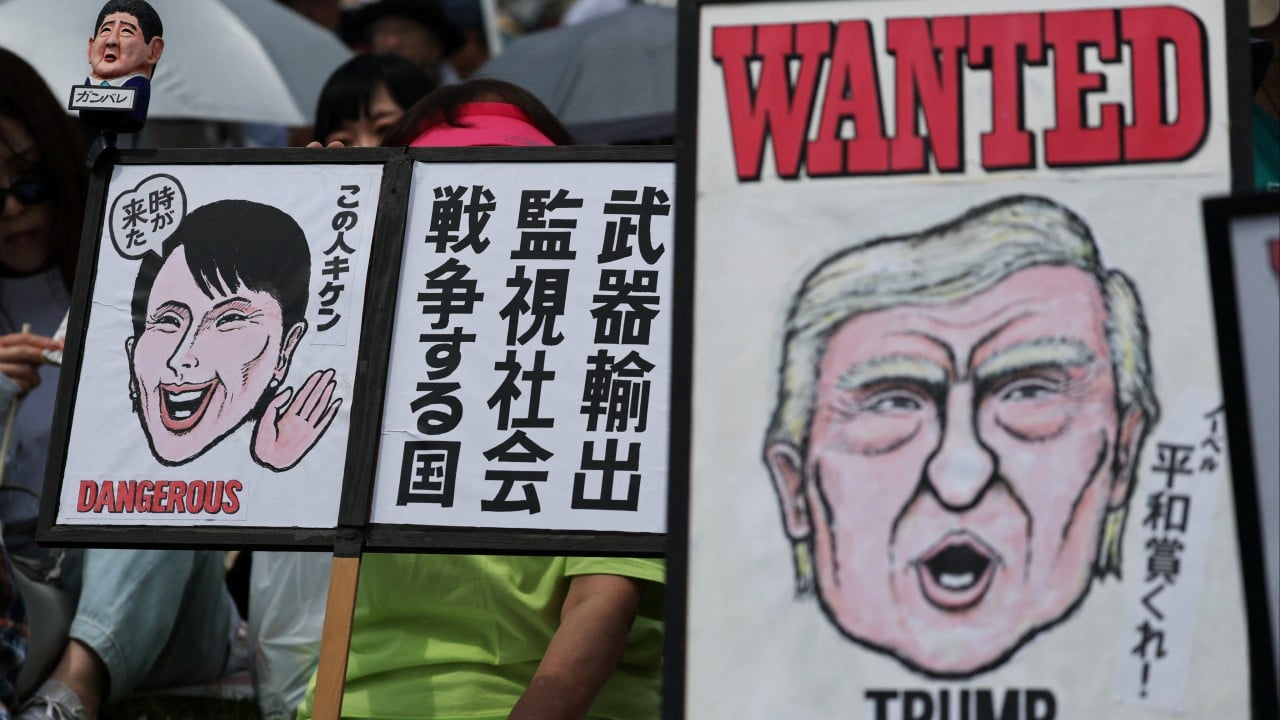
Dozens of protestors gathered outside Prime Minister Sanae Takaichi’s official residence in Tokyo in March, before she flew to Washington for talks with Trump. They demanded that Takaichi not give in to pressure from the US to commit troops to the conflict in the Middle East.
There were also protests last weekend in several cities across Japan in support of efforts to protect the constitution, which Takaichi had vowed to revise, alongside anti-Trump demonstrations. As many as 50,000 people reportedly gathered at a park in Tokyo to voice their opposition against the Iran conflict.
Kawakami said she was “disappointed” that there had not been more protests against US policies in Japan.
Given that the present crisis could persist for months, the Japanese public could reach a breaking point, she added.
Adams said: “I think Japanese people have been quite restrained in expressing their feelings so far, but that is changing. To them, this is personal because it is affecting them personally.”