
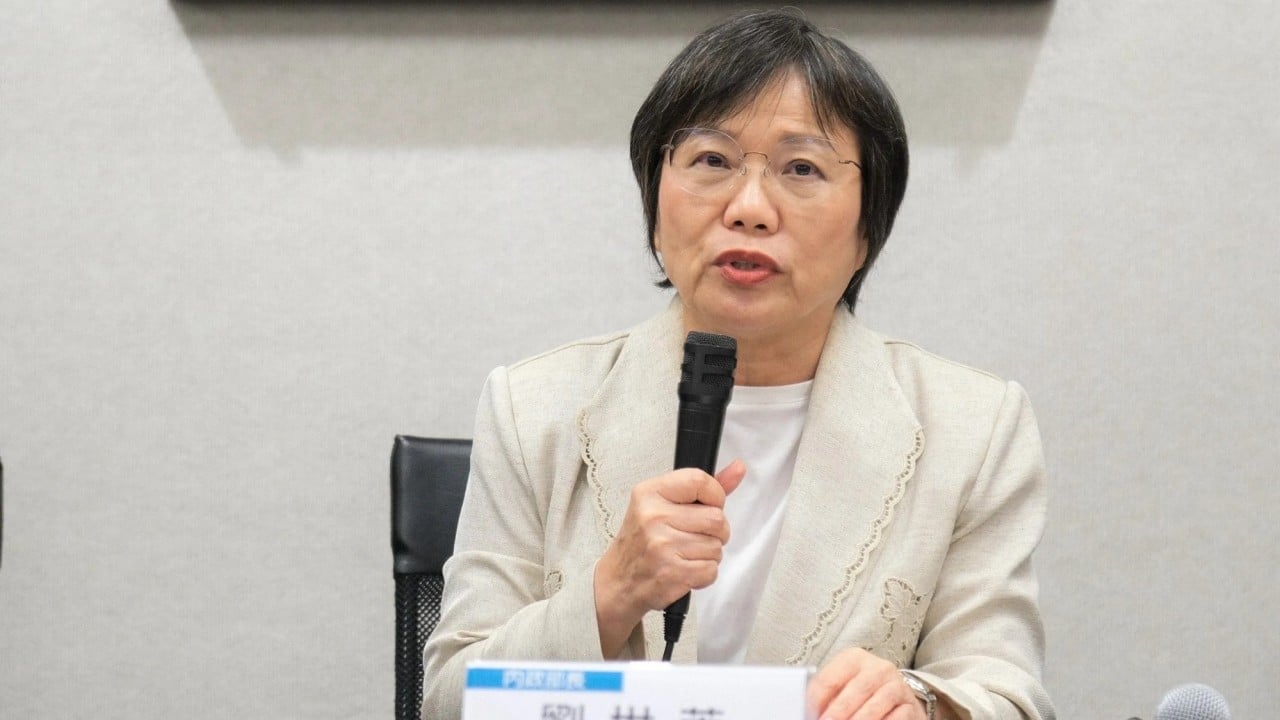
A Taiwanese company with mainland subsidiaries has fired the nephew of Taiwan’s interior minister, whom Beijing deems responsible for Taipei’s hostile policies towards the mainland.
The mainland subsidiary of Taiwan’s Long Time Technology Co. Ltd in Shanggao county, Jiangxi province, issued a statement on Wednesday night saying Yen Wen-chun, the nephew of Liu Shyh-fang, was dismissed from all positions he held at Long Time Technology and its mainland subsidiaries from April 7.
The statement said the company “solemnly pledged” to strictly require all employees to “stay away from any political behaviour that undermines peace and stability across the Taiwan Strait”.
It also said its corporate funds were used “solely for pure industrial research and development and business development”, “strictly prohibiting any resources from being used to directly or indirectly support individuals or organisations with specific political stances, such as those advocating ‘Taiwan independence’ or violating the one-China principle”.
In January, Liu and Taiwan’s education minister Cheng Ying-yao were designated as “staunch Taiwan independence figures”.
Beijing’s sanction list banned them and their families from entering mainland China, Hong Kong and Macau, and all companies associated with them are prohibited from engaging in profit-making activities in mainland China.
Beijing had accused Liu of “blatantly promoting separatist ‘Taiwan independence’ rhetoric”, as well as “persecuting mainland spouses in Taiwan and actively creating obstacles to cross-strait personnel exchanges”.
Before the sanction, Yen Wen-chun served as the general manager of Long Time Technology, headquartered in Taiwan’s New Taipei City. The company has promoted Terry Hu, the general manager of its subsidiary in Jiangxi province, to replace Yen, according to the company’s official website.
The Taiwanese company, established in 2009, primarily produces lithium-ion battery anode materials. It established three companies in Jiangxi, Guangdong, and Yunnan provinces in mainland China.
In February, Ta Kung Pao, a newspaper based in Hong Kong, said Yen’s senior positions in three mainland companies had allegedly provided political donations to Liu, triggering an investigation by the mainland’s Taiwan Affairs Office.
Chen Binhua, a spokesman for the State Council’s Taiwan Affairs Office, said on Wednesday that the mainland government would not allow “those who support secessionism and damage cross-strait relations” to make money on the mainland while backing “secessionist activities” on the other hand”, according to Xinhua.
He stressed that these measures targeted only a few secessionists and did not affect most people or businesses in Taiwan, according to mainland China’s state news agency.
Meanwhile, on Thursday, mainland police also announced the detention of an internet user in central mainland China who had used an unauthorised AI-generated digital avatar of Cheng Li-wun, the chairwoman of Taiwan’s main opposition party, the Kuomintang, during a live-stream, allegedly in a bid to attract eyeballs and boost sales.
The Ministry of Public Security’s cybersecurity bureau said the suspect, surnamed Xing and living in Datong, Shanxi province, said he wanted to leverage media attention generated during Cheng’s visit to the mainland last month.
Her trip included a meeting with the Communist Party’s general secretary Xi Jinping – the first between the leaders of the Communist Party and the KMT in nine years – in which Beijing played up a message of peace and economic cooperation with the island.
Shanxi police have put Xing under administrative detention, the statement said, which usually does not incur indictment.