
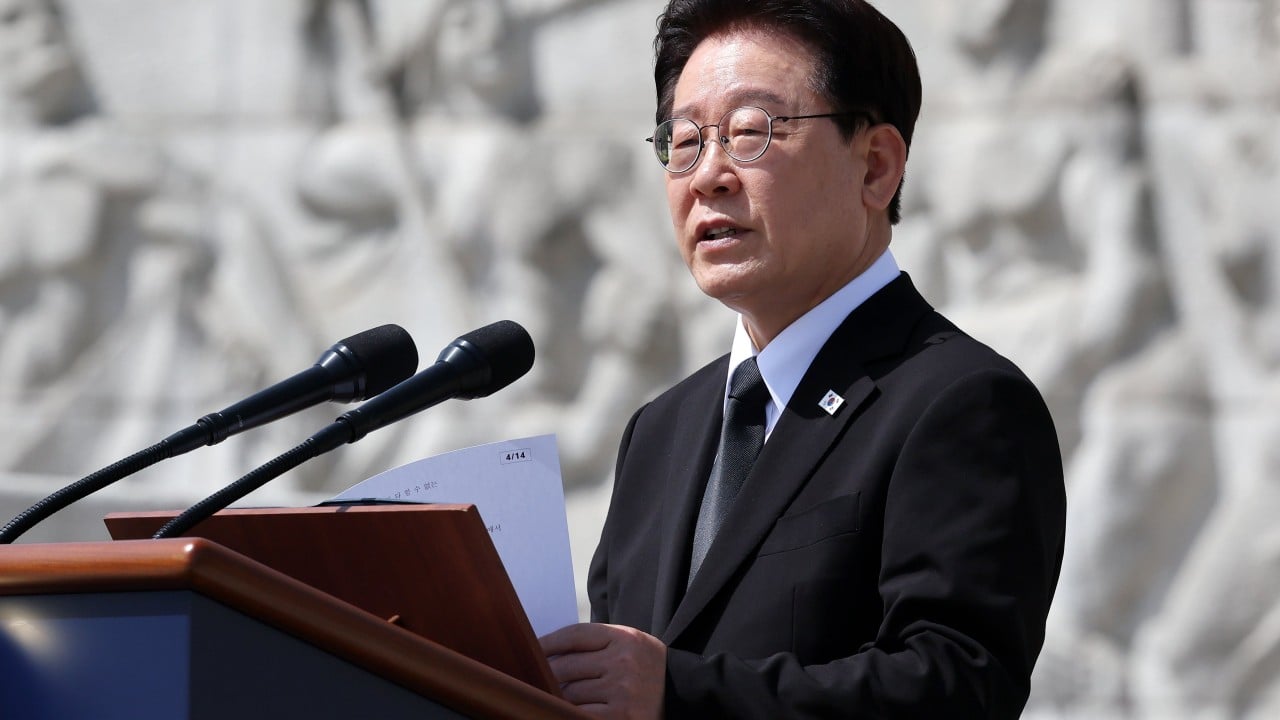
Bolstering strategic partnerships and economic ties will be high on the agenda during South Korean President Lee Jae Myung’s six-day trip to India and Vietnam, as Seoul seeks to expand cooperation with the Global South amid the Middle East turmoil.
Lee, who arrived in New Delhi on Sunday, is scheduled to meet Prime Minister Narendra Modi, business leaders and Korean expatriates before concluding the visit on Tuesday.
National security adviser Wi Sung-rak said South Korea will “comprehensively strengthen the special strategic partnership and present a vision for expanding mutually beneficial and strategic cooperation” with India, calling it a “key partner in expanding the scope of our pragmatic diplomacy centred on national interests”.
Kang Jun-young, a professor of international relations at Hankuk University of Foreign Studies, said that mounting global supply chain uncertainties – including energy security issues linked to the wars in Iran and Ukraine – and the intensifying US-China rivalry have prompted Lee to “broaden the country’s diplomatic horizon and diversify trade partners”.
Seoul and Delhi aim to accelerate talks to upgrade their Comprehensive Economic Partnership Agreement, with a goal of boosting bilateral trade to US$50 billion by 2030 from about US$27 billion last year.
In addition to enhancing coordination on regional and global issues, both sides are also expected to scale up their partnership in the shipbuilding, maritime industries, finance, artificial intelligence and defence sectors.
In Vietnam, Lee is looking to provide fresh momentum for bilateral relations, with a target of US$150 billion in trade by 2030 from around US$88 billion last year.
His trip to Hanoi comes eight months after Vietnamese leader To Lam visited South Korea as the first state guest of the Lee administration.
The two countries aim to strengthen collaboration in economic security – including energy, nuclear power, supply chain resilience and critical minerals – while broadening cooperation in science, technology, climate change and talent development.
Cultural exchanges and people-to-people ties are also expected to grow, reflecting the increasingly close relationship between the two nations.
“Lee is applying a pragmatic approach to diplomacy by reaching out to Global South countries, whose roles are becoming increasingly important in securing stability in global supply chains,” Kang said, pointing to the president’s recent tour of Singapore and the Philippines, where he sought to expand economic cooperation.
He noted that Seoul previously faced backlash from Global South nations for focusing too heavily on natural resources rather than sharing technology and the broader benefits of economic development.
“With this criticism in mind, South Korea is now taking more cautious, tailored approaches to meet the specific needs and interests of each country,” he said.
“For South Korea, India is a key strategic partner in South Asia,” Kang said, adding that prospects for bilateral cooperation are strong in manufacturing and strategic industries.
“In Vietnam, South Korea finds a partner for co-prosperity, where major Korean companies operate large manufacturing bases,” he said.
South Korea’s accumulated investment in Vietnam exceeded US$90 billion as of early 2026, driven largely by technology giants such as Samsung and LG.
Bilateral trade is also robust, spanning electronics, semiconductors, clean energy and other hi-tech industries.
Hur Jung, a professor in the economics department at Sogang University, said both India and Vietnam are critical partners in global supply chains.
Delhi also plays a central role in the US-backed IMEC, a proposed multimodal trade route linking India to Europe via the Middle East.
“South Korea aims to expand its presence in these alternative supply routes, whose importance is expected to grow once the situation in the Middle East stabilises,” Jung said.
He added that Vietnam holds one of the world’s largest rare earth reserves after China – resources that are crucial for South Korea’s semiconductor industry.
“South Korea needs to diversify its rare earth supply sources amid intensifying strategic competition between China – its largest trading partner – and its traditional ally, the United States,” he said.
“Vietnam welcomes South Korea’s technology and investment as it seeks to transition towards hi-tech industries, following years of export-driven growth similar to South Korea’s own development path,” he said.
Jung Suk-koo, former executive editor of the progressive Hankyoreh daily, said the inclusion of business leaders – particularly heads of South Korea’s four largest conglomerates – highlights the economic focus of Lee’s trip.
“It is also noteworthy that top banking and financial leaders are part of the delegation, suggesting that cooperation could expand into financial sectors such as mobile banking,” he said.
“In summary, Lee’s visit to India and Vietnam is part of South Korea’s broader effort to help rebuild global supply chains and reorganise production bases worldwide after the Middle East war.”