
Countries worldwide scrambled on Thursday to trace people who had left the cruise ship hit by a hantavirus outbreak before it got marooned off the coast of Cabo Verde, to prevent further spread of the disease.
Three people – a Dutch couple and a German national – died in the outbreak on the MV Hondius. Eight people, including a Swiss citizen, were suspected to have contracted the virus, according to the World Health Organization.
The vessel’s operator, Oceanwide Expeditions, said 29 passengers left the ship on April 24 on the remote South Atlantic island of St Helena, where it made a stop on its way to Cabo Verde before the outbreak was reported. The Dutch government said around 40 passengers had disembarked there.
The people who left the ship to return to their home countries were of at least 12 different nationalities, Oceanwide Expeditions said. It added that there were also two people whose nationalities were unknown.
One of those to disembark was the wife of the Dutchman who had died aboard the ship on April 11. She fell sick herself and died before she could reach the Netherlands.
Dutch airline KLM on Wednesday said it had taken the woman off a plane in Johannesburg on April 25 due to her deteriorating medical condition.
According to broadcaster RTL, a KLM stewardess who had been in contact with her has since been admitted to a hospital in Amsterdam after showing possible symptoms of a hantavirus infection.
The Dutch health ministry did not mention her job or who she may have been in contact with, but did confirm that a Dutch woman has been admitted to hospital and would be tested to determine whether she was infected with the hantavirus.
A spokesperson for KLM said the company could not “discuss individual cases” due to privacy concerns.
The virus found in the victims has been confirmed as the Andean strain, which can spread among humans through very close contact.
Experts have stressed that contagion was very rare and requires very close contact, but the outbreak has put health authorities on high alert.
UN health agency chief Tedros Adhanom Ghebreyesus has sought to provide context to the alarm, stating the situation was not comparable to the Covid-19 pandemic. “The risk to the rest of the world is low,” he said.
The United States’ Centres for Disease Control and Prevention (CDC) said it was closely monitoring the situation with US travellers on board the ship, adding that the risk to the American public was extremely low at the time.
One French citizen has been in contact with a person who had fallen ill but was not currently showing symptoms, French Foreign Minister Jean-Noel Barrot said.
Argentina’s health ministry has said it would carry out rodent trapping and analysis in the southern city of Ushuaia, the origin point of the cruise ship.
The leading hypothesis was that the Dutch couple contracted the virus during a birdwatching outing in Ushuaia, according to two investigators who spoke to Associated Press on the condition of anonymity.
Authorities were also tracing the Dutch tourists’ footsteps through the forested hillsides of Patagonia in southern Argentina.
Because early symptoms resemble the flu, “tourists might think they just have a cold and not take it seriously. That makes it particularly dangerous,” said Raul Gonzalez Ittig, a genetics professor at the National University of Cordoba and a researcher at state science body CONICET.
The MV Hondius, with nearly 150 people on board, headed for Spain late on Wednesday and was expected to dock in Spain’s Tenerife, in the Canary Islands, on Sunday, the EU’s Centre for Disease Prevention and Control (ECDC) said.
There was still no one showing any hantavirus symptoms on the ship, the ECDC, which is part of the medical team on board the Hondius, said, adding that it was working with Spanish authorities to finalise a protocol for disembarkation.
Once in Tenerife, if they were still healthy, all non-Spanish citizens would be repatriated to their countries, while 14 Spanish passengers would be quarantined in a military hospital in Madrid.
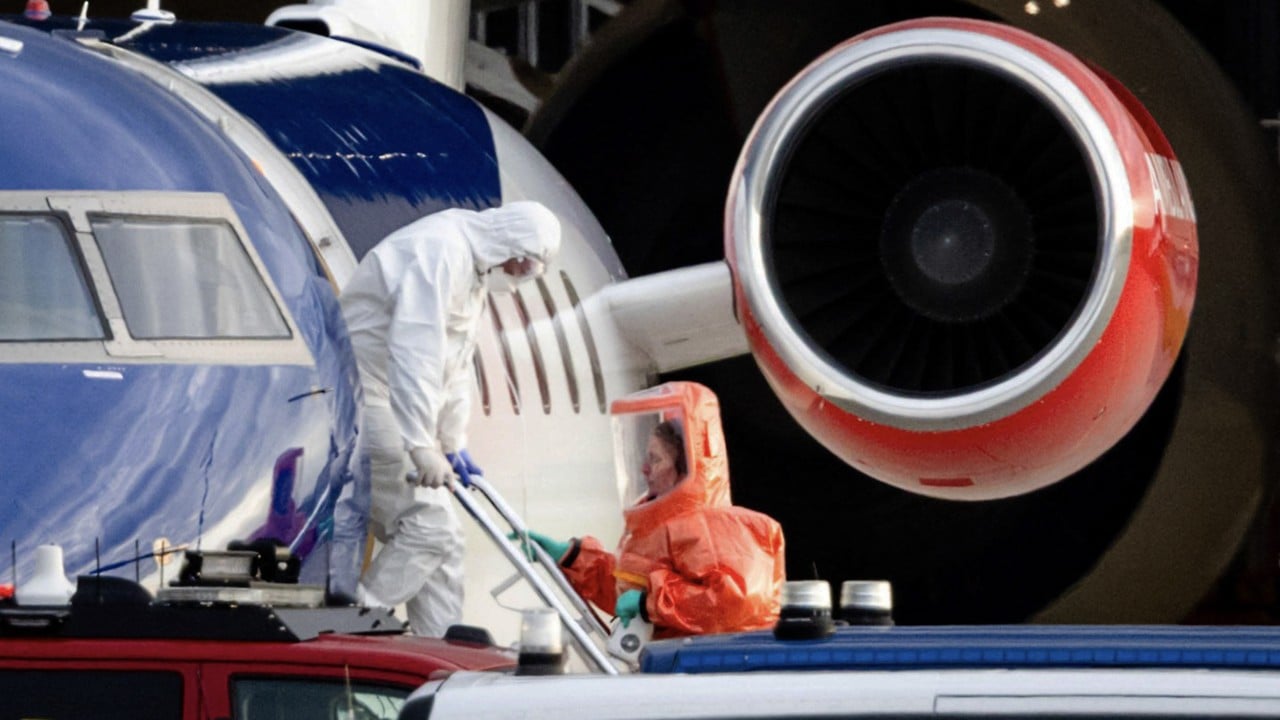
Three patients were evacuated from the ship on Wednesday. One of them has been admitted to a hospital in the Netherlands, while another one was transferred to Germany for medical care.
The plane carrying the third patient landed in the Netherlands on Thursday morning, after facing a delay due to a problem with the patient’s life support system.
Additional reporting by Associated Press and Agence France-Presse