
Myanmar’s appointment of a close confidant of US President Donald Trump to rebuild ties with Washington could offer the regime a sliver of hope to rebrand itself, even as a breakthrough on major issues, such as American investment in the country’s critical minerals sector, is likely to be limited.
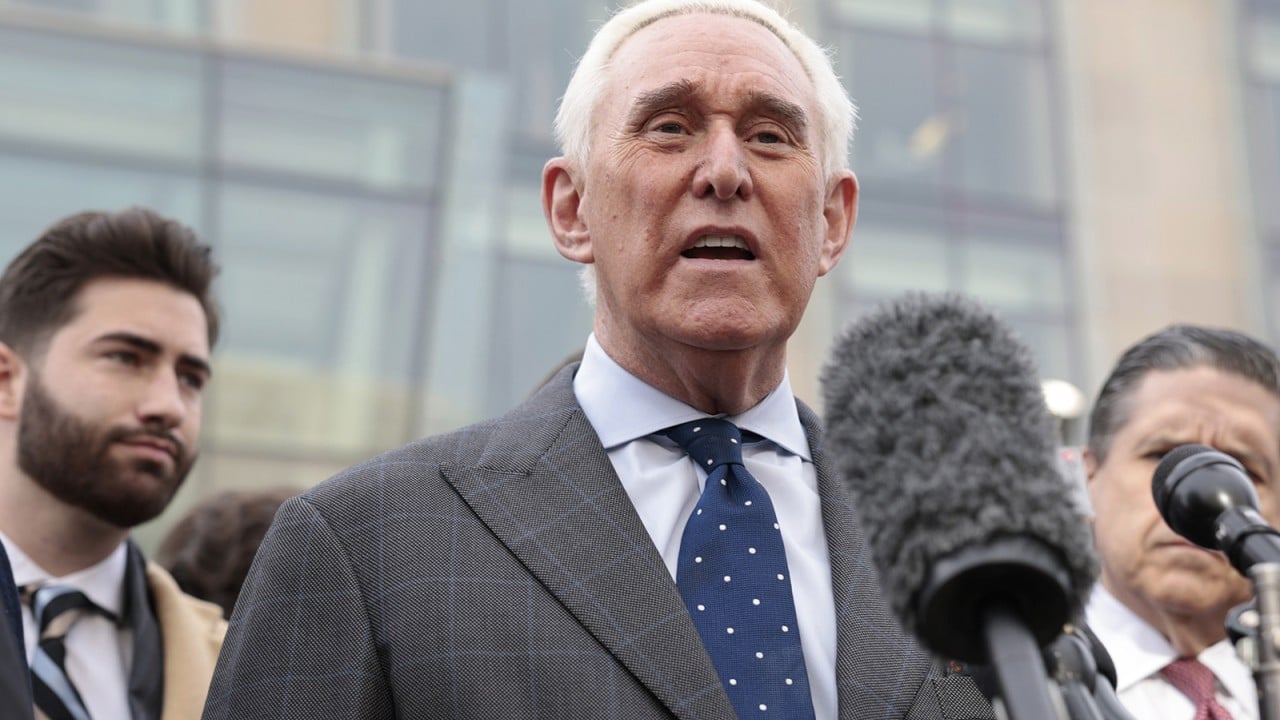
Naypyidaw’s Ministry of Information has hired veteran American political lobbyist Roger Stone to boost relations with the Trump administration, according to filings under the US Foreign Agents Registration Act in April.
Stone is said to draw US$50,000 monthly as a consultant for the Washington-based lobbying firm DCI Group, which signed a US$3 million contract with Myanmar in July last year.
The deal is aimed at normalising ties with Washington after the junta’s 2021 coup against Myanmar’s elected government, and at US American policy on the Southeast Asian nation’s economy, natural resources and humanitarian relief.
A long-time Republican operative, Stone has a four-decade relationship with Trump and has played a key role as adviser, confidant and strategist to the US president throughout his career.
Hunter Marston, director for Southeast Asia at the Lowy Institute in Sydney, said it was unclear if Myanmar authorities solicited Stone personally or whether DCI hired him with knowledge of his strong rapport with Trump.
“Given his long-time friendship with Trump, Stone may be uniquely positioned to influence the president’s thinking with regard to Myanmar,” Marston said, adding that the consultant would earn his monthly salary through DCI.
However, efforts to get Trump interested in Myanmar’s critical minerals largely fell flat last year, Marston noted.
“So it’s not clear how Stone could make the case differently,” he said, adding that Stone “stands a decent chance in helping the junta rebrand itself and establish its bona fides as a potential business partner”.
“But in reality, Myanmar remains a fraught investment destination, and the majority of American businesses will continue to shun it due to political and reputational risk,” he said.
Last year, the Trump administration initially showed significant interest in securing access to Myanmar’s critical minerals, particularly heavy rare earth elements, as part of a strategy to diversify supply chains away from China, the sector’s dominant player.
Efforts to sustain American interest ran into obstacles, however, amid Myanmar’s ongoing civil conflict, a lack of local refining capacity and severe environmental and human rights violations at mining sites.
While Myanmar is the world’s third-largest producer of rare earths, which are crucial for electric vehicles and defence, extracting and transporting such materials out of the conflict-ridden Kachin state without involving Chinese or junta-linked entities is nearly impossible.
Myanmar is also seen as a risky investment destination owing to ongoing Western sanctions against the junta, a paralysed banking sector and a rapidly depreciating currency.
Mikael Gravers, an associate professor emeritus at Aarhus University in Denmark who specialises in researching Myanmar, said recent elections conducted by the junta and the transformation of Min Aung Hlaing from military chief to civilian leader were all measures undertaken to improve his and the country’s image internationally.
Min Aung Hlaing might hope that through Stone, Trump could help to ease sanctions and “balance China’s influence, which many in Myanmar are worried about”, Gravers said.
Despite losing control of substantial territory to armed resistance, the regime has remained in power by consolidating power over major population centres and increasing aerial attacks against ethnic armed organisations, People’s Defence Forces and other civilian targets.
In December and January, the junta held a multiphase general election, claiming the vote was necessary towards restoring “multiparty democracy” and “stability” after the coup.
However, international observers, human rights groups and the United Nations widely denounced the process as a fraudulent exercise designed to entrench military rule.
In April, Min Aung Hlaing was appointed president while former leader and democracy icon Aung San Suu Kyi was moved from prison to house arrest in Naypyidaw. Former Myanmar president Win Myint was released from prison on April 17.
There are fears in Myanmar that China’s support for the regime to protect its own economic projects would not only further strengthen the junta but also exacerbate the current civil conflict.
‘Basket case’
Citing the UN, which has described the Southeast Asian country as a “polycrisis”, Gravers said Myanmar’s fuel crisis, already worsened by sanctions, had been compounded by Trump’s war on Iran.
“There is too little energy for production as well as for households,” he said, warning that inflation, as well as the lack of food and fertilisers, could potentially lead to famine.
Marston, also an adjunct fellow with the Centre for Strategic and International Studies’ Southeast Asia programme, said renewed ties between Naypyidaw and Washington would do nothing to help the resistance in its efforts to isolate the junta.
There was also little chance that Washington could replicate the calibrated. step by step easing of sanctions for political progress implemented by the Barack Obama administration between 2009 and 2016 to encourage democratic transition, Marston said.
“As long as Min Aung Hlaing is calling the shots in Naypyidaw, the military is likely to remain in control behind the scenes,” Marston said.
“That means Myanmar will continue to be a basket case for international investors due to domestic instability and ongoing fighting against military rule.”
Shortly after the February 2021 coup, the junta hired Israeli-Canadian lobbyist Ari Ben-Menashe and his firm, Dickens & Madson Canada, for US$2 million to “explain the real situation” of the coup to the US and other countries, aiming to get sanctions lifted.
That deal ended in July last year, shortly after Ben-Menashe announced he had ceased efforts to represent the generals because international sanctions made it impossible for him to be paid.
Campaign group Justice For Myanmar said in a statement on Tuesday that Stone and DCI “are profiting from a heavily sanctioned junta that is committing war crimes and crimes against humanity with total impunity”.
Benedict Rogers, senior director at human rights organisation Fortify Rights, wrote on social media that “no one with any moral fibre should be helping Myanmar’s sham, illegal, genocidal, mass murdering, criminal dictatorship”.