
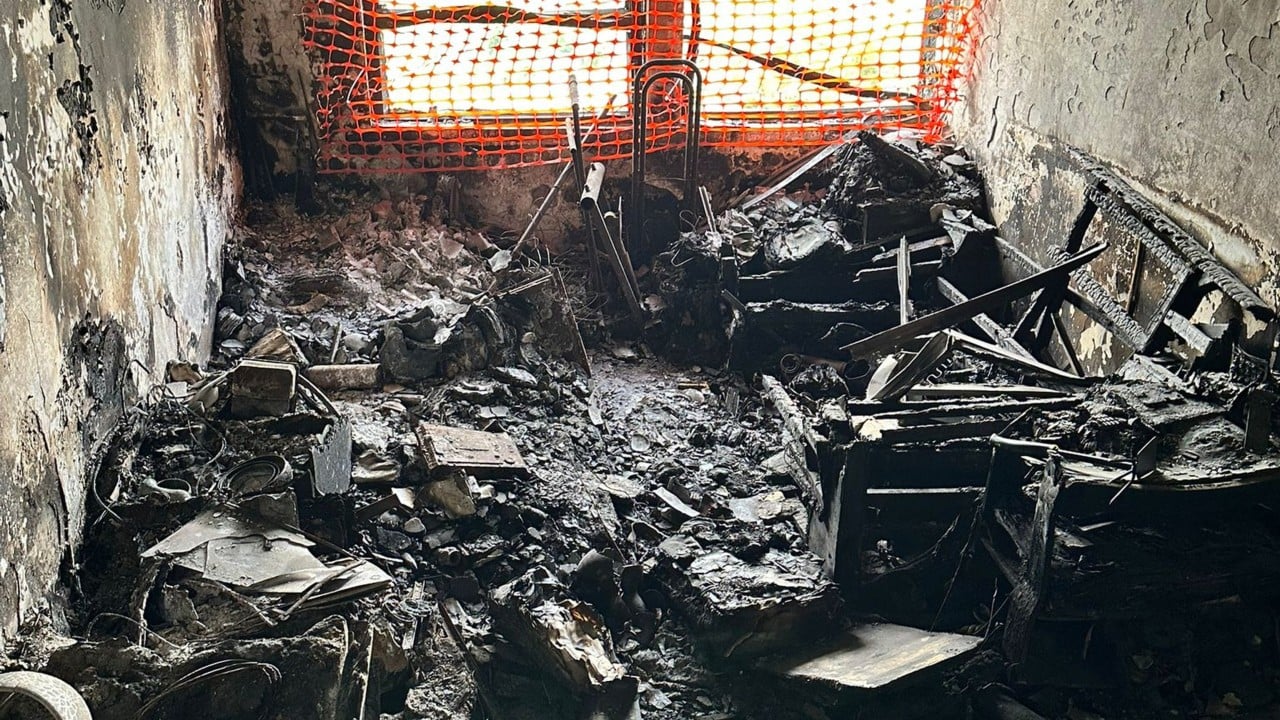
Bikes, figurines, paintings and a safe are among cherished items rescued from the ashes of Wang Fuk Court, as residents begin returning under close monitoring by Hong Kong government staff.
Wang Sun House residents, the first in the fire-ravaged Tai Po estate to return home for a three-hour packing session, told the South China Morning Post on Monday that the building’s interior was blackened and ash was abundant in scorched flats.
A 40-year-old resident surnamed Wong said his seventh-floor flat in Wang Sun House was badly burnt, with the floor covered in inches of ash “like charcoal after a barbecue”.
While the railings in the stairwell remained intact, Wong described a putrid, burnt stench and a stifling feeling as he ascended while wearing a mask.
Armed with a small shovel, Wong said he hoped to find the remains of his toy poodle, Dor Dor, to give it a proper goodbye.
“I tried looking around its favourite spots in the flat, like the living room or the bedroom,” he said.
But during the hour he spent in the flat, Wong was unable to locate Dor Dor’s remains.
He left with a small bag of personal belongings, including some toy figurines from his collection.
About 270 residents of fire-ravaged Wang Fuk Court are returning to their flats to pack their belongings, nearly five months after the deadly blaze, with authorities deploying more than 1,000 staff to assist them.
Steven Chung, 50, said the stairs of Wang Sun House were covered in soot as he walked up to his home on a lower floor.
“The stairs were blackened, but better than expected. I thought it would be stuffy, but it wasn’t, as there was good ventilation from the burnt-through windows,” Chung said.
While Chung’s home was largely unscathed in the inferno, he said parts of the ceiling had been damaged, with bits of concrete falling onto items in the flat.
“The television and game consoles were covered in ‘concrete-like liquid’. I don’t think they can be used any more,” Chung said.
He added that the hygiene condition of his flat was better than expected, as he had spotted only one or two insects and no foul smell inside.
“My neighbour’s flat has been reduced to ashes – it’s now just a pile of debris. Three hours will not be enough,” Chung said.
He also said he had managed to salvage items he wanted to retrieve from his home, including an undamaged painting, a mandala drawing he bought in Tibet and a computer system unit containing family photos.
“Maybe this mandala drawing protected my home from being burned,” Chung said with a chuckle.
The man added that the landscape painting he retrieved had been in his possession for over a decade and that he had carried it with him as he moved between flats.
Chung said he had also bid farewell to his cat, which died in the fire, by calling out to it at the usual spot where it used to sleep.
But retrieving these precious mementos and bidding farewell did not bring an end to his troubles.
“The path ahead is still unclear. It’s like one issue has been resolved and the next step is whether the government will help us again,” Chung said, urging authorities to subsidise Wang Fuk Court residents in retrofitting their next homes.
A woman surnamed Tai, who lived with her sisters and parents on the third floor of Wang Sun House, said they planned to collect gold jewellery, cash and keepsakes belonging to deceased family members.
While none of her family members were injured in the fire, Tai said that based on photos sent by her social worker, the blaze had ripped through their flat, with some walls collapsing.
“Everything is gone because most of my furniture was made of wood,” she said.
She added that residents in flats with odd numbers were assigned morning slots, while those in even-numbered ones would return in the afternoon.
Deputy Chief Secretary Warner Cheuk Wing-hing said 269 residents from 78 households in Wang Sun House would return to their flats in two phases.
“If conditions allow, residents can visit their flats more than once,” Cheuk told a press briefing, adding that those on lower floors might be able to make multiple trips as their flats were less severely damaged.
Each flat will be limited to four registered visitors, who may stay for up to three hours, excluding time spent on the stairs.
Cheuk said residents would be allowed to make multiple trips within the three-hour period after some appealed for greater flexibility.
While he did not comment on whether authorities would restrict the number of trips each household could make, he said visiting the flat three times was considered reasonable.
To facilitate residents who might need to heed the call of nature while packing, Cheuk said authorities had installed portable toilets on every other floor.
More than 1,000 government staff, including over 500 police officers and auxiliary policemen, had been deployed to assist with the 15-day operation, he said.
Authorities had assigned four teams of social workers and counsellors for every 10 floors to provide emotional support for residents who might feel shaken about returning to their fire-damaged homes, he added.
On media requests to visit the flats with residents, Cheuk said some residents had voiced concern.
“Visiting their flats to say goodbye or pack is a private moment, and they wish to do so quietly without disturbance,” he said.
“We appeal to members of the press not to visit the flats for reporting.”
Cheuk also appealed to residents to stick to their allocated time slots.
“While we understand there may be minor delays when packing, we have to clear the building to prepare for residents assigned to the afternoon session,” he said.
On Sunday, Cheuk said 6,000 residents had booked time slots to return, including 1,420 aged 65 or above.
Forty-seven households opted out, with many deciding against the trip after seeing images of their damaged flats.
He added that about 1,670 households, or 97 per cent of Wang Fuk Court residents, would return to their flats under government-assigned time slots with 74 per cent applying for the maximum quota of four people per unit.
Residents of Wang Sun House, the first block of Wang Fuk Court to allow re-entry, have braced for renewed grief as they return to their former homes after months of displacement.
Dozens of residents arrived at Kwong Fuk Community Hall for registration shortly before 9am. Wearing yellow helmets, they entered Wang Sun House accompanied by Social Welfare Department staff in vests.
The South China Morning Post observed torchlight beams in the stairwell of Wang Sun House, as well as residents carrying suitcases or large bags with gloved hands during the morning pack-up session.
A 60-year-old woman surnamed Tse, who was returning to her first-floor flat in Wang Sun House, said she was worried she would feel overwhelmed upon entering her home.
“I’m worried I’ll feel down as I’m always alone. My social worker said he will accompany me upstairs,” she said, adding that two of her close friends would also join her.
Recalling a photo of her flat showing furniture burned to a crisp, the woman said she hoped to salvage her passport and valuables from the ashes.
Some residents from other buildings in Wang Fuk Court also came to Kwong Fuk Community Hall to observe the arrangements for the pack-up session.
A 70-year-old woman surnamed Chin, who said she lived in one of the more severely burnt buildings, said she had come to observe the re-entry arrangements for residents.
Chin, whose son owns a flat in another block of Wang Fuk Court, said she had bought a metal detector to search for any melted gold in her fire-damaged home.
“We’ll go up and sift through the ashes to see if anything’s left,” she said.
Chin said she expected the trip to be emotional, as she would have to walk up seven floors to her former home.
“I still cry whenever I think about my [deceased] neighbours,” she said.
Another resident, surnamed Tam, 69, who lived in Wang Shing House and is due to return to her flat next week, said she had come to check what materials were being distributed.
“I need to see what kind of bags they’re giving out, as I’m going to pick up my ceramics,” she said.
Tam said she hoped to retrieve ceramics, crockery, cash, gold and clothes from her flat.
Lam Ching-choi, chairman of the Advisory Committee on Mental Health, said on Monday that residents should prepare themselves both physically and psychologically, as they might experience strong emotions when visiting their devastated homes.
For those who had family members die at the scene, he said they should consider how they wished to bid farewell and discuss arrangements with those accompanying them.
“Try to avoid any unexpected incidents during the process,” he said on a radio programme.
He added that the physical strain on the elderly and people with chronic illnesses should not be underestimated. Lam advised them to rest when necessary and wear oximeters to monitor their health indicators, such as heart rate, to assess whether they are fit to continue.
“I am also concerned about ventilation there. If people with lung disease or asthma experience breathing difficulties, they should notify healthcare staff at the scene,” he said.
He said residents should be accompanied by people they trusted, as they might become emotional during the process.
He added that social workers and clinical psychologists would be available to help those in need, urging residents not to force themselves to continue collecting belongings if they experienced an emotional breakdown.
Residents from the lower 10 floors of Wang Sun House, whose flats were not as badly damaged as others, were among the first returning to the seven buildings of the eight-block Wang Fuk Court to visit their homes.
Police officers or Civil Aid Service members accompanied residents during the process. The Social Welfare Department also deployed personnel to accompany households returning to flats with fatalities.
Residents were required to wear safety helmets, protective gloves and face masks.
The arrangement for residents of Wang Sun House will continue until April 22. Families from Wang Cheong House, Wang Yan House and Wang Tao House will return between April 23 and 28.
Time slots for residents in the remaining three blocks, Wang Tai House, Wang Kin House and Wang Shing House, are scheduled between April 29 and May 4.
Arrangements for Wang Cheong House and Wang Tai House, which sustained more severe fire damage, will take six days to complete, with only five floors accessible daily. The other buildings will be open for three days.
The deadly inferno on November 26 killed 168 people, displaced about 5,000 residents, and destroyed all but one of Wang Fuk Court’s eight blocks.
Additional reporting by Edith Lin and William Yiu