
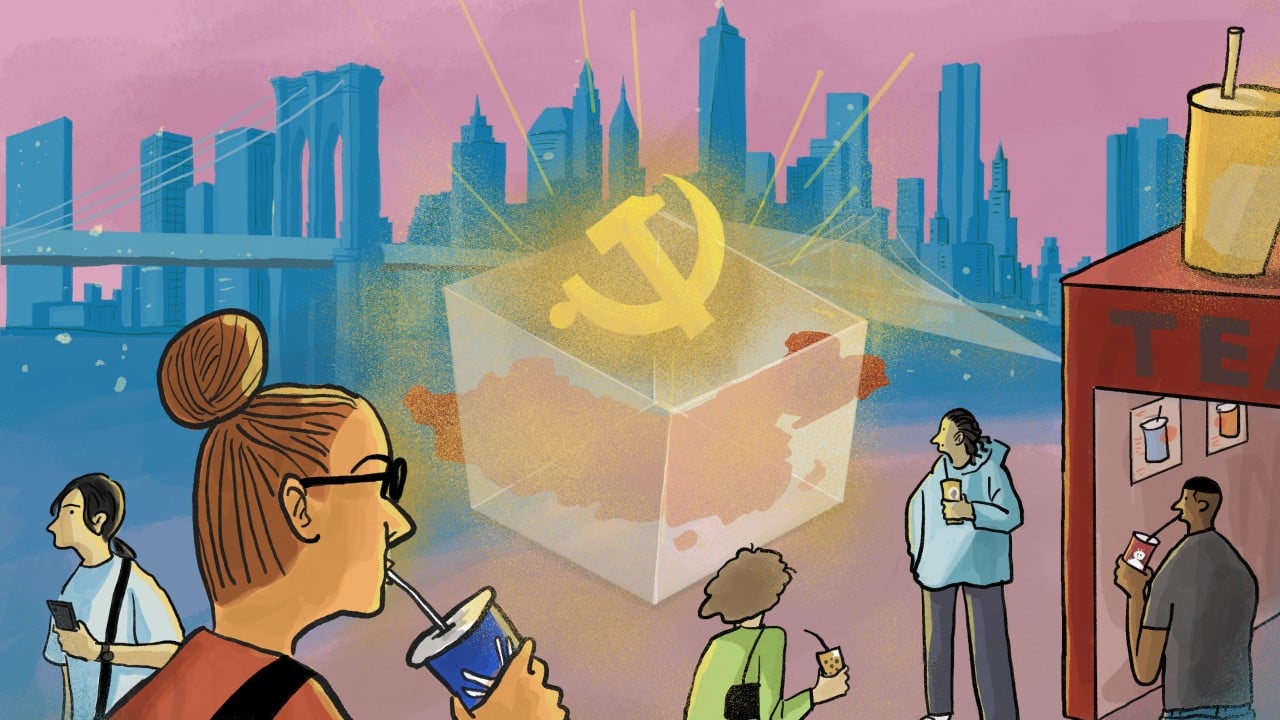
Makeda George steps out of a Mixue store in downtown Brooklyn, New York, clutching a bubble tea as she weaves through a crowd of teenagers. The local resident says she had been eager to try the brand after noticing a surge of new outlets opening in recent months.
“I decided to try the bubble tea. It was good,” she said, adding that she did not know it was a Chinese drink chain but figured it was Asian given the branding.
“Everywhere you go, every nook, every cranny, you just see them popping up.”
Across New York City and beyond, a new wave of beverage chains is expanding rapidly, bringing tea-based offerings, unique flavours and a design aesthetic distinct from American legacy brands such as Starbucks.
The new entrants share a different origin story: they are all Chinese-founded brands expanding their cultural footprint.
A few miles away in Sunset Park, Brooklyn’s largest Chinatown, HeyTea has adopted a sleeker Chinese-modern aesthetic with digital ordering screens, minimalist branding and carefully styled drinks, including jasmine-based teas.
And across town at a Mixue location in Manhattan’s Chinatown, thirsty customers wait for drinks like spring oolong milk tea, ordering from grab-and-go screens beneath the gaze of the chain’s mascot: an ice-cream-holding snowman whose face is plastered across the shop. Mixue’s chirpy theme song plays on a loop.
The spread of these Chinese chains, including Luckin Coffee and Cotti Coffee, from New York City to Washington and from Los Angeles to Chicago, reflects more than just shifting consumer appetites. They are part of a larger story about China’s soft power, some experts argue, driven not by state messaging but consumer preference.
The result: something as routine as a morning coffee can help shape perceptions of China.
“These chains are culture packaged as consumption. Every transaction is also, in a very small way, a moment of cultural contact,” said Shaoyu Yuan, an expert on soft power at New York University.
“You see Chinese characters on the cup. You encounter flavour profiles that are rooted in Chinese tea culture. You experience a design aesthetic that’s distinctly Chinese-modern. None of these things individually change your world view.
“But repeated over weeks and months, they do something very important: they make China feel normal. Familiar. Part of your daily routine. And familiarity is the raw material of soft power.”
Not everyone agrees. Familiarity alone is unlikely to outweigh larger geopolitical concerns, argues Penny Abeywardena, founder and chief executive of Soft Power Strategies, who said that people can enjoy a country’s products while remaining sceptical of its government.
“Someone can buy a drink from Luckin or Mixue every morning and not shift an inch on trade, security or human rights,” she said. “And where a brand’s main appeal is its low price, attraction tends to attach to the price more than the place.”
Affordable prices were the main draw for Brooklyn resident Jordan, who declined to give her surname. “I saw the ‘grand opening’ sign a few weeks ago,” she said, standing outside Mixue. “And the US$1.19 price tag. Honestly!”
Any soft power benefits that China garners from the drink brands will depend on the degree to which people connect them with the Asian giant, which is not always the case, said Aynne Kokas, a media studies professor at the University of Virginia.
According to Kokas, a brand stops being “just a business” and starts shaping perceptions of a country when it becomes synonymous with national characteristics or when countries actively leverage those brands and their values globally.
Jackie, a New Yorker of Asian descent who only gave his first name, said he immediately associated Mixue with China because of the name.
“I have seen a lot more [outlets] pop up, and it is probably making people think more about the Chinese brands that are coming here,” he added.
Jackie plans to try Luckin Coffee as well, but does not find himself in Manhattan very much, where the chain is concentrated.
Consumer chains might just be the single most underrated vehicle for soft power, Yuan argued, given that soft power worked best when it felt less like power than a personal choice.
These Chinese brands reflected a more commercially driven form of international influence oriented around scale, margins and market penetration, echoed Daniel Herszberg, doctoral associate at the China Centre, University of Oxford.
But there was also a risk in over-reading brand visibility as geopolitical influence, Herszberg said, adding that he was “hesitant to argue that it automatically translates into durable geopolitical sympathy for Beijing or policy alignment”.
The world has seen waves of soft power, with Starbucks serving as a clear example of America’s prowess.
“Starbucks didn’t just sell coffee. It exported a version of the American urban lifestyle to every major city in the world,” Yuan said. “That entire package communicated something about American culture that no embassy could.”
Starbucks also rode in on the end of the Cold War and followed the cultural success of Levi’s and McDonald’s as symbols of Western liberal democracy, Herszberg said, while Luckin’s arrival into Western markets had come “at the peak of Great Power tensions”.
A key difference between the current era and the Starbucks 1990s is the TikTok environment, according to Herszberg.
“Consumer content feeds are explicitly algorithm-centred, and the visibility of brands can be amplified very quickly without telling us very much about attitude changes [at least at this early stage],” he said.
China is following in the soft-power footsteps of Japan and Korea, each with their own model.
Japan’s soft power, through the 1980s wave of Sony, Toyota and Nintendo, and later emerging brands such as Muji and Uniqlo, spread Japanese minimalism, quality and attention to detail.
“People didn’t just buy a T-shirt. They bought into an idea about how life could be organised,” Yuan said.
The Korean soft power wave that followed was coaxed to go viral with K-pop, K-dramas, and skincare, Yuan said. From their inception, they were designed to go global, with active government coordination.
“Chinese brands are now entering that same territory,” Yuan added.
As China’s cultural footprint expands, public sentiment in the United States appears to be warming. American views on China have softened in recent years, with positive sentiment nearly doubling since 2023 from a low base to around 27 per cent, an April survey by the Pew Research Centre found.
According to the 2026 Global Soft Power Index, conducted annually by Brand Finance, a marketing consultancy, China maintained its number two position yet improved in many categories; and while the US retained the top spot, it recorded the sharpest decline among the world’s 193 nations.
In recent years, China’s reputation in education and technology has improved, even as US President Donald Trump’s “America first” rhetoric has undercut America’s standing, according to Brand Finance.
Cultural and marketing phenomena such as Huawei Technologies, TikTok, electric vehicles and the collectible Labubu, which gained global popularity in 2025, had boosted China’s reach further, the consultancy wrote.
Drink chains could also align with “Chinamaxxing” trends, which “show valuable tips, tricks and products distinctive to China”, added Kokas.
Much like Chinamaxxing, Chinese brand hype appeared detached from explicit political meaning, Herszberg argued, adding that it was too early to make a causal connection between the viral consumption of Labubus and broader geopolitical perceptions of China.
Abeywardena, a former New York City commissioner for international affairs, agrees.
“We should be careful not to treat every successful Chinese company abroad as proof of a coordinated soft power strategy, or every store opening as a geopolitical event,” she said. “The real significance of these brands is that they create the possibility of attraction.”
Many of China’s brands have found popularity among Gen Z, which Yuan attributed to this age group’s lifestyle experimentation as they looked for alternatives to the default American consumer playbook.
“Chinese wellness practices, food culture and tea traditions offer exactly that: a different way of thinking about daily rituals that feels practical, grounded and accessible,” he said.
Some research suggests that a relationship between consumer brands and soft power still relates to politics. A 2024 Edelman survey found that increasingly, consumers are associating brands with their countries’ politics. The survey polled 15,000 people from 15 countries, finding nearly 80 per cent would boycott a brand based on its country of origin.
“It is important to distinguish between the US government and popular views of China. What is particularly notable right now is that they are significantly diverging, with more favourable popular views and very negative government views,” Kokas said.
American views of China are complex, analysts note, driven by fear, admiration, misconceptions and exotic products they enjoy.
“When your only exposure to China is through news headlines about trade wars, military tensions and surveillance, China exists in your mind as a geopolitical abstraction. It’s threatening, distant and monolithic,” Yuan said.
But this can be tempered by a feel-good consumer moment. In drinking Chinese tea, for example, consumers created a second, competing association, he added, that evoked pleasure, comfort, quality and daily life.
“You can still think China is a strategic competitor while also thinking Chinese tea culture is wonderful.”
HeyTea customer Sherry, who only gave her first name, said she was always exposed to Chinese-style drinks shops growing up in Sunset Park, but had been surprised by their growing popularity on social media and in real life, attracting growing interest from non-Asian customers across the country.
Jasmine-based drinks in particular are an easy introduction to Chinese culture.
“It smells nice, it tastes nice,” Sherry added. She tied the popularity in part to a growing fascination with Chinese culture as a rebound from the US anti-Chinese rhetoric during the pandemic.
“And the easiest way to kind of get introduced to that is through drinks,” she said.