
The threat by the US to impose additional tariffs on imports from India over forced labour supply-chain concerns is a “pressure” tactic deployed by Washington to drive a harder bargain in its trade talks with New Delhi, according to analysts.
Following a Section 301 unfair trade practices investigation, the Trump administration proposed that products from India, China, Japan, South Korea, Brazil and Switzerland would be subject to a 12.5 per cent levy, while a 10 per cent rate would apply to goods from Canada, Mexico, the EU, the UK and Pakistan, among other places.
The recommendation came even as officials from the US Trade Representative (USTR), led by chief negotiator Brendan Lynch, visited Delhi earlier this week to speed up talks on finalising an agreement after reaching an interim framework in February.
“The engagements were marked by a spirit of cooperation and pragmatism, with both sides reaffirming their commitment to concluding a mutually beneficial agreement that strengthens bilateral trade and economic ties,” the Indian government said in a statement on Thursday.
Washington had earlier agreed to reduce US tariffs on India to 18 per cent from a peak of 50 per cent last year.
The latest tariff proposal appears to be aimed at replacing some of the tariffs that were rejected by the US Supreme Court in February, analysts say.
“This may be partly about labour standards, but it is also about US leverage over India,” said Uday Chandra, a political-science professor at India’s Ashoka University.
“The Trump administration is using forced labour as a new legal and moral language for tariff pressure after courts struck down its earlier tariff policy.”
The USTR said it would accept public comments on the proposed tariffs and other remedies until July 6, followed by a public hearing the next day.
The announcement of the additional tariff proposals came ahead of the expiration of a 10 per cent temporary duty on July 24. That duty had kicked in on February 20, the same day the Supreme Court struck down US President Donald Trump’s earlier tariff measures under the International Emergency Economic Powers Act.
“For India, Washington isn’t actually arguing that Indian exports are produced by forced labour. It is that India uses supply chain inputs linked to forced labour elsewhere,” Chandra said, adding that it makes it a trade policy matter as well as a supply chain governance issue.
“It gives Washington another instrument to pressure India at a delicate moment in bilateral trade negotiations.”
The US has been seeking, among other things, the elimination or substantial reduction of tariffs on industrial goods and agricultural products, including dairy items – concessions that could spark a backlash from millions of Indian farmers.
“I don’t think the proposal for additional tariffs will skew the US trade negotiations. But it could certainly be problematic,” said Vivek Mishra, deputy director of strategic studies at the Observer Research Foundation think tank.
On Wednesday, US envoy Sergio Gor said in Mumbai that the trade pact was 99 per cent complete and both sides were trying to resolve the remaining “1 per cent” within the next several weeks.
Trump also expressed confidence that the accord was nearing completion.
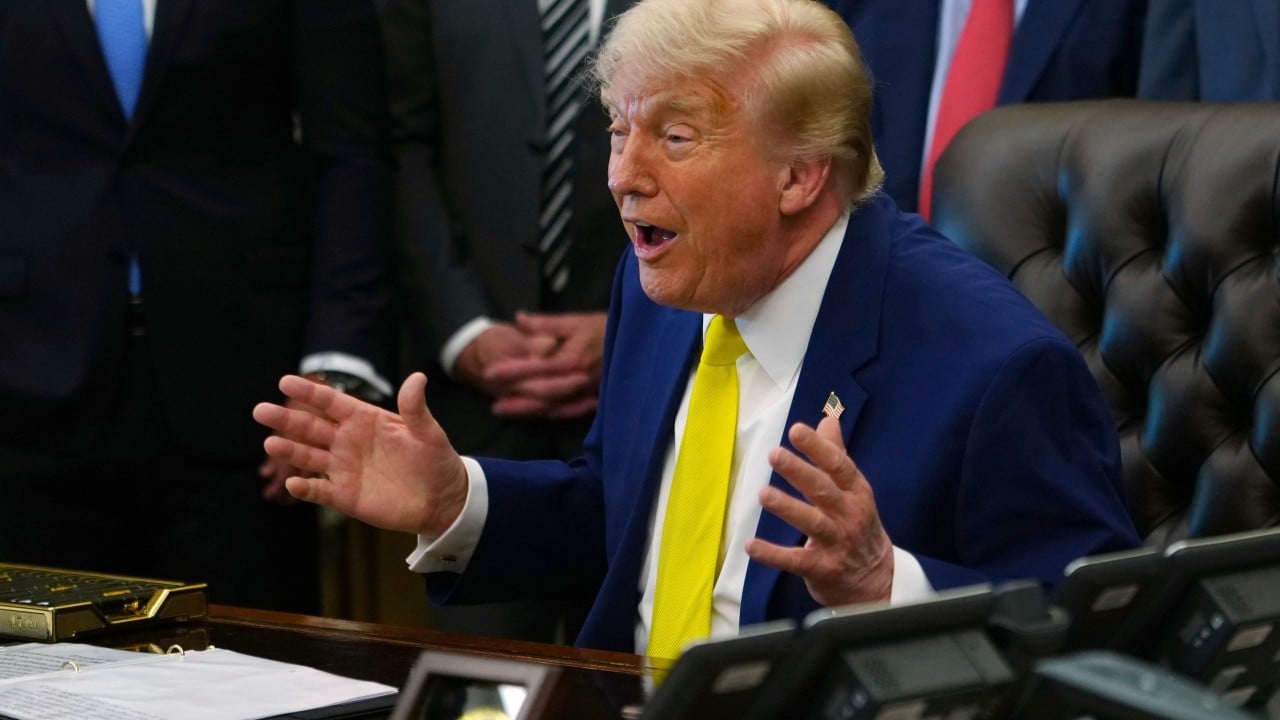
“We’ll get to a deal, because I like, you know, I like your prime minister a lot,” he told reporters in the Oval Office on Thursday, referring to Narendra Modi.
Mishra said the remaining “1 per cent” could be in jeopardy because of the additional US tariff proposal, but added that Delhi was unlikely to adopt “a path of confrontation”.
Complicating a resolution
Analysts say the relatively lower tariffs imposed on arch-rival Pakistan compared with India’s proposed extra levies create a bad look for Delhi.
Islamabad has been actively mediating between the US and Iran to end the war between the two countries.
“I am not sure if this differential logic should be read straightforwardly as a geopolitical reward,” Chandra said. “New Delhi will certainly see a geopolitical subtext. Optics may matter, in other words, beyond legal reasoning.”
He said the move was part of Trump’s negotiating style, in which the president sought to ratchet up pressure before eventually settling on terms.
The latest tariff episode suggested that any US-India trade deal would be a “carefully crafted bargain” involving a range of issues, Chandra said.
“India will seek to separate the forced labour tariff process from the overall US trade deal. Delhi can seek tariff relief later as part of the final package.”