
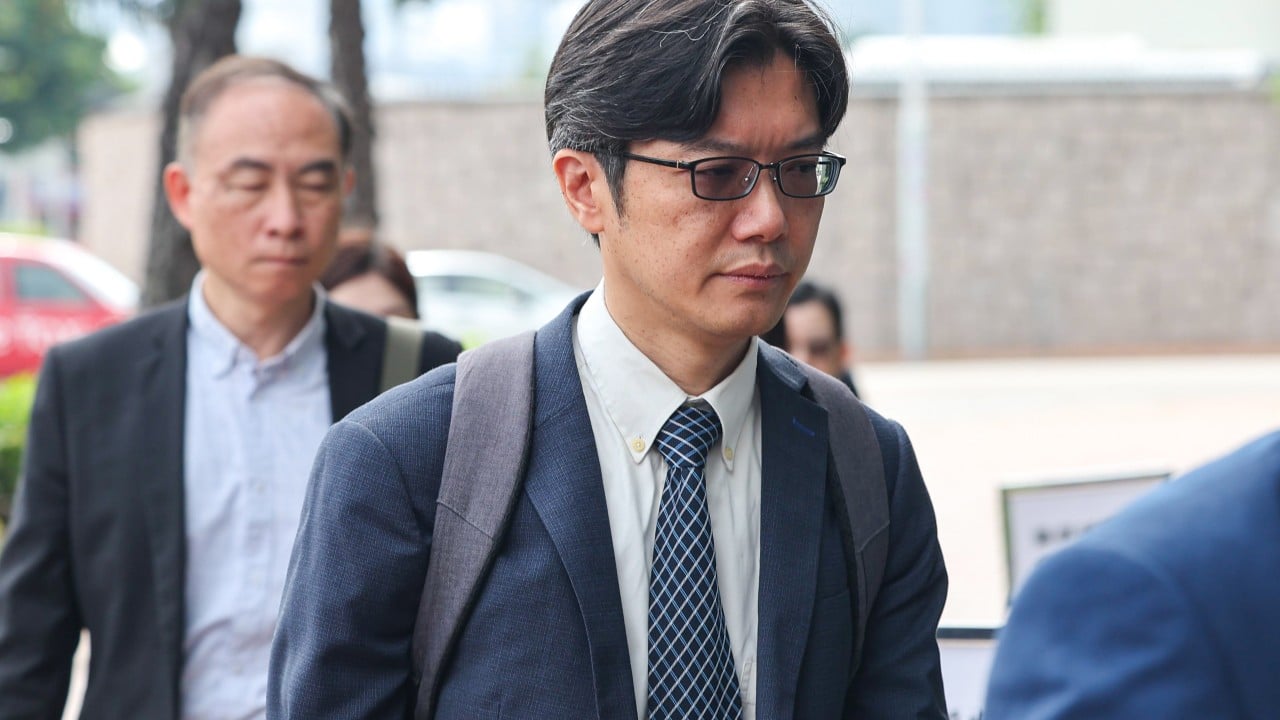
A Hong Kong building inspector mistook illegal alterations to emergency staircases at a housing estate ravaged in a deadly fire as protective measures for “broken” windows, because he based his assessment solely on documents and did not carry out a site visit, a public inquiry has heard.
Senior maintenance surveyor Nick Yung Siu-lun, the head of the minor works team of the Housing Bureau’s independent checking unit, said on Thursday he thought the wooden boards used to cover the temporary openings at Wang Fuk Court’s eight buildings were designed to protect the original non-fire-rated windows due to be replaced with fireproof panels during a HK$336 million (US$43 million) renovation project.
He told an independent committee that he did not realise the windows had been deliberately removed to give workers access to scaffolding when he inspected photos of the modifications in a document review in May last year.
He insisted that existing protocols at the time only required him to ensure the contractor had submitted all necessary information to authorities, without conducting any site visits.
Yung said he would have inspected the changes in person had the Buildings Department updated its manual on monitoring construction sites, prompting the judge overseeing the committee to question whether he was evading responsibility on the matter.
The fire broke out on November 26 last year while the Tai Po estate was undergoing repairs required under the mandatory building inspection scheme. The blaze raged across seven of the eight towers for 43 hours, killing 168 people and displacing nearly 5,000.
The committee previously heard that the removal of windows at staircases had allowed toxic fumes to enter the buildings, preventing residents from escaping.
The unit, which is responsible for overseeing maintenance works at subsidised residential complexes, received 48 minor work applications relating to Wang Fuk Court’s overhaul after work started in July 2024.
Only half were classified as Class I, involving higher-risk procedures, with the remainder falling under Class II, such as improving the estate’s exterior finishes.
Yung said exterior wall renovations were often categorised as posing a lower risk to the public to allow work to commence quickly and save costs.
But he acknowledged that such categorisation was problematic as renovation works would become substantially more risky if they were carried out across multiple buildings at the same time.
Yung said the unit’s minor works control system did not require regular site audits, and that surveyors would only conduct on-site inspections in response to complaints.
The committee heard the unit randomly selected two Class I minor works at Wang Fuk Court for an audit fundamental check in May 2025: the erection of protective barriers at Wang Cheong House and alteration of windows along the staircases at Wang Chi House.
Yung said he did not realise from the photos submitted for the review that the wooden boards installed at the windows of the two buildings were meant to allow workers access to scaffolding.
The committee’s lead counsel, Victor Dawes SC, questioned why the widespread replacement of windows at the estate did not arouse Yung’s suspicion.
Yung said he mistakenly believed the original windows had been damaged, but Dawes cast doubt on that assertion, suggesting the surveyor might have devised the explanation on the spur of the moment while giving evidence.
“If you guys as professionals failed to notice the issue, how could you expect ordinary people to realise this was a significant problem?” Dawes said.
Yung conceded that he had no reason to believe the alterations were done for protection only, after being shown a photograph of a digital lock being installed on a wooden board.
Dawes also highlighted Yung’s witness statement, in which the surveyor suggested the problem could have been discovered sooner had the Buildings Department updated instructions on inspecting minor construction works in a timely manner.
The statement said the unit was only informed after the fire that the department had begun conducting site inspections of at least one-fifth of projects selected for audit since April 2023.
Yung said it was likely that one of two minor works at Wang Fuk Court selected for a review in May 2025 would have come under scrutiny in an on-site inspection, had the unit followed the department’s latest practice.
But Dawes said the witness’s conclusion drawn in hindsight provided little assistance to the inquiry.
“So it was the Buildings Department’s fault and not yours? What’s your point in saying all these?” the lawyer said.
“We’d have followed the same practice had such an internal arrangement been in place,” Yung replied.
Committee chairman Mr Justice David Lok Kai-hong pointed out that official inspectors were prone to overlooking unauthorised works done during projects because they were not required to check the sites themselves.
“Many questions were put to you for explanations, but your answers appeared far-fetched and as though you were trying to push the blame to the Buildings Department,” Lok told the witness.
Yung said that was not his intention.
“I’m not saying we didn’t do [on-site inspection] because we weren’t told. I’m saying we could’ve done it if we knew [the department’s latest practice],” he added.
The hearing is scheduled to resume at City Gallery in Central on Friday.