
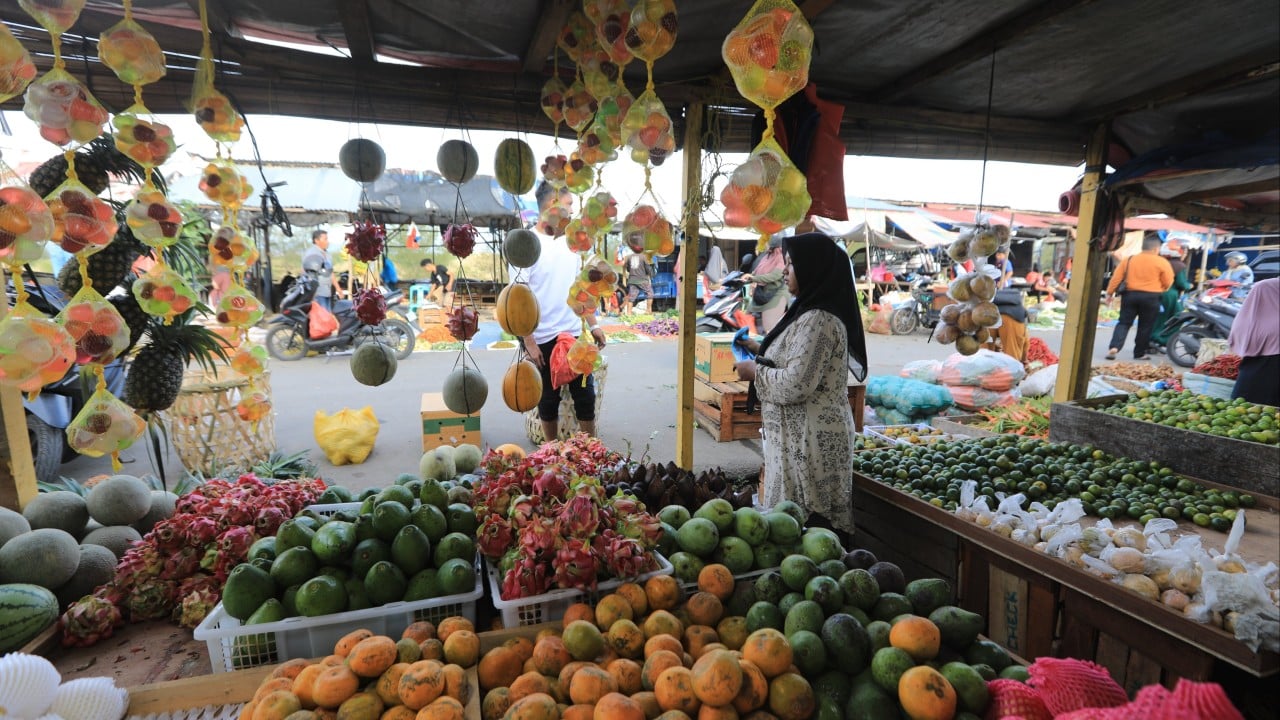
Indonesia’s economy grew 5.6 per cent during the first quarter of 2026, its fastest pace in more than three years, but analysts warn that the coming months will pose significant tests for Southeast Asia’s biggest economy.
Statistics body BPS attributed the growth to robust household consumption – which made up 54.36 per cent of gross domestic product and grew by 5.52 per cent year-on-year – and a surge in government spending.
Amalia Adininggar Widyasanti, head of BPS and deputy minister for economic affairs at the Ministry of National Development Planning, told reporters on Tuesday that increased spending during the Muslim holy month of Ramadan and Eid ul-Fitr-related travel between mid-February and March had boosted growth.
Government spending also surged 21.8 per cent in the first quarter, thanks to President Prabowo Subianto’s priority programmes such as free nutritious meals, Red and White Village Cooperatives, and religious holiday bonuses for civil servants, BPS said.
The growth rate, the fastest since the third quarter of 2022, exceeded the 5.3 per cent predicted by analysts polled by Reuters.
“The 5.6 per cent growth was above my expectation of 5.3 per cent, but not entirely surprising given the strong growth in government spending throughout the first quarter,” David Sumual, chief economist at Bank Central Asia, told This Week in Asia.
Mohammad Faisal, executive director at the Centre of Reform on Economics Indonesia, said the rapid growth was also caused by a “low base effect”, as the economy grew only 4.87 per cent in the first quarter of 2025 due to the government’s strict efficiency measures.
Josua Pardede, chief economist at Bank Permata, noted that sectors relying on the domestic market performed well in the first quarter, such as accommodation, food services and transport.
“Household spending remained resilient because the timing of Ramadan and Eid lifted food, transport, retail, hospitality and travel spending. Consumer confidence was also still supportive, with Bank Indonesia’s March survey showing the consumer confidence index at 122.9, still in the optimistic zone,” Josua said.
“However, this pace may not be fully sustainable through the rest of 2026. The coming quarters will face higher imported costs, weaker rupiah purchasing power, and pressure from non-subsidised fuel adjustments.”
Headwinds ahead
Despite the strong headline number, external fundamentals already showed signs of strain. Non-oil and gas exports grew by only 0.97 per cent year-on-year to US$63.65 billion, while oil and gas exports dropped nearly 11 per cent year-on-year to US$3.25 billion.
In March, a few weeks after the war in Iran started, non-oil and gas exports declined 2.52 per cent to US$21.25 billion from March 2025, due to lower prices of cocoa, coffee, tea and spices, BPS said.
Trade surplus narrowed significantly to US$5.5 billion in the first quarter, down from US$10.91 billion during the same period last year.
“The decline in non-oil and gas exports warrants vigilance, as it indicates weakening from external factors. If commodity prices remain weak, pressure on non-oil and gas exports could persist,” said Rizal Taufikurahman, an economist at the Institute for Development of Economics and Finance.
“For oil and gas, the risks are different. High oil prices could increase the value of oil and gas exports, but Indonesia is also a net oil and gas importer, potentially increasing pressure on imports, subsidies and the current account deficit.”
Every dollar increase in the global Brent crude oil price adds about 6.8 billion rupiah (US$392,175) to the state budget. The 2026 fuel subsidy calculation, some 210 trillion rupiah, was based on an assumption of a US$70 per barrel oil price.
Investment growth in the first quarter cooled to 5.96 per cent from 6.12 per cent during the fourth quarter of 2025, suggesting that “businesses are becoming more selective”, Josua said.
“The slowdown does not yet signal a collapse in investment, but it shows that private-sector expansion is facing more constraints. Imported machinery, equipment, raw materials and construction inputs become more expensive when the rupiah weakens, while global interest rate uncertainty raises financing costs.”
On Monday, the rupiah fell to 17,424 per US dollar, an all-time low, which Chief Economic Minister Airlangga Hartarto blamed on strong dollar demand during the haj season.
Manufacturing also showed signs of weakening. According to S&P Global, the Purchasing Managers’ Index contracted to 49.1 in April, a drop from 50.1 in March.
Economists agreed that Indonesia’s economy would continue to face headwinds from rising geopolitical tensions in the Middle East, high oil prices and global interest rates, and a stronger dollar, which would keep annual economic growth in its usual 5 per cent range.
“Internally, the challenges include the economy’s dependence on short-term consumption, weak manufacturing exports, increasingly limited fiscal space amid subsidy pressures and a weakening rupiah,” Rizal said, predicting 2026 growth to be between 5.1 and 5.3 per cent.
To navigate the challenges, he suggested the government “focus on maintaining macroeconomic stability, strengthening the productive sector … and ensuring that the stimulus truly creates long-term economic impact”.
Sumual urged Jakarta to “navigate the budget prudently and ensure the effective transmission of priority programmes”.
Joshua predicted growth of “close to 5.2 per cent” for 2026, though he warned it could be lower should external pressures worsen.
“If the average oil price remains above US$100 per barrel, the rupiah stays under pressure, and manufacturing or export weakness deepens, growth could slip closer to 4.9 to 5.0 per cent,” he said.