
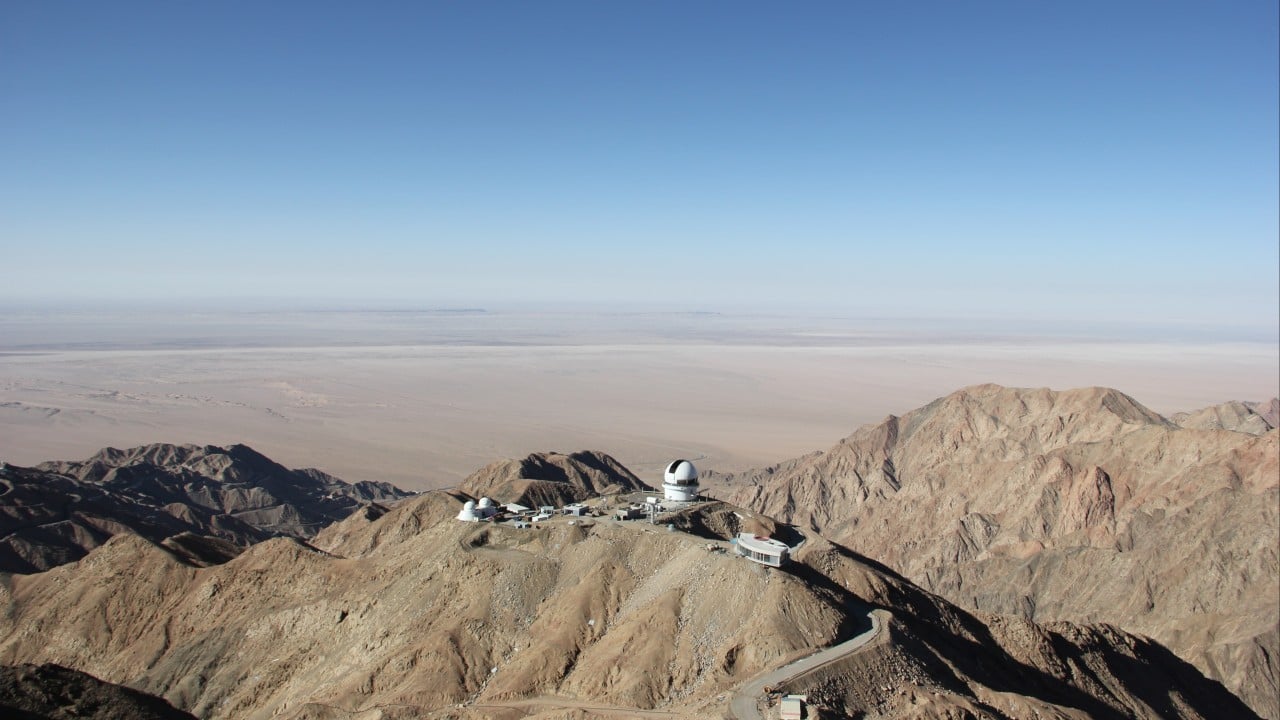
Construction on the Tibetan plateau of some of the Earth’s most powerful optical telescopes is putting China on track to house the world’s biggest astronomy base by the mid-2030s, according to project scientists.
Deng Licai, lead scientist for site planning at the National Astronomical Observatories of China (NAOC) in Beijing, said the telescopes at Saishiteng Mountain in northwestern Qinghai province would stretch between 6.5 metres (21.3 feet) and 14.5 metres across, and partner with dozens of smaller instruments.
“Their collective light-gathering power is expected to surpass [that of the telescopes] on Hawaii’s Mauna Kea peak,” he said on Wednesday.
Mauna Kea has long been regarded as the crown jewel of ground-based astronomical observation, home to the twin 10-metre Keck telescopes, the 8.2-metre Subaru and the 8.1-metre Gemini North.
Groundwork, mirror polishing and instrument development were already under way for the 2.5 billion yuan (US$369.03 million), 14.5-metre Large Optical Telescope (LOT) and the 1.5 billion yuan, 6.5-metre MUltiplexed Survey Telescope (MUST), Deng said.
The LOT is government-funded and led by the NAOC, while MUST is backed mainly by private capital and led by a team from Tsinghua University. Both aim to achieve “first light” – or practical use – by 2030.
A planned 11-metre telescope, meanwhile, was undergoing feasibility studies and would be entirely privately financed, Deng said.
A leap from China’s current two-metre-class, general-purpose instruments, the LOT will become the world’s second-largest optical telescope on completion – surpassed only by Europe’s 39-metre Extremely Large Telescope under construction in Chile’s Atacama Desert.
The Chinese telescope’s main mirror will consist of 120 hexagonal glass segments, each measuring 1.44 metres across, according to a member of the LOT team who requested anonymity because they were not authorised to speak to the media.
With its enormous aperture and light-collecting capabilities, the LOT will be able to peer back to the universe’s infancy, observing the first stars and galaxies to form after the big bang.
It is also designed to observe cosmic reionisation – a pivotal era when early starlight cleared the prevailing cosmic fog, transforming a dark, opaque universe into a transparent one – according to the source.
The telescope would deploy an advanced coronagraph to block stellar glare and detect faint exoplanets, the source said, adding that the 120 mirror segments and most of the telescope’s on-board instruments – including a high-precision spectrograph to split light and reveal the chemical composition and motion of stars and planets – would be manufactured domestically.
The LOT’s target completion date is December 2030, according to the source. The team must first overcome engineering challenges, however, including ensuring the 500-tonne structure can track with the pinpoint accuracy astronomers require – a technical bottleneck that has historically dogged other 10-metre-class optical systems.
Chinese researchers hope the LOT will be open to the international community once fully operational, as premier telescopes in Hawaii and Chile are.
“Astronomy has always been a global effort,” the source said. “When China is ready, we need to step up and contribute.”